Tungsten – Going Full Force

It is interesting to note that the current division between the Them (China, Russia, Iran and some BRICs) and the collective US. The US used to be the USA and its camp followers, but now in the midst of a shambolic war in the MidEast, the collective US is divided itself into the USA, Israel and the rest. The first to peel off were the Europeans, tired by the barrage of sticks (and a few carrots) that rained down on them before the first schoolgirl had been bombed. It is looking like the dreaded breakup of NATO might come as a blessed (and cathartic) relief to all concerned.

In these bellicose times, if we had to choose a metal to crown as the military metal par excellence it would undoubtedly be Tungsten for its usage in shells/missiles and in armour-plating to resist said shells.

On the eve of the current Tungsten renaissance, there were a (small) tattered army of survivors that had spent a decade in the wilderness. There were only two producers listed in Western stock markets. The Chinese dual-use export ban brought a small number of new players into the space. Interestingly, most of these are focused on past producers, with promoters for once realizing that greenfield exploration was “for the birds”.

It’s worth noting that, of all the critical metals in the military sphere, it is Tungsten where the Europeans find themselves best positioned and, inarguably, way ahead of the US. Tungsten’s main source since its rise to industrial usage has been the Iberian Peninsula. This produces an interesting history which has relevance today because, following the invasion of the Soviet Union, Germany became dependent on Portugal and Spain for their Tungsten supplies, due to its value in producing war munitions. But then again so did Britain. This prompted a massive tug of war over Portugal, and to a lesser extent Spain, over who they would supply to while maintaining a pseudo-neutral status. In this story lies a good example of our “supply & deny” watchwords.

The irony is that Europe finds itself way ahead of the US in Tungsten production with operating mines in Portugal, Spain and Austria. The UK is soon to be added to this group of producing nations. None of this is by design, we might note, but rather historical momentum. The potential to turn back on substantially more production in the Iberian Peninsula (and the UK) is particularly poignant.

Tungsten production was almost driven out of Europe but the stalwart efforts of Almonty Industries Inc. (NASDAQ: ALM | TSX: AII | ASX: AII | FSE: ALI1), backed by powerful players in the machine tools industry that kept operations on the road by paying over the depressed market prices to keep themselves free of the Chinese threat to their fundamental businesses.

Almonty’s main operation is the Panasqueira mine in Portugal which moved into poll position amongst European Tungsten mines when Almonty’s other operation, Los Santos (which we visited and wrote up in 2015), which is in north-west Spain, came to the end of its mine-life recently but is now being rebooted as a tailings reprocessing operation. The company is keeping its powder dry thus far on the greenfield Valtreixal mine/project, which is relatively near to Los Santos.

Wolfram Bergbau operates the Mittersill mine in Austria (near Salzburg) that has been functioning since 1976. A company called Allied Critical Metals Inc. (CSE: ACM | OTCQB: ACMIF) is trying to revive two old Tungsten mines in northern Portugal. These being the Borralha and Vila Verde Tungsten Projects.

Other Tungsten assets have been through the meatgrinder of financial travails and bankruptcy. Wolf Minerals went bankrupt on its Hemerdon Tungsten/Tin mine in south-west England. Hemerdon then passed into the hands of Tungsten West plc (LSE: TUN). Ormonde Mining came to grief on the Barruecopardo mine in Spain and that asset passed, through private equity hands (Saloro), to EQ Resources Limited (ASX: EQR) that had revived Mt Carbine in Queensland. Meanwhile, W Resources plc, holders of the La Parrilla mine in Spain (which now features in the EU wishlist), delisted from the London Stock Exchange, disappearing from (investors’) sight.

Tungsten is, poignantly, the element that has achieved the most with the least support from the Brussels nomenklatura.
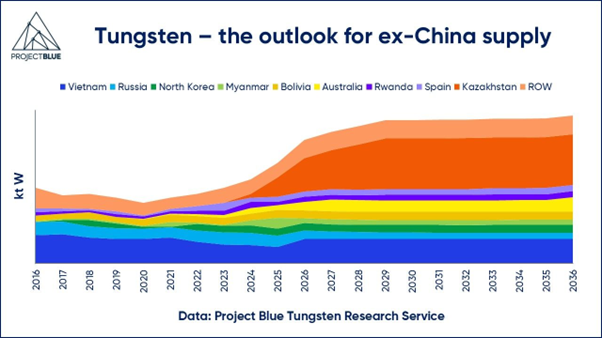
Tungsten in North America

The US has quite a strong potential to advance in Tungsten even if it cannot catch up with Europe any time soon. Canada has two contenders in the developer space (Fireweed Metals Corp. (TSXV: FWZ | OTCQX: FWEDF) and Northcliff Resources Ltd. (TSX: NCF)) but both are gargantuan or challenged in other ways (e.g. location and jurisdiction) not to mention eye-watering capex numbers. There is also an explorer worth noting, Fox Tungsten Ltd. (TSXV: FOXT), in British Columbia.

All the US players that we give credence to, American Tungsten Corp. (CSE: TUNG | OTCQB: TUNGF, Guardian Metal Resources PLC (LSE: GMET | OTCQX: GMTLF) and the aforementioned Almonty, have past-producing mines in the Western US. American Tungsten, in Idaho, is a relatively new entrant into the fray. Its shareholders didn’t have to transit the valley of death that the more long-lived participants experienced. However, because it managed to get its hands on a past-producing asset with a relatively short time to reactivation, it has advanced itself up the rankings faster than many other players.

The picture is relatively similar with Guardian, which has two past producing assets in Nevada, with the Tempiute project appearing to be quite plug-n-play. The London-listed GMET also just secured a NASDAQ listing, following in Almonty’s footsteps. The latter, which redomiciled to the US last year, also just added a Montana past-producing asset to its armoury (pardon the pun).

There is a fourth company with an ASX-listing but we cannot be bothered highlighting its scant virtues as it was so low down the pecking order that we had not been able to distinguish it from pond scum. We spoke to several companies in the sector when we had heard outlandish (negative) claims about them and this was attributed by aggrieved managements to this rogue set of corporate slanderers. We later heard they had tried to leave their past misdeeds behind them by changing their name from something totally inappropriate to something overweening and pompous. They shall go on being ignored by us.

The Tungsten Lifecycle Chart

Our Lifecycle chart, shown below, serves particularly well, in the case of Tungsten, to show the state of progress of the various players vis-à-vis each other on the exploration-production continuum.
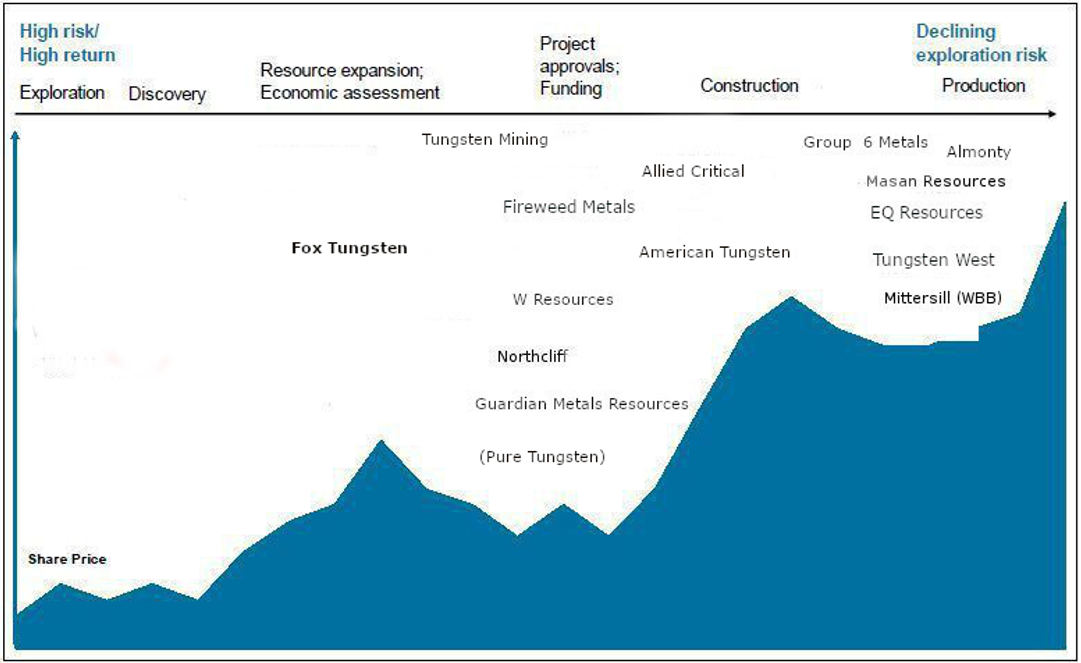
In many of the latest go-go metals there are many players that are not serious about getting to production, whereas in Tungsten the culling of the ranks has left only the most determined players. Moreover, it is very rare in charts such as that above that there are so many at the production end of the continuum that we run out of space.

Summing Up

As we have noted the Tungsten space is weighted towards mainly serious (producing) companies that have walked across broken glass over the last  10-12 years to remain in the business and reinforce their commitment to a metal that they believed was pivotal to Western economies and Western militaries, even when those two consumer groups did not know themselves how vulnerable they were to Chinese Tungsten squeeze tactics.

While much verbiage is dedicated to the US’s mighty military-industrial complex, we might almost say that the closest that Europe comes to achieving self-reliance in any critical metal is in Tungsten. The EU’s much touted Circular Economy concept is defective here, though, as little Tungsten is recyclable, particularly that in munitions.

In this hare & tortoise race, the EU tortoise has pulled well ahead and its up to the US hare (to mix a metaphor) to pull its socks up.


Brian Leeners on Homerun Resources’ High-Grade Silica Positioning for a Critical Role in Energy and Technology Supply Chains

In a recent interview with market maker Darren Cudmore, host for InvestorNews.com, he spoke with Brian Leeners, CEO and Director of Homerun Resources Inc. (TSXV: HMR | OTCQB: HMRFF), about a strategy built around one of the most overlooked materials in the global economy: silica.

Leeners framed the company’s thesis around two converging forces—electrification and the material constraints required to support it. “There are key materials within that,” he said. “It’s interesting that we focused on silica because it’s not really recognized as one of those—but it’s actually a key material in both the technology side and in the energy side.”

While rarely highlighted in critical mineral discussions, silica underpins modern life across a wide value spectrum. At its lowest grade, it is used in construction and industrial applications; at its highest purity, it becomes essential for semiconductors, solar panels, and photonics. “Remove silica from your life, you will feel it miserably,” Leeners said, pointing to its central role in solar energy systems, where both silicon and glass components depend on it.

Homerun’s focus on Brazil reflects both geological advantage and shifting geopolitical priorities. Leeners described the country as one of the few jurisdictions capable of supporting large-scale, vertically integrated supply chains for critical materials. “When you go around the world and you look for that, you’ve got Canada, Australia, and Brazil,” he said, emphasizing Brazil’s lower capital intensity and growing alignment with Western supply chain diversification efforts.

The company’s strategy is structured around vertical integration, with each segment designed to develop into what Leeners described as a “complementary unicorn.” Rather than tying the company to a single commodity, the model is built to capture value across multiple stages of processing and manufacturing. “We didn’t want it specific to any material,” he said. “We wanted to name it after what we wanted to achieve.”

A central pillar of that strategy is Homerun’s collaboration with the University of California, Davis, where the company is advancing lower-carbon processing technologies. The objective is to replace conventional, hydrocarbon-intensive methods with electrified processes capable of reducing emissions while maintaining economic viability. “How do we process our silica using electricity?” Leeners said. “How do we produce new advanced materials using electricity?”

With approximately $9 million in operating capital secured and a bankable feasibility study underway for its solar glass initiative, Homerun is now focused on project-level financing structures designed to minimize dilution. “The financing is related to the actual project,” Leeners said, underscoring a disciplined approach to capital allocation as the company advances toward commercialization.

To access the complete interview, click here

Don’t miss other InvestorNews interviews. Subscribe to the InvestorNews YouTube channel by clicking here


InvestorTalk Alert: Ali Haji from American Tungsten Corp. to host on Thursday, April 2, 2026, at 9:00 AM EST

InvestorNews.com is pleased to announce an upcoming InvestorTalk scheduled for tomorrow, Thursday, April 2, 2026, at 9:00 AM EST, featuring Ali Haji, CEO and Director, American Tungsten Corp. (CSE: TUNG | OTCQB: TUNGF). To participate in this engaging discussion, please email [email protected] to RSVP.

American Tungsten Corp. is a Canadian exploration company focused on high-potential tungsten and magnetite assets in North America. The Company is advancing the IMA Mine Project in Idaho to commercial production, addressing critical metal scarcity in North America. The Company’s IMA Mine Project is a historic and high-quality underground tungsten past-producing property on private-patented land well above the water table with significant infrastructure. The Company holds an exclusive option to acquire full ownership (subject to a 2% royalty) and has expanded its land position with 113 additional federal claims covering nearly 2,000 acres.

In preparation for tomorrow’s InvestorTalk, here are some recent news releases from American Tungsten for your review, which are listed below:

  • March 25, 2026 – American Tungsten Extends Strike Length of Tungsten Mineralization at IMA Mine, Idaho, US — click here
  • March 18, 2026 – American Tungsten Completes C$40 Million Bought Deal Financing – click here
  • March 17, 2026 – American Tungsten Completes Strategic Investment in Viking Mines – click here

We found the March 25th news release titled, “American Tungsten Extends Strike Length of Tungsten Mineralization at IMA Mine, Idaho, US” particularly noteworthy and here are 5 key data points from it:

  • High-Grade Tungsten-Silver Intercepts – American Tungsten reported strong drill results including 28.3 ft at 0.39% WO₃ and 1.08 oz/t Ag, with higher-grade intervals up to 1.03% WO₃, confirming robust mineralization.
  • Strike and Up-Dip Extension Confirmed – Drilling from the second D-level station demonstrates continuity of the polymetallic vein system, extending mineralization along strike to the northwest and up-dip from historical workings.
  • Ongoing Drill Program Expansion – The Company has completed ~7,800 feet across 23 holes and plans additional drilling, including ~2,800 feet on D-level and up to 10,000 feet on Zero level.
  • Advancing Toward Resource Definition – Current drilling aims to confirm historical mineralization and define a modern, mineable resource, supporting potential restart of underground operations.
  • Past-Producing High-Quality Asset – The IMA Mine historically produced ~199,449 MTUs of WO₃, and the Company is advancing it as a strategic North American tungsten project with existing infrastructure.

For more information on American Tungsten Corp., click here

For more information on the InvestorTalk pre-market series, go to InvestorTalk.com.


From Green Dreams to War Metals: A Critical Minerals Wake-Up Call for Europe

There are reports that describe a market. And then there are reports that quietly expose it.

Christopher Ecclestone’s latest Hallgarten note—Europe & Critical Metals: Poised for Action or Jawboning?—falls firmly into the latter category.

At first glance, it reads like a familiar critique: Europe talks a good game on critical minerals but struggles to execute. But beneath that framing is something far more consequential—a reframing of what actually matters now in the critical minerals economy.

Not lithium. Not ESG narratives. Not even the energy transition.

War.

Ecclestone’s central insight is disarmingly simple: strip away the “padding” from critical minerals lists, and a far narrower, more urgent group emerges—tungsten, antimony, tin, rare earths, and helium. These are not fashionable metals. They are functional ones. They are the inputs of munitions, electronics, and industrial resilience. They are, increasingly, the metals of a rearming world.

And here, Europe finds itself in a paradox.

On paper, it is dangerously dependent—on China for processing, on external partners for supply, and on its own bureaucracy for delay. The Critical Raw Materials Act (CRMA) is ambitious, targeting 10% domestic extraction and 40% processing by 2030, but ambition is not execution.

In practice, however, Europe is not as resource-poor as it pretends to be.

Spain and Portugal sit atop meaningful tungsten potential. Scandinavia and Central Europe host rare earth infrastructure that, as Ecclestone notes, “puts the US to shame.” Tin is quietly re-emerging in Cornwall. Antimony, long written off, remains embedded across Slovakia and Iberia.

The issue is not geology.

It is will.

Ecclestone is unsparing on this point. Europe’s greatest vulnerability is not China—it is NIMBYism, regulatory inertia, and what he characterizes as a political class more comfortable with “slogans, buzzwords and soundbites” than mines. The “Circular Economy,” once positioned as a solution, is dismissed as a delaying tactic—recycling cannot substitute for primary supply when demand is surging and stockpiles are depleted.

And demand is not theoretical.

Two active conflicts, combined with a structural rearmament cycle, are driving real consumption of tungsten and antimony. This is not the energy transition’s slow burn—it is immediate, industrial demand tied to national security.

That shift has profound implications for capital.

Investors, Ecclestone observes, are no longer rewarding “perpetual drillers.” They are backing developers—projects that can move from resource to production in a compressed timeframe. This is a critical distinction. In a world where supply chains are weaponized, optionality has less value than deliverability.

It also explains why certain metals—long ignored—are now experiencing violent price swings. Antimony’s spike to US$60,000 per tonne, followed by a sharp correction, is not volatility for its own sake. It is a signal: supply chains are thin, opaque, and easily disrupted.

And perhaps most provocatively, Ecclestone challenges the prevailing narrative around Chinese dominance.

Yes, China controls processing. Yes, it can manipulate pricing. But in many cases, it does not control the underlying geology. Europe, he argues, could replace portions of that supply—if it chose to.

That “if” is doing a great deal of work.

Because the report ultimately lands on a familiar, uncomfortable conclusion: Europe understands the problem but has yet to act with the urgency it demands. The CRMA is a framework. Strategic projects have been identified. Partnerships are being discussed. But execution remains uneven, and in some cases, misguided—overweight lithium, underweight military metals.

Meanwhile, the United States is experimenting with mechanisms like “Project Vault,” blending public and private capital into a demand-driven strategic reserve. Whether that model succeeds is secondary. What matters is that it exists.

Europe, by contrast, is still debating.

There is a tendency in this sector to focus on discovery—on the next deposit, the next jurisdiction, the next story. Ecclestone’s report is a reminder that the real story is structural.

Who produces.

Who processes.

Who decides.

And increasingly, who is prepared.

For readers in the critical minerals space—whether operators, investors, or policymakers—this is required reading.

To access the complete report, click here


InvestorTalk Alert: Sheldon Bennett from DMG Blockchain Solutions Inc. to host on Wednesday, April 1, 2026, at 4:05 PM EST

InvestorNews.com is pleased to announce an upcoming InvestorTalk scheduled for tomorrow, Wednesday, April 1, 2026, at 4:05 PM EST, featuring Sheldon Bennett, CEO and Director, DMG Blockchain Solutions Inc. (TSXV: DMGI | OTCQB: DMGGF). To participate in this engaging discussion, please email [email protected] to RSVP.

DMG Blockchain is a sustainable, vertically integrated blockchain and data center technology company that develops, manages, and operates comprehensive platform solutions to monetize the blockchain ecosystem. The Company’s operations are driven by two strategic pillars: Core and Core+, both unified by DMG’s commitment to vertical integration and environmentally responsible practices. DMG’s subsidiary Systemic Trust Corporation is focused on custody of digital assets.

In preparation for tomorrow’s InvestorTalk, here are some recent news releases from DMG Blockchain for your review, which are listed below:

  • March 5, 2026 – DMG Blockchain Solutions Announces 75 MW Utility Approval Expanding Christina Lake Data Center Power, February Preliminary Operational Results — click here
  • February 25, 2026 – DMG Blockchain Solutions Reports First Quarter 2026 Financial Results – click here
  • February 6, 2026 – DMG Blockchain Solutions Announces Receipt of $1.5 Million Energy Efficiency Incentive, January Preliminary Operational Results – click here

We found the March 5th news release titled, “DMG Blockchain Solutions Announces 75 MW Utility Approval Expanding Christina Lake Data Center Power, February Preliminary Operational Results” particularly noteworthy and here are 5 key data points from it:

  • Power Capacity Increased to 75 MW – DMG Blockchain Solutions Inc. received approval for an additional 10 MW of non-firm power, bringing total available capacity at its Christina Lake facility to 75 MW (15 MW firm + 60 MW non-firm).
  • Shift Toward Non-Firm Power Strategy – The Company plans to pursue additional non-firm power instead of firm power, citing faster availability and lower capital costs, with only minimal historical curtailment.
  • AI Data Center Positioning – DMG is exploring AI data center opportunities, including potential use of hedged power contracts, which are more suitable for AI workloads than Bitcoin mining.
  • Energy Flexibility and Sustainability Options – The Company is evaluating natural gas and renewable natural gas (RNG) for backup or primary power, offering potential for carbon-neutral operations.
  • February 2026 Operational Metrics – DMG mined 23 BTC, achieved 1.78 EH/s hashrate, and held 410 BTC, with some Bitcoin sold to fund operations.

For more information on DMG Blockchain Solutions Inc., click here

For more information on the InvestorTalk pre-market series, go to InvestorTalk.com.


InvestorTalk Alert: Brent Willis from Voyageur Pharmaceuticals Ltd. to host on Tuesday, March 31, 2026

InvestorNews.com is pleased to announce an upcoming InvestorTalk scheduled for tomorrow, Tuesday, March 31, 2026, at 9:00 AM EST, featuring Brent Willis, President, CEO, and Director, Voyageur Pharmaceuticals Ltd. (TSXV: VM). To participate in this engaging discussion, please email [email protected] to RSVP.

Voyageur is focused on developing barium and iodine Active Pharmaceutical Ingredients (API) and imaging contrast agents. The Company is advancing five Health Canada-licensed barium contrast products and plans to partner with third-party GMP pharmaceutical manufacturers in Canada to generate initial cash flow and secure global regulatory validation. Over time, Voyageur aims to transition into a high-margin domestic manufacturer of radiology drugs. Central to its strategy is its 100% owned Frances Creek barium sulfate project, which hosts high-grade material suitable for pharmaceutical use. Voyageur’s vertically integrated approach—from raw material sourcing to final product—targets improved quality and cost efficiency in contrast media production.

In preparation for tomorrow’s InvestorTalk, here are some recent news releases from Voyageur Pharmaceuticals for your review, which are listed below:

  • March 25, 2026 – Voyageur Announces Non-Brokered Life Offering — click here
  • March 16, 2026 – Voyageur Announces Advancements on its Barium & Iodine Contrast Media Projects – click here
  • March 4, 2026 – Voyageur Pharmaceuticals Confirms Pharmaceutical-Grade Purity of Barite from Frances Creek and Progresses to Health Canada Human Trial with Alberta Innovates Grant; Announces Stock Option and DSU grants, and Proposed Issuance of Securities for Debt – click here
  • February 23, 2026 – Voyageur Pharmaceuticals Announces Collaboration with Bayer – click here

We found the March 16th news release titled, “Voyageur Announces Advancements on its Barium & Iodine Contrast Media Projects” particularly noteworthy and here are 5 key data points from it:

  • Dual BFS Strategy Underway – Voyageur Pharmaceuticals Ltd. is advancing two bankable feasibility studies for its radiology drug manufacturing project and the Bayer iodine project, forming the foundation of its vertically integrated strategy.
  • Frances Creek Barium Project Advancing – The Frances Creek project hosts 132,000 tonnes of pharmaceutical-grade barium sulfate (98.8% purity) and is currently in the BFS stage, targeting completion in H2 2026.
  • Initial Commercial Validation Achieved – Voyageur has generated approximately C$32,000 in early product sales from its Health Canada-approved barium contrast products, supporting market validation and pricing insights.
  • U.S. FDA Approval Process Initiated – The Company has begun the FDA approval process (505(b)(2) pathway) for its barium products, with potential U.S. market entry targeted for 2027.
  • Iodine Production and Strategic Partnership – Voyageur is advancing iodine production targeting 35 million doses annually, alongside a US$2.35M-supported Bayer iodine project, with potential future offtake-linked financing.

For more information on Voyageur Pharmaceuticals Ltd., click here

For more information on the InvestorTalk pre-market series, go to InvestorTalk.com.


Critical Minerals Institute Announces CMI Summit 5: “The New Critical Minerals Economy” — Toronto, May 13–14, 2026

March 29, 2026 — TORONTO, ONTARIO — Capital is rapidly repositioning around critical minerals — but the question is no longer where to invest, it is who will control the supply chains.

At a moment when capital flows, industrial policy, and geopolitical strategy are converging around the same finite set of resources, the Critical Minerals Institute (CMI) will convene its flagship annual gathering — CMI Summit 5: “The New Critical Minerals Economy” — on Wednesday and Thursday, May 13–14, 2026, at the Historic National Club in Toronto, Canada — a forum designed to shape the market, not follow it. To register as a CMI 5 Delegate, click here

This is not simply a conference — it is a strategic forum where investment thesis meets execution reality. As institutional capital searches for scalable exposure to critical minerals, and governments accelerate efforts to secure domestic and allied supply chains, the market is entering a new phase—one defined less by discovery and more by control, processing capability, and downstream integration.

CMI Summit 5 is designed to address precisely this transition. Over two days, senior executives, policymakers, institutional investors, and technical experts will engage in a rigorously structured program of keynote addresses, deep-dive presentations, and high-level panel discussions. The focus is not theoretical—it is operational: how capital is deployed, how projects move into production, how bottlenecks in processing and permitting are resolved, and how durable, allied supply chains are constructed in a fragmented geopolitical landscape.

Well-known for its intellectually serious programming, CMI Summit 5 features an exceptional roster of confirmed speakers and participants who are actively shaping the evolution of the global critical minerals’ ecosystem. These include Lewis Black, Almonty Industries Inc. (NASDAQ: ALM | TSX: AII | ASX: AII); Constantine Karayannopoulos, Neo Performance Materials Inc. (TSX: NEO | OTCQX: NOPMF); Pini Althaus, Cove Capital LLC; Pat Ryan, Ucore Rare Metals Inc. (TSXV: UCU | OTCQX: UURAF); Kamran M. Khozan, CVMR Corporation; David Argyle, Arlington Innovation Partners (AIP); Terry Lynch, Power Metallic Mines Inc. (TSXV: PNPN | OTCQB: PNPNF); Ali Haji, American Tungsten Corp. (CSE: TUNG | OTCQB: TUNGF); Craig Lindsay, Resolution Minerals Ltd. (ASX: RML | OTCQB: RLMLF); Roy Bonnell, Allied Critical Metals Inc. (CSE: ACM | OTCQB: ACMIF | FSE: 0VJ0); Feisal Somji, Sio Silica Corporation; Jim Atkinson, Antimony Resources Corp. (CSE: ATMY | OTCQB: ATMYF); Robin Dunbar, Grid Metals Corp. (TSXV: GRDM | OTCQB: MSMGF); Marcy Kiesman, Quantum Critical Metals Corp. (TSXV: LEAP | OTCQB: ATOXF); Denis Clement, Critical Minerals Americas Inc. (CMAI); Mark Wall, American Rare Earths Limited (ASX: ARR | OTCQX: ARRNF | ADR: AMRRY); Guy Bourassa, Scandium Canada Ltd. (TSXV: SCD); Gary Lewis, AE Fuels Corporation (TSXV: AEF | OTCQB: NRGFF); Michael Hargett, CVMR Corporation; Mark Tory, Defense Metals Corp. (TSXV: DEFN | OTCQB: DFMTF); Debra Bennethum, Energy Fuels Inc. (NYSE American: UUUU | TSX: EFR); Alex Moyes, USA Rare Earth, Inc. (NASDAQ: USAR); Tom Drivas, Appia Rare Earths & Uranium Corp. (CSE: API | OTCQB: APAAF); Nicole Brewster, Renforth Resources Inc. (CSE: RFR); Brett Marsh, Spartan Metals Corp. (TSXV: W | OTCQB: SPRMF); Douglas Morrison, Centre for Excellence in Mining Innovation (CEMI); Ellie Saklatvala, Argus Media; Christopher Berlet, Stakeholder Gold Corp. (TSXV: SRC | OTCQB: SKHRF); Nick Parry, Hermitage Consulting; along Critical Minerals Institute (CMI) Directors Jack Lifton, Mel Sanderson, Tracy Hughes, Peter Clausi, Stephen Burega, Alastair Neill, Alister MacDonald and Stephen Lautens.

This carefully curated speaker list reflects a deliberate emphasis on operators and decision-makers—those directly responsible for deploying capital, advancing projects, and building the infrastructure required to support a new era of industrial policy and supply chain resilience.

Jack Lifton, Co-Chairman of the Critical Minerals Institute (CMI), stated:

“Critical minerals are now the currency of industrial power. The global conversation has shifted from identifying deposits to mastering processing and control of the value chain. CMI Summit 5 brings together the capital and expertise required to confront the defining challenge of our time—the processing bottleneck.”

Melissa “Mel” Sanderson, Co-Chair of the Critical Minerals Institute (CMI), added:

“The ‘defining challenge’ of this moment is alignment between the relative strengths of each potential partner – governments, investors and industry. Shaping and defending reliable critical supply chains is the hurdle confronting us all in a time of unprecedented global flux. Whether this challenge can ultimately be achieved remains an open question.”

CMI also recognizes and extends its appreciation to the distinguished group of CMI Summit 5 Gold Sponsors, whose leadership underscores the increasing importance of collaboration across the critical minerals ecosystem: 47G.Org; AE Fuels Corporation (TSXV: AEF | OTCQB: NRGFF); Allied Critical Metals Inc. (CSE: ACM | OTCQB: ACMIF | FSE: 0VJ0); Almonty Industries Inc. (NASDAQ: ALM | TSX: AII | ASX: AII | FSE: ALI1); American Rare Earths Limited (ASX: ARR | OTCQX: ARRNF | ADR: AMRRY); American Tungsten Corp. (CSE: TUNG | OTCQB: TUNGF); Antimony Resources Corp. (CSE: ATMY); Appia Rare Earths & Uranium Corp. (CSE: API | OTCQX: APAAF); Ara Partners; Arlington Innovation Partners; Cove Capital LLC; Critical Minerals Americas Inc.; CVMR Corporation; Defense Metals Corp. (TSXV: DEFN | OTCQB: DFMTF); Geophysx Jamaica Ltd.; Grid Metals Corp. (TSXV: GRDM | OTCQB: MSMGF); Power Metallic Mines Inc. (CSE: PNPN | OTCQB: PNPNF); Resolution Minerals Ltd. (ASX: RML); Quantum Critical Metals Corp. (TSXV: LEAP | OTCQB: ATOXF | FSE: 86A1); Scandium Canada Ltd. (TSXV: SCD | OTCQB: SCDCF); Sio Silica Corporation; Spartan Metals Corp. (TSXV: W | OTCQB: SPRMF); Ucore Rare Metals Inc. (TSXV: UCU | OTCQX: UURAF); and USA Rare Earth, Inc. (NASDAQ: USAR).

About the Critical Minerals Institute (CMI):

The Critical Minerals Institute (CMI) is a global think tank for the critical minerals economy, serving as a central hub that connects companies, capital markets, and policymakers, and delivering actionable intelligence through its monthly CMI Masterclasses, weekly Critical Minerals Report (CMR), bespoke research, and board-level advisory services across exploration finance, supply chains, and geopolitics. CMI also organizes its flagship Annual Critical Minerals Institute Summit, a global gathering of government leaders, institutional investors, and industry executives, with the upcoming CMI Summit 5 — “The New Critical Minerals Economy — scheduled for May 13–14 in Toronto, Canada. For more information, please contact Chrissy Hessam, Director, Membership Services, at [email protected] or +1 647 289 7714, or visit CriticalMineralsInstitute.com. To register for the CMI Summit 5, click here


America’s Military Potemkin Crisis

The now-fading military crisis du jour, the critical minerals, metals, and materials crisis, is a supreme example of a Potemkin situation. Let me explain this to my younger readers. 

There is a historical tale that in the days of the Russian Empress Catherine the Great, she set out upon a progress, which meant she was to review the standard of living in villages in her empire. Her managers, or what we would today call the deep state, decided that it was not a good idea for Catherine to see the levels of despair and poverty actually present in the Empire. Therefore, they had constructed along the way to her progress false fronts on the streets she would travel, showing shops, theaters, and restaurants, decorated with peasants, others, and officials in gaily colored clothes, looking as if they were having a good time. These places she visited became known historically as Potemkin villages. Illusions to calm the nerves of rulers, and prevent inquiries that might be embarrassing 

In today’s America, those bureaucrats who need to find ways to maintain their power, influence, and income, and not to disturb our highest elected officials with reality, have created what I call our age of the Potemkin crisis. 

For the managers of any Potemkin crisis du jour, the only required necessity to solve the crisis is capital. Naturally, this is other people’s money, i.e., yours and mine. 

Therefore the solution to every problem is to fund first a study and then to finance the physical property, plant, and equipment necessary to manufacture whatever it is that we are short of through the distribution of immense amounts of capital to friends, family, and donors so they can use some of the capital to find people to identify and find the various components necessary to manufacture that item even though the Potemkin bureaucrats have no idea what those items should be, where they come from, how they are to be processed into useful forms, or any of those myriad details associated with the “tradesmen” who actually do the work.

It is, of course, required by the Washington bureaucracy that no one with actual experience in the total supply chains required to produce the necessary products be involved in any way in the process of the allocation of capital. The sole requirement to receive government largesse is that you “know someone.”

Naturally, it is always necessary to point out to the taxpayers that we are deprived of these critical materials due to the machinations of the evil others, not due to the fact that we are short-sighted, greedy, and completely illiterate in both mineral and manufacturing economics.

One thing I do have to admit is that denominating a company as a “national champion” is a masterstroke worthy of P.T. Barnum and of the American advertising industry that created our urgent need for instant gratification in place of long-term solutions.

Barnum’s thesis that there is a sucker born every minute was vastly understated. The sucker turnover seems to be approaching light speed.

And as an afterthought, I recall from a very distant past that the purpose of soldiering was to kill the enemy and break his fortifications through training,  discipline, unit cohesion, obedience to officers,  personal strength, and whatever was handy, such as

– A rock
– A club
– A spear
– A sword
– A knife of any kind or a sharp object. 
– A pilum (Roman specialized spear)
– A mace
– A longbow
– A firearm
– A cannon, or
– A two by four with a nail in it (I note that the nail was optional).

All are effective. None need critical minerals, metals, or materials that are not readily available.


Déjà vu all over again.

America’s private sector financiers, whom I will categorize for the purposes of this essay as the Wall Street crowd, seem to have reverted to the thinking and actions of 1928. They, not the elected officials in Washington, chart the course of the American economy and impose upon the elected officials their views. Their biggest supporter is the current President of the United States, who is the first businessman with no political experience ever elected to that high office. His approach to solving political, economic, and social problems is that of a successful CEO. He is a results-oriented manager and has no problem abandoning politically driven solutions in favor of quick fixes, regardless of immediate political or even economic consequences.

His greatest strength lies in exposing the fact that his opponents never think of long-term consequences and are literally ignorant of Industrial or manufacturing economics that impact technology. In fact, his actions have made more and more of the American public aware of the fact that they have ceded the control of the largest economy in the history of the world to a group of elected individuals and bureaucrats incompetent intellectually to manage such an economy.

The mistake that both the President and his detractors make, and one that is increasingly imperiling the course of America’s economic future is to consider the world as only divided into resource-producing economies and industrial manufacturing economies. This was the same division accepted by the then coming victors in the Second World War, towards its end, as they met to determine how to control the post-war global economy so as to avoid the revival of the economic situations that they believed had caused that war.

The failure of National Socialism and the rejection of its now forgotten “new order” in European economics, which was basically German economic imperialism enforced by military hegemony, added to the temporary military dominance of the eastern portion of the European continent by the Soviet Union at the end of the war, allowing the Russian version of Communism to proceed. Simultaneously, the abrupt American withdrawal from open-ended military support for the Nationalist Chinese allowed the Communist Chinese under Mao Zedong, supported by the Soviet military’s material and managerial assistance, to rapidly take over China. Both the Russian and Chinese states were thinly disguised empires, each as autocratic as National Socialist Germany had ever been. The then-dominant self-styled “socialist” power, the Soviet Union, proceeded to bankrupt itself, albeit over half a century, by embarking not on an economic but on a military competition with the United States. The Chinese socialist state proceeded to match the early history of the Soviet Union and almost obliterated itself in famine and poverty. But the Chinese were rescued from the demise of their Soviet-style state in the very last decade of the 20th century, when a sage leader altered their economic direction. By the beginning of the 21st century, China had embarked on a Western-style reinvention of its “socialist” Economy with “Chinese Characteristics.” In part, emulating late 19th-century Japan, China imported Western industrial capitalism defined as a form of socialist “economics with Chinese characteristics.” The Chinese Communist Party retained absolute political control but allowed individual Chinese entrepreneurs to rapidly propel the Chinese economy into the 21st century, and supported this transformation with a nationally mandated emphasis on STEM education.

The results have been as astonishing to the rest of the world as the Japanese defeat of the Imperial Russian Navy at the Battle of Tsushima in 1905, which shocked the Eurocentric world of that time.

But contemporary Chinese economic imperialism, as evidenced by its current control of the so-called critical materials necessary for the maintenance of industrial economies, has now run into the same barriers as European imperialism of the nineteenth and early twentieth centuries.

The global south, as the nations comprising the majority of the human population are now called, is in the process of rebelling against both American and Chinese economic imperialism. These nations, which were once sources of raw materials and sites of consumption of manufactured goods for European empires and now for the Chinese empire, are rebelling. They want to emulate, not worship, the industrialized, technology-driven consumption of societies in both the United States and the People’s Republic of China. In order to do this, they now recognize the need to expand their domestic economies by adding downstream processing of their natural resources, both mineral and food, for the production of sufficient end-user products in their own countries, to rapidly raise their standards of living. This will support the rise of their societies into modern, industrial, technology-based consumer economies. Their common goal is to reach the level of prosperity first achieved in the United States and soon to be achieved in the People’s Republic of China.

The financiers of both of today’s industrial imperialist states are resisting this trend as best they can. Mostly by trying to continue supporting the raw-material imperialism of the rapidly retreating past. Thus, the Chinese have made enormous, unrepayable loans under the guise of their Belt and Road Initiative to the resource-producing nations of the global south. When those nations default on their loans, the Chinese can simply take over the production of those resources and limit the ability of the supplier nations to industrialize and modernize, and to become International competitors in manufactured goods. The United States simply assumes that the natural resource-producing nations will be glad to support the American economy in return for economic assistance and military protection from China. Neither of the two economic imperialist nations seems to care about the rapid growth of desire for independent economic life and progress towards a high-level consumer economy in the global south.

The current American initiative to create an international critical materials stockpile consortium dedicated to advancing and maintaining the American domestic economy will fail because it ignores the social and economic aspirations of the seemingly subordinate nations

With perhaps a visceral understanding that this period of economic imperialism is coming to an end, the American federal government is hedging its bets through pork-barrel politics. It is raining money on newly formed (by financiers, not technologists) companies and groups with little apparent capability to “solve” America’s now-suddenly recognized domestic production deficits in natural resources necessary to support its manufacturing economy.

The United States’ enormous natural resources of both fuel and non-fuel minerals have been marginalized by an influential grouping of mostly elitist social do-gooders who have played right into the hands of self-interested financiers by touting economically suicidal policies that affect themselves very little but can be and are becoming devastating to the economic lives of ordinary citizens.

Are there critical minerals, materials, and metals? Only in the sense that the so-designated materials are necessary to maintain the quality of life and the standard of living in today’s United States. The small but not insignificant demand for these materials by the United States military is necessary only to maintain that military’s technological superiority over the militaries of the rest of the world.

If globalization continues to fracture, it will impact the prices of minerals, both fuel and non-fuel, and food.

For individual nations, domestic self-sufficiency in both categories, minerals and food, will become a necessity if they are to maintain their current levels of prosperity and to grow that prosperity.

The so-called developed nations with high labor and living costs we’ll have to subsidize the production of those resources necessary to maintain their consumer economy. The current resource supplying nations will have to focus investment on going downstream from simple resource production to technological manufacturing competence.

In my opinion, the best businesses in the future will be:

  • mining
  • refining
  • downstream processing into end-user products for manufacturing and
  • manufacturing engineering and technology providers

For American and European nations to be self-sufficient in natural resource production, their economies will likely need to subsidize it.

Even so, the comfortable lead that those parts of the world have in the above four categories should provide the next generation’s leading profitable business venture.

The Overblown “Investments” in high-speed computing, glamorized by Wall Street as artificial intelligence, are already being moderated by the sudden discovery by the financiers that the electrical power required by the servers for this technology will dramatically impact the supply and therefore the cost of electricity for the ordinary citizen. This will quickly bring the AI crisis to a halt, as the story of how clean energy will prevent the now-fading climate crisis comes up against the enormous cost of fueling today’s AI crisis

The foolish allocation of capital to service America’s crisis pornography is now revealing the limitations of capital formation and deployment.

The historical truism that comes to mind is that no matter what the economic system, only the lowest cost and most robust business ventures will and can survive.

Too Big to Succeed is my analysis of the current promotion of untested suppliers of critical minerals, materials, and metals. The coming failure of most of these ventures will have destroyed useful capital. The beneficiaries will be the nations of the Global South as their competition for the manufactured goods of the developed nations fades due to the high cost of such goods from the developed nations, based on the enormous waste of capital by those developed nations.

The geological distribution of natural resources has nothing to do with the political boundaries of today’s nation-states. I suspect that the nations of the global south will, in time, organize trading networks among themselves to distribute the natural resources they control in a way that benefits them first and their grouping later.

The eurocentric resource imperialism that has dominated global history for the last several centuries is now entering its terminal phase.


Leave Your Valuables on the Way Out

Early last decade we worked a lot in Turkey, and, as in many countries, there was the official story, and then there was the real story. The official story much repeated by gold bulls everywhere, was that Turks loved gold. Who doesn’t but the vast bulk of the Turkish population had little gold and not much interest in accumulating it, unlike the Indian middle classes. The real story was that Turkey was energy poor (except for some frenzied building of dams) and that the country was importing enormous amounts of oil and gas from Iran and paying for it with physical gold. Then the Iranians were moving the gold across the Persian Gulf to the gold bazaar that is the UAE. Ergo sanctions fed the idea that Turkey was a big gold buyer/hoarder when it was only a conduit.

To that then in 2022 was added the extra layer of sanctions against Russia (and friends) for the role in instigating the Ukraine invasion. The en masse relocation of a mass of Russians to Dubai was not just because they loved the warmer climes. Russians actually like the cold. What they also liked was Dubai’s role as the biggest laundromat on the planet. In comes gold, out go crisp, new dollars.

Much has been made of the role of the Gulf states as “captive” buyers for the tsunami of dollars issued by the US to fund its ever-larger deficits. The gold bugs have latched onto this as one of their prime pillars of gold resurgence without scratching beneath the surface.  The old pillars of inflation protection and safe haven in unsafe times became mere backseat drivers.

Few asked themselves what might happen should the wash-cycle be run in reverse, with the added spin cycle of the Gulf States themselves being ravaged not only ongoing daily pulverisation but also the prospect that post-war the glean will have gone off the dreaming spires and the tax haven status.

Now they are finding out with a vengeance. This though might be only the start of the process. The US, in a bizarre move, started loosening sanctions on Russia and approving oil trades for India (and eventually others). Iran, looking like they currently have a strong hand, despite being outgunned (but smarter) are looking for not only sanctions to be lifted but for massive compensation. As the US will not be putting its hand in its pockets to pay this reparation amount (by some estimates $500 billion) it will be the Gulf States that will be shaken down. Thus, the Great Liquidation Sale begins. Few recall that at the end of the First Gulf War, the US presented Kuwait with an eye-watering bill for rescuing them from Saddam Hussein. The country had to liquidate many, indeed most, of their international portfolio assets to meet the obligation.

Ironically, in light of how we started off this article, it was reported by Reuters this week that the Turkish Central Bank’s gold reserves, fell by almost 50 tonnes to 772 tonnes in the preceding week, marking the largest ​weekly drop since August of 2018 amid fallout from the ​Iran war.

The central bank sold about $3 billion worth of gold ⁠last week for the first time, adding to the $26 billion in foreign ​currency sales it has carried out since the Iran war began nearly ​a month ago, reflecting steps by authorities to stabilise markets. Net reserves have fallen $35 billion since the Iran war started. Turkey is the canary in the coal mine (to mix a few metaphors). They won’t be the only ones seeking liquidity in this time of stress.

Thus, our argument is that the gold weakness if not just for the duration of the war but rather with sanctions in tatters and rebuilding/reparations on the must-do list, gold could be in for an extended period of liquidation.

But how long will the war itself last. The long derided “it’ll be over by Christmas” that was trotted out in 1914, 1939 and with the start of the Ukraine war has been replaced in the annals of idiotic over-weaning confidence with “it’ll be over by Monday” (i.e. a Weekend War). That has already been proven to be a fallacy.

Many in the precious metals’ spaces have been girding their loins for months if not years, and hey, we just thought they were self-pleasuring themselves. But, lo and behold, their moment of being right has come to fruition, but scarcely has it been the push to $10,000 gold that we had been promised. Gold has behaved like a souffle taken out of the oven too early, while Silver, far from the peak of over $100, reached quite a while before the first missile flew. Maybe the enthusiasts would dismiss this as “buy on the rumour and sell on the news”. This is indeed what seems to have taken place.

Our litmus test of what is a good asset to hold in such a situation is to imagine oneself as a resident of Warsaw in 1939. What serves you best when Panzers start rolling your way? Gold in an ingot, silver in coins, Swiss francs or American dollars? Maybe the answer is German marks. As we have noted, the Gulf States are the home of excess cash or at least moving around the excess cash of others and pretending that it’s yours.

The old adage, though, that “nothing focuses the mind like hanging,” could be tweaked to “nothing focuses the mind like bombing,” and even worse, there are few ways out when the airports are all shut down. What to take when you’ve bought gold but it’s in the vault of your Swiss or London banker? The issue is not how much you have, but can you get your hands on it when what you really need is to snaffle yourself a private jet ride out of the influencers’ favorite hellhole.

So, what does one hold as a safe haven investment at this juncture (putting aside appreciation for the moment)? Explorers would seem to have little attraction. Producers have still not fallen back enough, and their epically slack managements have shown the usual bull market tendency to allow massive overruns in OpEx and CapEx. Most producers do not have dividends to underpin their stock prices when the grim reaper comes calling.

The ongoing rationalisation of the royalty company space has been accelerated by the arrival of Tether Investments S.A. de C.V., whose vast balance sheet is beginning to reshape the sector. This stablecoin affiliate has appeared in relatively short order as the Godzilla stamping across the precious metals space. Knocking Elemental Royalty Corporation (NASDAQ: ELE | TSXV: ELE) together with Gold Royalty Corp. (NYSE American: GROY) makes sense. Instead of just merging them, Tether has enough cash in its till to take them both out. One might also see it chomping upon fallen majors. As the company becomes more au fait with the mysteries and management of mining—rather than just the mechanics of passive vehicles in the royalty space—we might see it going forth and conquering. Frankly, there are not that many other fish in the waters these days.