Canada Backs First Phosphate’s Bégin-Lamarche Infrastructure with $4.8 Million
First Phosphate Corp. (CSE: PHOS | OTCQX: FRSPF | OTCQX ADR: FPHOY | FSE: KD0) has secured an additional $4.8 million in non-repayable, non-dilutive funding from the Government of Canada to advance power transmission and road infrastructure planning for its Bégin-Lamarche project in Quebec.
In an interview with InvestorNews host Tracy Hughes, First Phosphate CEO and Director John Passalacqua explained that the new contribution follows the $16.7 million in federal support announced in March for engineering work associated with the proposed mine concentrator.
“This is developing the critical infrastructure that will be able to get the mine operating and also get the products to market,” Passalacqua said.
The Bégin-Lamarche site is located near both an existing power line and a major highway, with the required connections estimated to be no more than two kilometres from the project. The next step is determining how that infrastructure can be designed and constructed cost-effectively while respecting community priorities and minimizing environmental impacts.
“It’s not a question of if; it’s a question of how,” Passalacqua explained. “How do we bring that power transmission line in the way that is most effective and cost-effective, and most in keeping with the needs and desires of the local community?”
The latest funding complements the earlier $16.7-million contribution, which is supporting engineering work for the proposed concentrator that would process mined rock into phosphate concentrate.
“This is now about how to get that concentrate to market across a road and how to get the power to that concentrator so it can do its job,” Passalacqua said. “It ties everything together.”
Support for Bégin-Lamarche also extends beyond the federal government. Passalacqua pointed to the Quebec government’s decision to fast-track the project and establish a working group bringing together the ministries involved in its review and permitting.
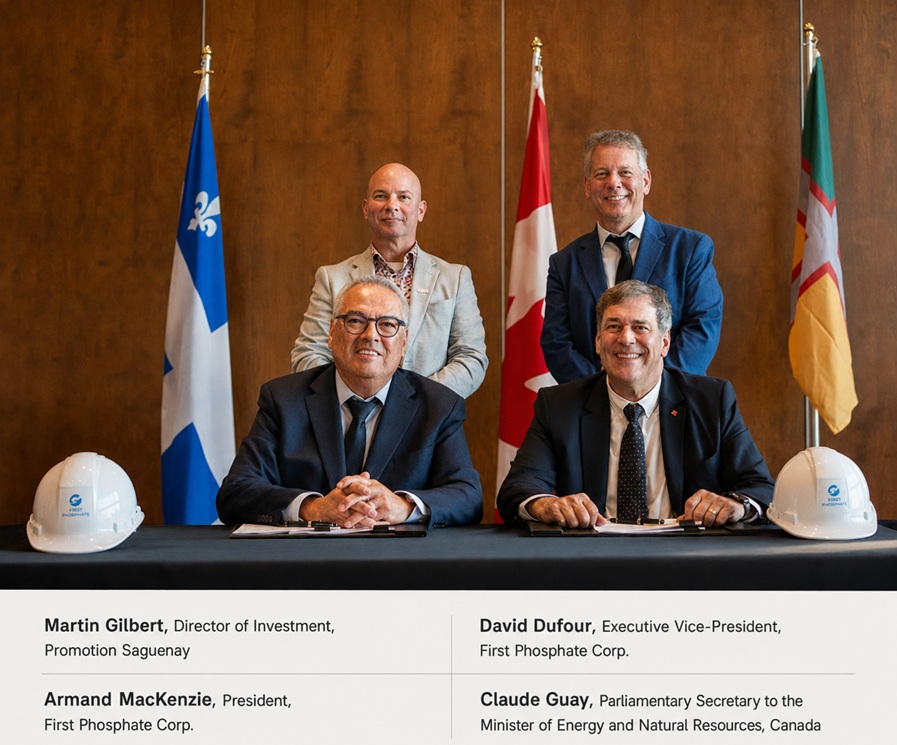
At the international level, Bégin-Lamarche was identified as a priority project during the June G7 Summit. Passalacqua also cited support from the European Union and the governments of Denmark, Italy and Belgium.
“You’ve got everything from local support to provincial support, federal support and multinational support for the project,” he said. “It all ties in very well together.”
According to First Phosphate’s most recent financial statements, the company had more than $30 million in treasury. Combined with approximately $21.5 million in announced federal contributions, Passalacqua said the company has access to more than $50 million in capital.
“It allows us to get through feasibility, permitting and right to a final investment decision,” he said. “Having the capital gives credence to the project and security to our internal staff and external suppliers.”
Passalacqua believes First Phosphate’s progress reflects the quality of the Bégin-Lamarche project, the company’s engagement with local and Indigenous communities, and the strategic need to establish secure North American and European supplies of high-purity phosphate for lithium iron phosphate batteries.
“North America and Europe are short on phosphate, and we need to secure the LFP battery supply chain,” he said. “This is one of the highest-purity sources in the world.”
Looking ahead, First Phosphate is working toward completing a feasibility study by the end of 2026 or early 2027.
To access the complete interview, click here
Don’t miss other InvestorNews interviews. Subscribe to the InvestorNews YouTube channel by clicking here