Jack-in-the-Stox: Heavy Rare Earth Claims Enter the Delivery Years
In his ongoing Jack-in-the-Stox series, Jack Lifton comments on public companies, technologies, capital markets, supply chains and geopolitics. He is not a licensed investment adviser, and his views are provided for informational purposes only. Nothing in this column constitutes investment advice or a recommendation to buy, sell or hold any security.
The question for rare earth investors is no longer simply which companies have dysprosium and terbium in the ground. Many do. The question is which companies can deliver those elements, in usable chemical forms, in commercial quantities—and when. That distinction will determine whether the growing list of non-Chinese rare earth projects becomes a functioning industrial supply chain. It should also help investors distinguish a production business from a development story.
For this week’s review, I have been examining the public production claims of companies developing sources of heavy rare earths outside China, particularly dysprosium, terbium and yttrium. The announced dates cluster around 2026 through 2028. But those dates describe very different accomplishments. Some mean first pilot samples. Others mean the beginning of plant commissioning. Fewer refer to commercial production. Fewer still establish repeat deliveries of material accepted by a customer. Those are different investment milestones.
Start With the Product
Dysprosium and terbium help certain high-performance neodymium-iron-boron permanent magnets resist demagnetization at elevated temperatures. Producing them involves more than mining material that contains them. A mixed rare earth carbonate can be a valuable commercial product. It gives a separation company feedstock from which it can recover individual rare earths. But it is not interchangeable with high-purity dysprosium oxide or terbium oxide.
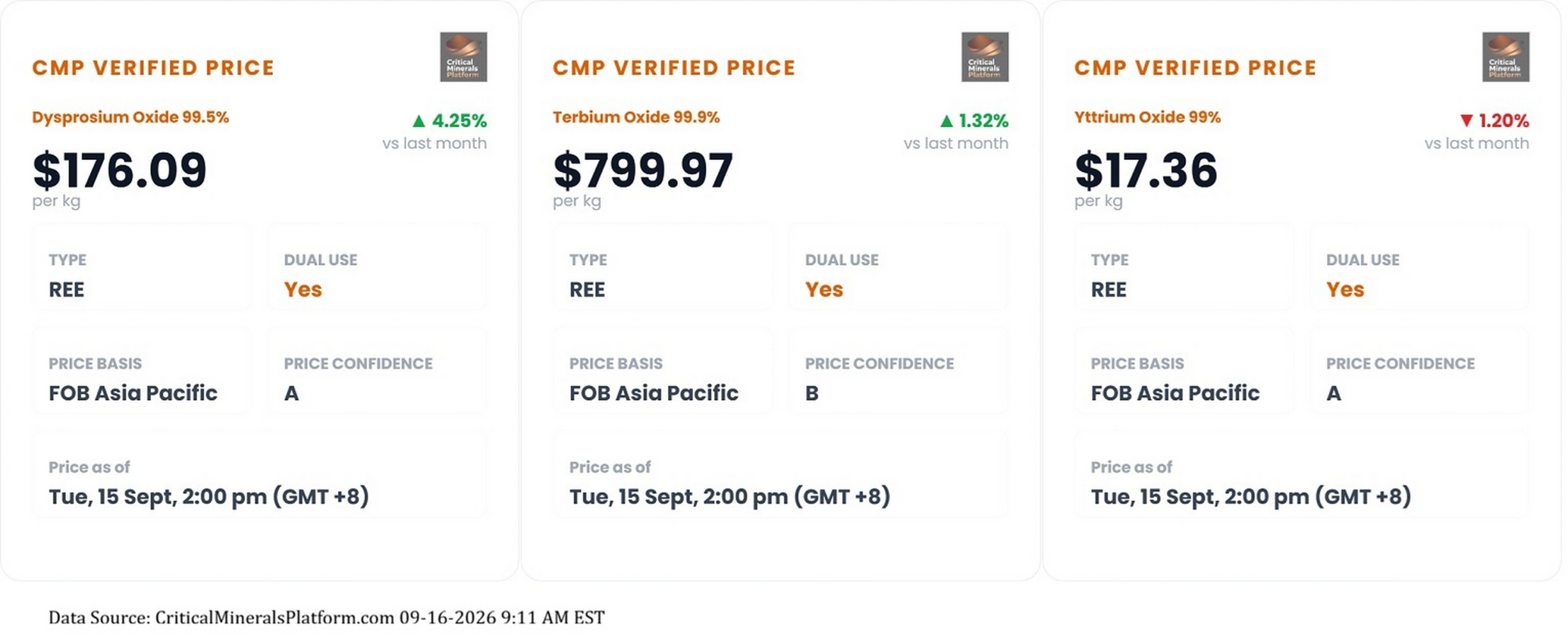
The carbonate must undergo further separation and purification. The resulting oxides must meet the specifications of the next processor, which converts them into metals and alloys. Aclara Resources Inc.’s (TSX: ARA) integrated project disclosures describe this sequence explicitly.
Consequently, “we have produced a commercial-grade product” does not necessarily mean “we are producing commercial quantities.” Rainbow Rare Earths Limited (LSE: RBW) illustrates this well. In February, it announced approximately two kilograms of mixed rare earth hydroxide from its Phalaborwa pilot operation. That is a processing milestone. Its stated target for first production from the full project remains 2028. The planned heavy-bearing product is a SEG+ mixed carbonate containing, among other elements, dysprosium, terbium and yttrium.
Both the chemistry and the scale must be understood.
The First Group Is Already Being Tested
Lynas Rare Earths Ltd. (ASX: LYC | OTCQX: LYSDY) is the operating reference point in this comparison. It first produced separated dysprosium in Malaysia in May 2025 and terbium in June. Its subsequent reporting discusses sales of those products. For Lynas, the investor’s question has moved beyond first production to the pace, consistency and economics of expansion.
The Next Group Has Announced Starts During 2026
MP Materials Corp. (NYSE: MP) targeted mid-2026 commissioning of its heavy rare earth separation facility, initially emphasizing dysprosium and terbium. Investors should now seek confirmation of saleable output and sustained operation. A commissioning target is not evidence that a plant has reached commercial delivery rates.
In France, Solvay’s second-quarter results specify industrial-scale dysprosium and terbium separation at La Rochelle in autumn 2026. Carester’s Caremag project at Lacq targets a late-2026 start, with announced design output of 600 tonnes a year of combined dysprosium and terbium oxides. That capacity should not be mistaken for first-year production. These are near-term claims that can soon be measured against operating results.
The 2027 Promises Need Careful Reading
Ucore Rare Metals Inc. (TSXV: UCU | OTCQX: UURAF) targets completion of installation, testing and commissioning of its initial Louisiana separation plant in the first half of 2027. The announced approximately 600-ton annual capacity is total rare earth oxide capacity—not 600 tons of dysprosium and terbium. Its ability to produce particular heavies also depends on the feedstock presented to the equipment.
The Saskatchewan Research Council (SRC) distinguishes its milestones more explicitly: commissioning by December 2026, followed by ramp-up and operation during 2027. Its planned products include dysprosium and terbium oxides. REalloys Inc.’s (NASDAQ: ALOY) relationship with this facility provides downstream exposure, but SRC production and REalloys’ offtake must not be counted as two independent sources of oxide.
Iluka Resources Limited’s (ASX: ILU) Eneabba refinery also targets 2027. Its advertised capacity includes up to 725 tonnes a year of combined dysprosium and terbium oxide, depending on feedstock. The feed qualification is important: a refinery’s potential output and the output supported by its initial feed blend are not necessarily the same.
Energy Fuels Inc. (NYSE American: UUUU | TSX: EFR) offers an especially instructive case. Its pilot dysprosium oxide achieved 99.9% purity and passed a South Korean customer’s initial purity and quality-control benchmarks. That is meaningful evidence of product suitability. Nevertheless, the company moved its earlier end-2026 commercial target into 2027. Its July construction announcement calls for fourth-quarter 2027 commissioning of the Dy/Tb circuits, with design capacities of up to 120 tonnes and 20 tonnes a year, respectively. A company can demonstrate good chemistry while still needing substantial time to establish commercial throughput.
The Mines and the Refineries Must Arrive Together
Several upstream developers point to 2028.
Meteoric Resources NL’s (ASX: MEI) Caldeira and Viridis Mining and Minerals Limited’s (ASX: VMM) Colossus projects target mixed carbonate production that year. Those projects could provide feed for separation businesses, but their output should not be presented as finished heavy rare earth oxides.
Aclara Resources Inc.’s (TSX: ARA) April technical disclosures target second-quarter 2028 commissioning for its Louisiana separation project, while Carina’s startup is scheduled for the second half of 2028, with ramp-up through 2029. That creates an obvious question about feed availability during refinery startup. An integrated strategy still requires coordinated operating schedules.
USA Rare Earth (Nasdaq: USAR) presents two different investment timelines within one company. Its recently acquired Serra Verde operation in Brazil began production in January 2024 and is expanding mixed-product output. Round Top, in Texas, targets commercial production in late 2028. Investors should assess the operating Brazilian asset separately from the developing American project.
Yttrium Needs Its Own Examination
Yttrium appears in several companies’ resource and product descriptions. Its presence does not establish a dated source of high-purity yttrium oxide.
Rainbow Rare Earths identifies it in planned SEG+ carbonate. Energy Fuels’ July design includes it in a mixed Ho+ carbonate stream. These could be useful sources for further processing, but neither disclosure should be read as a firm commitment to commercial separated yttrium oxide on the same schedule as Dy/Tb.
What I Will Be Watching
Future stock reviews for these critical elements will focus on five questions:
- What chemical product was actually produced?
- How much was produced, and over what period?
- What purity and impurity specifications were achieved?
- Has a customer accepted the material?
- Have repeat commercial shipments begun?
I will also watch revisions to the promised dates. A disclosed delay can be evaluated. An announcement that quietly changes from commercial production to pilot production requires closer scrutiny. The non-Chinese heavy rare earth industry is beginning to offer investors measurable operating milestones. The most useful announcements will increasingly be about tons delivered and accepted.