The Top 10 Tungsten Companies Powering North America’s Critical Minerals Race
The market is no longer asking whether tungsten matters. It is asking which companies can turn strategic urgency into dependable supply.
“Tungsten can punch through armor, survive the inferno of a rocket engine and keep the machinery of modern industry cutting. Yet the United States has not mined it commercially in more than a decade.” — Tracy Hughes, Executive Director, Critical Minerals Institute (CMI)
The most important thing about tungsten is not its melting point. It is that a modern industrial economy can need the metal almost everywhere and still produce none of it at home.
That contradiction has moved tungsten from the back pages of the commodity market to the centre of the critical minerals discussion. Before turning to the public companies attracting North American capital, here are ten facts that explain why this obscure metal has suddenly become so difficult to ignore.
Ten Tungsten Facts That Make the Market Matter
1. Tungsten is the heat champion of the metals. Its melting point is approximately 3,422 degrees Celsius, the highest of any pure metal. That is why tungsten remains useful in environments where most materials soften, deform or fail.
2. It is almost as dense as gold. Tungsten has a density of about 19.25 grams per cubic centimetre, remarkably close to gold at roughly 19.3. That weight, combined with heat resistance, makes tungsten valuable in counterweights, vibration dampening, radiation shielding and high-density defense applications.
3. Its chemical symbol is W, not T. The W comes from wolfram, the older name still embedded in the mineral wolframite. It is a small reminder that tungsten’s industrial history long predates today’s critical minerals vocabulary.
4. The hardest-working form is often tungsten carbide. Elemental tungsten is impressive, but combining it with carbon creates one of industry’s most important wear-resistant materials. Tungsten carbide keeps drill bits drilling, cutting tools cutting and mining equipment working under punishing conditions.
5. Most American tungsten disappears into tools people rarely notice. The U.S. Geological Survey estimates that roughly 60% of U.S. consumption goes into cemented-carbide parts for cutting and wear-resistant applications. Tungsten is therefore not a futuristic demand story. It is already embedded in manufacturing, mining, construction and energy.
6. It is a defense metal as much as an industrial one. Tungsten’s density, strength and tolerance for extreme heat support applications ranging from armor-piercing components and rocket nozzles to electronics, aerospace systems and specialized alloys. In some of those uses, substitution means accepting inferior performance rather than simply choosing another metal.
7. China controls roughly four-fifths of mined supply. The exact share moves from year to year, but the structure does not: China dominates global tungsten mining and also holds enormous influence over conversion and downstream processing. Few strategically important mineral chains are this concentrated.
8. The United States has not mined tungsten commercially since 2015. American industry still consumes it, but domestic mine supply has been absent for more than a decade. That gap is now pushing capital toward old mines, brownfield plants, advanced deposits and recycling capacity.
9. Export policy turned concentration into a visible market risk. China introduced controls on selected tungsten products in February 2025. The measure did not remove every tonne from the market, but it forced buyers to confront how much of the chain passes through a single jurisdiction.
10. The price has already delivered a warning. Critical Minerals Platform data show a dramatic twelve-month repricing followed by a pullback from the 2026 high. That is enough to establish the direction without mistaking one spot quote for a durable economic assumption. The verified series, methodology and live market detail are available through CMP membership.
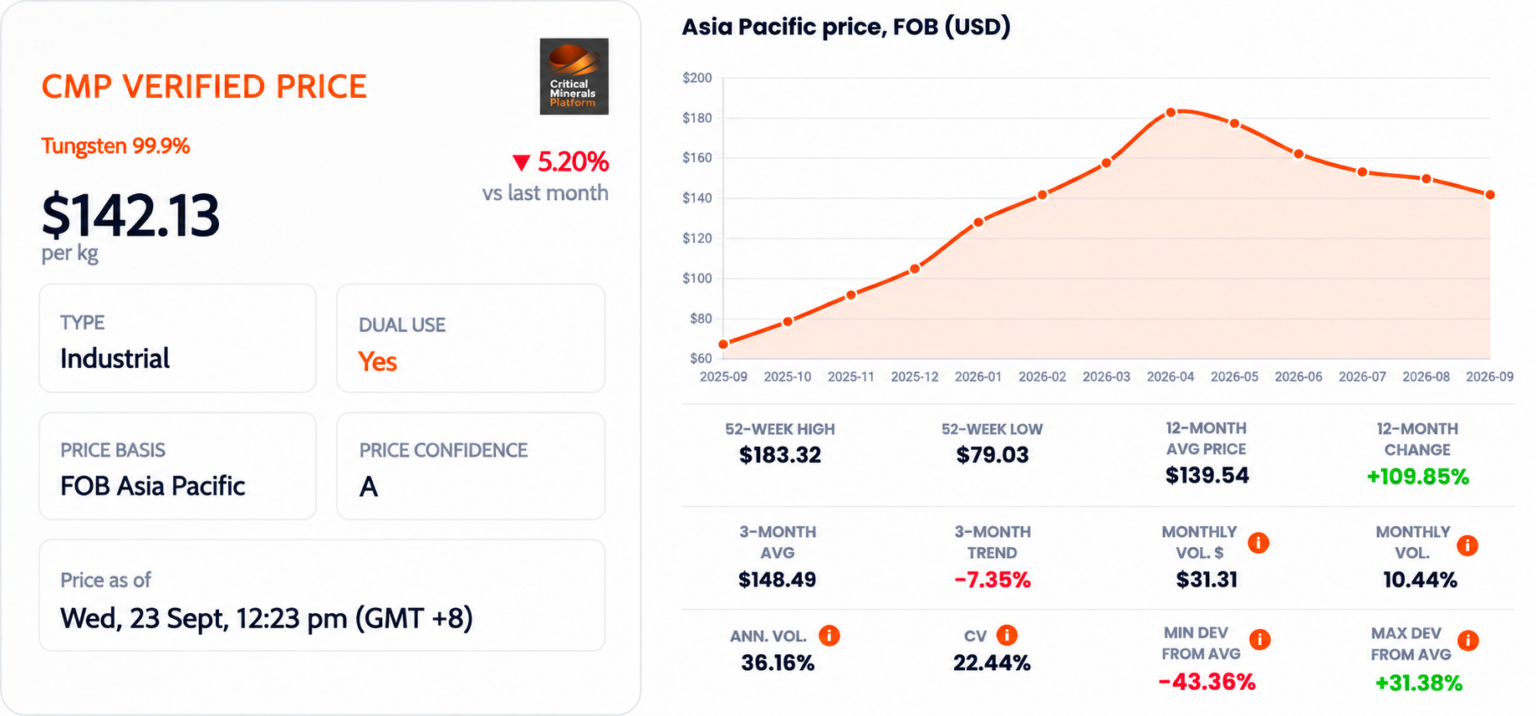
Together, those facts describe a metal with exceptional physical properties, entrenched demand and an unusually narrow supply base. They also explain why governments are backing projects that would have struggled for attention only a few years ago.
But strategic importance does not make every tungsten stock equivalent. The public market contains operating miners, mine developers, early-stage explorers, a processing and manufacturing company, and diversified businesses for which tungsten is only one part of the valuation. Ranking them requires more discipline than simply searching for the word “tungsten” in a corporate presentation.
How This Ranking Was Built
This list includes companies traded on a recognized U.S. or Canadian exchange and for which tungsten is a material part of the business strategy. The assets themselves may be located outside North America; the test is access through the North American public markets. Market capitalizations are based on the September 30, 2026 close and rounded to the nearest million U.S. dollars. Canadian values were converted at approximately C$1.419 per US$1.
The ranking uses each company’s total equity market capitalization. It does not pretend to value the tungsten asset alone. That point is especially important for United States Antimony, The Elmet Group, Fireweed Metals and Blue Moon Metals, all of which have meaningful businesses or commodities beyond tungsten.
Kennametal is excluded because it is a diversified industrial tool manufacturer and a tungsten user rather than a tungsten supply company. Collective Mining is excluded because tungsten remains subordinate to the gold, copper and silver investment case at Apollo. Australian issuers that trade only through the OTC market in North America are also outside the definition used here. These are line-drawing decisions, but they prevent a ranking of tungsten equities from turning into an indiscriminate list of conglomerates, end users and foreign listings.
The Ranking at a Glance
| Rank | Company | Principal North American listing | Approx. market capitalization | Central tungsten exposure |
|---|---|---|---|---|
| 1 | Almonty Industries Inc. | Nasdaq: ALM | US$3.81 billion | Producing and commissioning mines |
| 2 | United States Antimony Corp. | NYSE: UAMY | US$624 million | Fostung project plus operating minerals platform |
| 3 | The Elmet Group Co. | Nasdaq: ELMT | US$608 million | Processing, manufacturing and supply integration |
| 4 | Fireweed Metals Corp. | TSXV: FWZ | US$477 million | Mactung advanced resource |
| 5 | Blue Moon Metals Inc. | Nasdaq: BMM; TSXV: MOON | US$448 million | Springer mine, mill and APT complex |
| 6 | Guardian Metal Resources PLC | NYSE American: GMTL | US$363 million | Pilot Mountain development project |
| 7 | Allied Critical Metals Inc. | CSE: ACM | US$252 million | Borralha and Vila Verde projects |
| 8 | Northcliff Resources Ltd. | TSX: NCF | US$159 million | Sisson feasibility-stage project |
| 9 | American Tungsten Corp. | TSXV: TUNG | US$93 million | IMA mine redevelopment |
| 10 | Adex Mining Inc. | TSXV: ADE | US$43 million | Mount Pleasant brownfield project |
1. Almonty Industries Inc.
Nasdaq: ALM | Approximate market capitalization: US$3.81 billion
Almonty is not merely the largest company in this group. It sits in a different operational category. The company already produces tungsten concentrate at Panasqueira in Portugal, while its much larger Sangdong mine in South Korea has crossed from construction into commercial operation. Final operating certificates issued in September authorize the processing plant and crushing facilities to produce saleable concentrate.
That transition explains much of Almonty’s valuation premium. Junior mining markets are crowded with deposits that may one day become mines; far fewer companies have actually assembled the financing, engineering, equipment, workforce, permits and customer commitments required to begin production. Almonty says more than 90% of Sangdong’s Phase I output is covered by a long-term offtake agreement with Global Tungsten & Powders, giving the ramp-up a defined commercial outlet.
The next test is execution rather than geology. Investors will be watching recovery, concentrate quality, throughput and the speed at which Sangdong reaches stable production. A high market capitalization also raises expectations: delays or a slow ramp can matter more once the market has already assigned substantial value to success. Even with that qualification, Almonty is the clearest public-market expression of new large-scale tungsten supply outside China, and it deserves the number-one position by a wide margin.
2. United States Antimony Corp.
NYSE: UAMY | Approximate market capitalization: US$624 million
United States Antimony requires the most careful reading in this ranking. Its established business is antimony, not tungsten, and much of its market value reflects operating momentum, government-linked demand and the scarcity of domestic antimony capacity. Yet the company now treats tungsten as a disclosed strategic pillar rather than an incidental occurrence.
USAC acquired the Fostung property in Ontario in 2025 for US$5 million plus royalty considerations. The skarn deposit has an inferred resource of 14.77 million tonnes grading 0.17% tungsten trioxide, or approximately 54.2 million pounds of contained WO₃. That is enough to make Fostung a credible development platform, but it remains an intermediate-stage asset with no measured or indicated resource, reserve, mine approval or production.
The distinction matters. UAMY’s US$624 million market capitalization should not be read as a market valuation of Fostung. It is the value of an operating antimony company that has acquired a meaningful tungsten option and possesses in-house experience in mining, milling, metallurgy and government contracting. Investors are paying for an existing platform; tungsten supplies an additional avenue of growth. Fostung must still progress through drilling, metallurgy, engineering and permitting before it can carry its own economic weight.
3. The Elmet Group Co.
Nasdaq: ELMT | Approximate market capitalization: US$608 million
Elmet turns the usual mining thesis on its head. Its strategic value lies downstream, where tungsten becomes powder, plate, rod, wire and precision components for demanding industrial and defense customers. In a market obsessed with deposits, Elmet offers something arguably scarcer: conversion capacity, technical know-how and a route to the end user.
The company’s ambitions expanded sharply in September when it announced a US$450 million committed U.S. government investment to support tungsten mining, processing and manufacturing capacity. Elmet then disclosed a roughly US$125 million investment for a 4.99% interest in Masan High-Tech Materials, accompanied by multi-year supply arrangements, and a long-term offtake agreement tied to Tungsten West’s Hemerdon mine.
This is a supply-chain strategy, not a single-mine wager. Elmet is attempting to secure feed from multiple sources and move more material through allied processing and manufacturing channels. The model can reduce geological concentration risk, but it introduces a different challenge: management must deploy a large amount of capital, integrate commercial relationships and convert government backing into sustainable returns. Its market capitalization reflects the value of an operating industrial platform and its strategic position, not ownership of a flagship orebody.
4. Fireweed Metals Corp.
TSXV: FWZ | Approximate market capitalization: US$477 million
Fireweed owns the deposit that gives the ranking its most compelling combination of scale and grade. The Mactung project, near the Yukon–Northwest Territories border, contains 41.5 million tonnes in the indicated category grading 0.73% WO₃ and a further 12.2 million inferred tonnes at 0.59% WO₃. Fireweed describes it as the world’s largest high-grade tungsten deposit, a claim grounded in the unusual coexistence of tens of millions of tonnes and grades well above those found in many bulk-tonnage projects.
Mactung is nonetheless a resource, not a mine. Its northern location raises questions about access, energy, logistics, construction windows and capital intensity. The project needs more engineering, environmental work, consultation, permitting and ultimately a financeable development plan. Fireweed also owns the large Macpass zinc-lead-silver project, so its valuation cannot be attributed solely to tungsten.
What sets Fireweed apart from smaller explorers is that the geological question has largely been answered. The market does not need another handful of attractive tungsten intercepts to establish that Mactung is important. It needs a credible plan showing how a remote, high-grade asset can be permitted, financed, built and connected to customers. That is a demanding agenda, but it is also why Fireweed sits ahead of every mine developer below it.
5. Blue Moon Metals Inc.
Nasdaq: BMM | TSXV: MOON | Approximate market capitalization: US$448 million
Blue Moon’s advantage is not a pristine greenfield discovery. It is industrial archaeology with a strategic purpose. The Springer complex in Nevada includes past-producing open-pit and underground workings, a 1,200-tonne-per-day mill and an ammonium paratungstate plant designed for potential annual output of as much as 4,000 tonnes.
In September, Blue Moon, Elmet and EQ Resources announced a binding letter agreement outlining US$150 million to US$175 million of contemplated investment in Springer. The proposed transactions include mine and mill funding, an APT-plant joint venture, offtake arrangements and a tungsten prepayment facility. Existing land, water, power, transport access and processing infrastructure could shorten the route back to production compared with a project that must build every component from zero.
The caution is equally clear. Springer’s quoted 10.7-million-tonne historical resource is not a current NI 43-101 resource, and the investment package still requires closing and execution. Blue Moon’s stated production timetable therefore rests on financing, rehabilitation, modern resource verification and a successful restart. Springer may offer one of the fastest plausible routes to material U.S. tungsten output, but “brownfield” does not mean “low risk.” It means the problems are different—and potentially more manageable—than those of an undeveloped deposit.
6. Guardian Metal Resources PLC
NYSE American: GMTL | Approximate market capitalization: US$363 million
Guardian has taken Pilot Mountain in Nevada past the point where investors must infer an economic case from drill results alone. Its June 2026 prefeasibility study established reserves, a mine plan and projected economics for tungsten production over an initial eight-year life. The study was supported by a US$6.2 million Defense Production Act investment, an unusually direct signal of the project’s perceived strategic relevance.
Pilot Mountain’s attraction is location as much as geology. A new primary tungsten mine in Nevada would serve the precise policy objective now drawing federal capital: restoring domestic production after a decade-long absence. Guardian is also advancing Tempiute, another historic Nevada tungsten district, giving the company additional exposure beyond the initial Pilot Mountain plan.
The investment case has now moved into its harder phase. Prefeasibility economics are modelled outcomes, not cash flow. Guardian must continue engineering, secure permits, arrange construction capital and demonstrate that the deposit can support the operating assumptions used in the study. Its market capitalization shows that investors have already rewarded that progress. The milestones that come next—particularly permitting, financing and a construction decision—will determine whether Pilot Mountain becomes a mine or remains an advanced strategic proposal.
7. Allied Critical Metals Inc.
CSE: ACM | Approximate market capitalization: US$252 million
Allied controls two past-producing tungsten properties in northern Portugal, led by Borralha. The project’s updated resource includes approximately 13.0 million measured and indicated tonnes grading 0.21% WO₃ and 7.7 million inferred tonnes at 0.18% WO₃. Allied has also delivered exceptionally high-grade drill intervals from the project’s breccia system, while Vila Verde provides a second brownfield opportunity.
The company is pursuing a phased route that places a small pilot operation ahead of a conventional full-scale development sequence. Allied has said it is targeting initial tungsten concentrate production in the fourth quarter of 2026, subject to regulatory approvals and delivery of long-lead equipment. Financing and an offtake agreement support that ambition.
The qualification deserves as much attention as the target. Allied states that the proposed Vila Verde pilot plant is not based on a mineral resource or reserve and has not been supported by a preliminary economic assessment or feasibility study. That creates a high degree of technical and economic uncertainty, even if small-scale operations generate useful data and early product. Investors are assigning real value to speed, grade and Europe’s demand for non-Chinese supply. The company now has to prove that an accelerated pilot strategy can become a durable operating business.
8. Northcliff Resources Ltd.
TSX: NCF | Approximate market capitalization: US$159 million
Northcliff’s Sisson project in New Brunswick is the heavyweight of the Canadian development group. An updated feasibility study released in August defines 276.8 million tonnes of proven and probable reserves grading 0.075% WO₃ and 0.023% molybdenum. The proposed operation would process roughly 30,000 tonnes a day over 27 years and average 598,000 metric tonne units of WO₃ annually.
Sisson illustrates why mineral scale and equity value can diverge so dramatically. The study outlines a long-life North American source with substantial tungsten output, but initial capital is estimated at C$1.528 billion. The economics also rely on a rising long-term tungsten price forecast. Investors should stress-test those assumptions rather than treating the headline net present value as money already earned.
The deposit is not the issue. Capital formation is. Northcliff must assemble financing, partners, contracts and execution capacity on a scale far larger than its current market capitalization. If that package comes together, Sisson could become one of the Western world’s most important tungsten mines. Until it does, the market will continue to discount the project for the very risks that a feasibility study cannot eliminate.
9. American Tungsten Corp.
TSXV: TUNG | Approximate market capitalization: US$93 million
American Tungsten is rebuilding the investment case around Idaho’s historic IMA mine. An August 2026 mineral resource estimate defined 316,000 indicated tonnes grading 0.55% WO₃ and 2.178 million inferred tonnes at 0.55% WO₃. A separate indicated tailings resource contains 267,000 tonnes at 0.15% WO₃, creating the possibility of a phased development concept that considers both historic waste and underground mineralization.
IMA benefits from old workings and a history of tungsten production, but the current company still has an early-stage development task ahead. American Tungsten has continued drilling beyond the resource estimate and is advancing engineering and technical studies toward a preliminary economic assessment. The target is to show that multiple vein systems can support sufficient continuity, tonnage and mine planning flexibility for a credible restart.
At this valuation, investors are paying for grade, jurisdiction and redevelopment potential. They are not buying a completed economic study or a fully financed mine. The gap between those two descriptions is where the risk lies—and where much of the upside would come from if continued drilling and engineering deliver.
10. Adex Mining Inc.
TSXV: ADE | Approximate market capitalization: US$43 million
Adex secures the final position through Mount Pleasant in New Brunswick, a property with a history that many junior miners would envy. The site includes roads, grid power, buildings, a maintained tailings area, extensive underground development and a mine that operated from 1983 to 1985. During that period, the Fire Tower Zone produced about one million tonnes of ore and approximately 2,000 tonnes of concentrate grading 70% WO₃.
The published Fire Tower Zone resource contains 13.489 million indicated tonnes at 0.33% WO₃ and 0.21% molybdenum disulfide, plus 841,700 inferred tonnes at 0.26% WO₃ and 0.20% molybdenum disulfide. Those numbers give Adex unusual substance for a company of its size.
They also come with a glaring date stamp. The resource estimate was prepared in 2012, and much of the corporate discussion of engineering and prefeasibility work is similarly old. Infrastructure and historical production retain value, but capital markets do not award full credit to a project whose technical narrative has fallen behind. Adex’s challenge is straightforward: update the geology, metallurgy, economics and development strategy so investors can judge Mount Pleasant against today’s market rather than yesterday’s plans.
The Company Just Outside the Cut
Fox Tungsten Ltd. (TSXV: FOXT) is the near miss. At roughly US$37 million, its September 30 market capitalization sat below Adex and placed it eleventh under the same methodology.
That does not make Fox the weaker geological story. Its British Columbia mineral resource contains 582,000 indicated tonnes grading 0.83% WO₃ and 565,000 inferred tonnes at 1.23% WO₃. Preliminary test work recovered 76% of the tungsten into a concentrate grading 68% WO₃. Those are attractive grades and encouraging metallurgical results.
The open question is scale. Fox needs to add enough mineable tonnes and demonstrate sufficient continuity to support an economic development case. Its planned exploration and eventual preliminary economic assessment are therefore more important than another isolated high-grade intercept. Because the market-cap gap between tenth and eleventh is modest, the order can change with ordinary trading. On the September 30 snapshot, however, Adex holds the final place.
What the Ranking Really Says
The distance between Almonty and the rest of the group is the first message. A company moving a major mine into commercial operation commands a premium over even high-quality undeveloped resources. The second message is that capital is beginning to reward more than ore in the ground. Elmet’s processing and manufacturing position, Blue Moon’s brownfield infrastructure and USAC’s operating platform all rank alongside large mineral inventories.
The third message is that government support is becoming a competitive factor, not background noise. Direct investment, Defense Production Act funding, permitting attention and strategic offtake can lower some of the barriers that kept tungsten projects dormant. They cannot repeal geology, fix a weak flowsheet or guarantee construction performance. They can, however, change which projects obtain financing and which remain stranded.
Finally, market capitalization is a ranking tool, not an investment conclusion. A large valuation can reflect lower operating risk, diversified revenue or simply higher expectations. A small valuation can signal opportunity, but it can just as easily reflect stale technical work, financing difficulty, thin liquidity or years of development still ahead. The useful comparison is not share price alone. It is market value against the next measurable milestone.
That is the question investors should carry through this list. Can the company move from resource to reserve, from study to financing, from construction to concentrate, or from concentrate to a qualified finished product? Tungsten’s strategic case has already been made. The next fortunes will be determined by execution.
Methodology note: Market capitalizations are approximate closing values for September 30, 2026. Canadian-dollar values were translated at approximately C$1.419 per US$1 and rounded. Rankings can change with share prices, financings, option exercises and currency movements. Mineral resources that are not mineral reserves do not have demonstrated economic viability. Company targets and study projections are forward-looking and should not be read as operating results. This article is for information only and is not investment advice.