AR3 expands Overland carbonatite discovery
130m carbonatite intersection open at depth expands Overland discovery
September 15, 2026 (Source) — Highlights
- Follow-up drilling has extended the Overland carbonatite discovery ~5km south, materially increasing the potential scale of the emerging system
- Hole OV176 intersected 130 metres (downhole) of carbonatite from 68 m depth and terminated within carbonatite. True thickness is not yet known, with the system remaining open at depth.
- Drilling now supports interpretation of a large-scale carbonatite complex extending along a ~10km magnetic corridor.
- Results from additional step-out drilling strengthen confidence in the geological model and validate magnetic anomalies as an effective targeting tool.
- Assays are pending and will help determine the fertility and economic significance of the system.
- Engagement with leading academic and government geological researchers is underway, reflecting growing scientific interest in this discovery.
- Engage and Contribute at the AR3 investor hub here.
AR3 Managing Director and CEO, Travis Beinke said:
“The results so far from this drilling program have significantly increased our confidence that Overland hosts a carbonatite system of considerable scale. The 130 metre carbonatite intersection in OV176, located approximately 5 kilometres south of our original discovery hole, significantly extends the known footprint of the system, which remains open at depth.
Importantly, drilling continues to correlate strongly with 10 kilometre magnetic corridor that we are systematically targeting. This is increasing our confidence that magnetics can provide a highly effective exploration tool for potentially identifying further carbonatite intrusions across the broader Overland Project.
With additional drilling underway and samples for assays now being dispatched, our focus is now on determining the fertility and potential economic significance of what is emerging as a large-scale carbonatite system.
We are also encouraged by the interest from leading researchers and government geologists, which reflects the rarity of this rock type and its potential importance as a source of critical minerals.”
Cautionary note: Visual estimates of mineral abundance should never be considered a proxy or substitute for laboratory analyses where concentrations or grades are the factor of principal economic interest. Visual estimates also potentially provide no information regarding impurities or deleterious physical properties relevant to valuations. The Company is sampling zones of interpreted carbonatitie lithology and expects to receive the laboratory analytical results of those samples in approximately 6 weeks. Addtionally, petrographic and isotopic studies currently underway will provide further input to the Company’s geological and mineralogical interpretation.
Overview
Australian Rare Earths Limited (ASX: AR3) is pleased to provide an update on its ongoing follow-up drilling program at the Company’s 100%-owned Overland Project in South Australia.
The drilling program, announced on 1 September 2026, is testing the continuity and scale potential of the recently discovered niobium-rare earth carbonatite system identified in drill hole OV167 and associated geophysical targets along a 10km magnetic corridor.
Results received to date identify a potential carbonatite complex of substantial scale.
Most notably, recent drilling has intersected material interpreted to be carbonatitic approximately 5 km south of the original OV167 discovery, demonstrating that the interpreted system extends well beyond the initial discovery area.
Significant Carbonatite Intersection in OV176
The southern-most drill traverse completed during the current campaign has delivered the most significant geological result obtained since the original discovery.
Hole OV176 intersected 130 metres (downhole) of carbonatite from 68 m depth, with the hole terminating at 201 m while still within carbonatite. True thickness is not yet known.
The drill core displays characteristic carbonatite mineralogy and texture, with significant sulphide mineralisation and a pronounced gamma signature. Remaining open at 201m, the 130m intercept is a major step forward in understanding the scale and nature of the Overland carbonatite system.
Southern Traverse Delineates Carbonatite Footprint
Two additional holes were completed at ~100-metre spacings west of OV176 to test the extent of the interpreted intrusive body.
OV177
Hole OV177 recorded an even stronger gamma response than OV176 but with fewer obvious carbonatite mineralogical and textural characteristics.
This suggests the hole may have intersected alteration associated at the margins of the carbonatite intrusion, with nearby basement rocks showing evidence of carbonatite-related mineralogical modification.
OV178
A further 100m step-out hole, OV178, returned significantly lower gamma responses and defined the western margin of the carbonatite at this location and is consistent with moving away from the magnetic high.
These results reinforce magnetic anomalism as an effective tool for targeting the carbonatite system along strike, sharpening the Company’s ability to prioritise future drilling across the corridor.
A cross-section through OV176, OV177 and OV178 is included Figure 1 below.
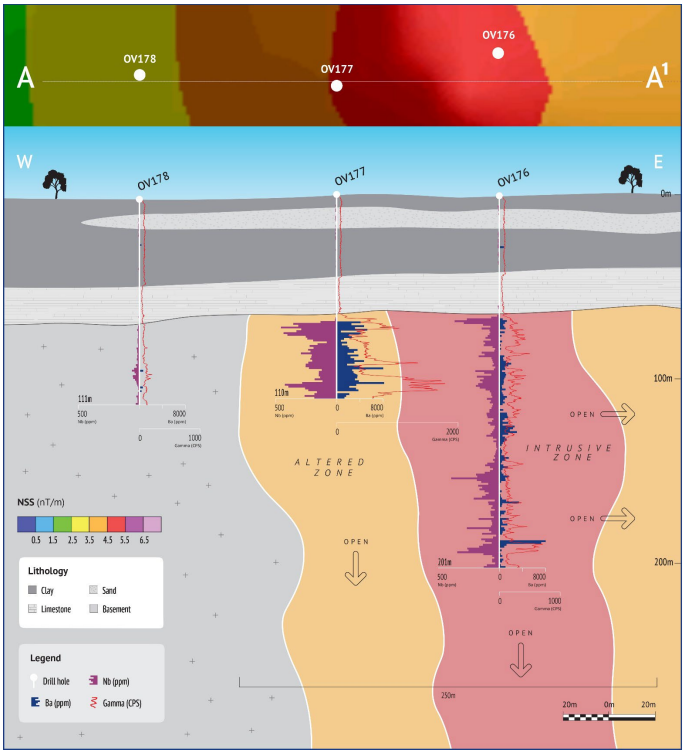
Figure 1: Cross-section through drill holes OV176, OV177 and OV178 showing the interpreted carbonatite geometry and associated alteration zones, together with downhole natural gamma and pXRF Nb and Ba responses. The upper panel shows the corresponding plan-view magnetic response and drill-hole locations along section A–A′. Refer to Figure 2 for the regional magnetic setting.¹
¹ In relation to the disclosure of pXRF results, the Company cautions that estimates of niobium and barium elemental abundance from pXRF results should not be considered a proxy for quantitative analysis of a laboratory assay result. Assay results are required to determine the actual widths and grade of the mineralisation. The company uses an Olympus Vanta M Series portable X-ray Fluorescence (pXRF). While pXRF confirms the presence of mineralisation, it does not accurately determine elemental concentrations due to limitations such as a small analysis window, uneven distribution, shallow penetration depth, and irregular surfaces. The pXRF results are indicative and the pXRF readings are subject to confirmation by chemical analysis from an independent laboratory.
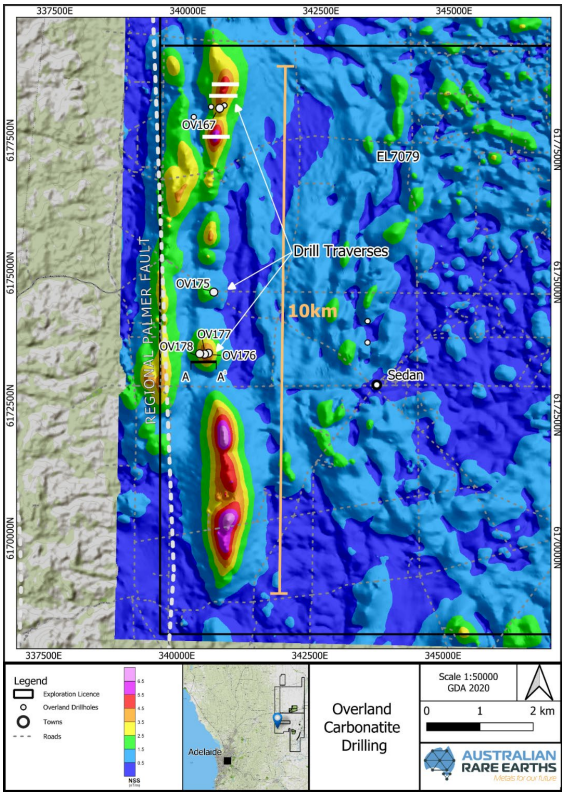
Figure 2: Overland magnetic imagery showing completed drill holes and the interpreted 10km carbonatite corridor.
Historic Target (R64) Validation at OV175
This hole, from approximately 58m depth encounted elevated gamma responses and alteration features consistent with a carbonatite source.
Importantly, the position of OV175 relative to the north-south trending magnetic feature at this location provides further support for using magnetic anomalies as an effective targeting mechanism across the broader corridor.
Emerging Evidence of a Large Carbonatite Complex
The proposed carbonatite intercept 5km south of the original discovery, combined with the strong correlation between drilling results and magnetic anomalies, gives increasing confidence that the 10km magnetic corridor reflects a substantial carbonatite intrusive system.
Drilling of the remaining traverses in the current program is still to be completed, with approximately one week of drilling remaining.
The Company considers that the Overland Project hosts a large carbonatite complex capable of extending over several kilometres.
Samples from completed drilling have been dispatched for analysis (the next key catalyst) and will define the distribution of rare earth elements, niobium and other critical minerals within the system.
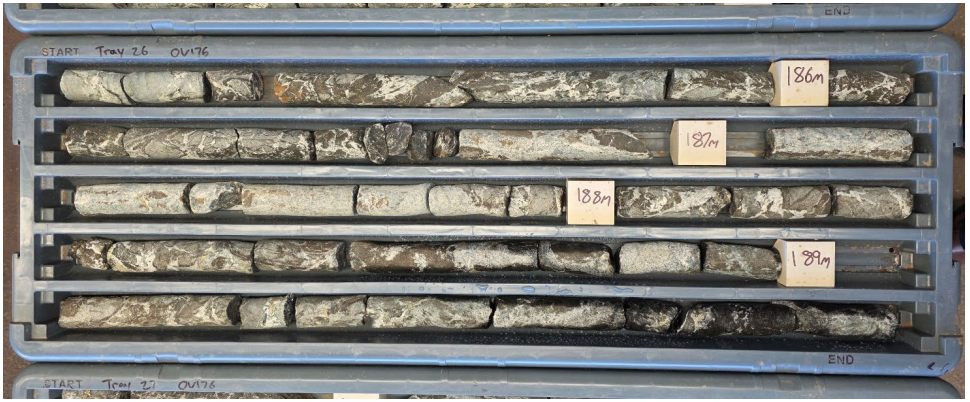
Figure 3: OV176 core (185m to 190m) showing pervasive carbonate veining, typical of carbonatites.
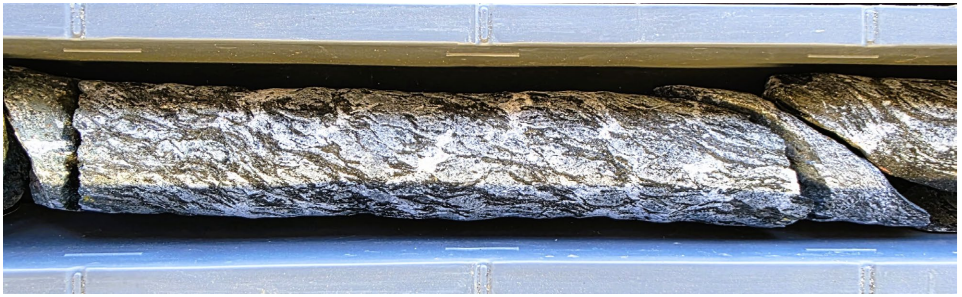
Figure 4: OV176 core (centred on 146.4m) showing strong foliation, brecciation, and metasomatic alteration.
Scientific Interest and Collaboration
The significance of AR3’s carbonatite discovery at Overland continues to attract interest from the geological and academic community.
Representatives from the ARC Training Centre for Future Critical Resources, Geological Survey of South Australia and Adelaide University recently visited the drill site to inspect core recovered from OV176.
AR3 is continuing to work closely with:
- Professor Carl Spandler, Deputy Director and Chief Investigator, ARC Training Centre for Future Critical Resources;
- Holly Cooke, PhD Researcher in Earth Sciences, Adelaide University; and
- Dr Adam Abersteiner, Researcher in the Australian Critical Minerals Research Centre at Adelaide University
- Representatives of the Geological Survey of South Australia.
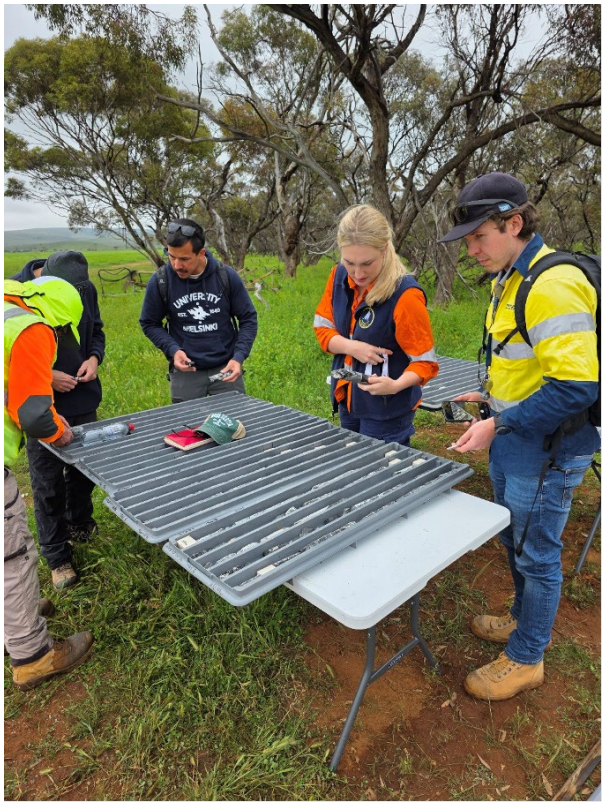
Figure 5: Professor Carl Spandler, Dr. Adam Abersteiner, Holly Cooke and Geological Survey of South Australia representative Mitchell Bockmann examining OV176 core.
Carbonatites are a globally rare rock type but host many of the world’s most significant rare earth and niobium deposits; context for the level of scientific interest in the discovery. Models that underpin critical minerals exploration strategies need to focus on new understanding of geological processes that control critical metal transport and concentration. Scientific research into these systems will assist in developing innovative models for formation of deposits as part of a continuum of magmatic and hydrothermal evolution from mantle to upper crust. Appropriately applied research will develop quantitative tools to enhance exploration programs.
The Company intends to continue these collaborations as geological, mineralogical and geochemical studies progress, with the objective of rapidly assessing the broader significance and economic implications of the emerging carbonatite system.
Based on the lithologies intersected to date and preliminary petrological observations, the Company’s current interpretation is that the mineralised system is carbonatite-related. This interpretation is supported by anomalous niobium and barium, characteristic lithological textures, and the system’s proximity to the Palmer Fault. The Company is also considering alternative models and additional studies will be able to advance our current understanding.
The announcement has been authorised for release by the Board of Australian Rare Earths Limited.
For further information please contact:
Australian Rare Earths Limited
Travis Beinke
Managing Director and CEO
T: 1 300 646 100
Media Enquiries
Jessica Fertig
Tau Media
E: [email protected]
Competent Person’s Statement
The information in this report that relates to Exploration results is based on information compiled by Australian Rare Earths Limited and reviewed The information in this report that relates to Exploration Results is based on, and fairly represents, information and supporting documentation compiled by Mr Chris Cockburn, who is a Member of the Australian Institute of Geoscientists (AIG). Mr Cockburn is an employee of Australian Rare Earths Limited and has sufficient experience that is relevant to the style of mineralisation and type of deposit under consideration and to the activity being undertaken to qualify as a Competent Person as defined in the 2012 Edition of the Australasian Code for Reporting of Exploration Results, Mineral Resources and Ore Reserves (JORC Code). Mr Cockburn consents to the inclusion in this report of the matters based on his information in the form and context in which they appear.
Forward-Looking Statements
This announcement contains forward-looking statements. Such statements are based on the Company’s current expectations and are subject to risks and uncertainties. Actual results may differ materially from those expressed or implied. Reference to the Simandl & Paradis (2018) paper is for contextual exploration modelling purposes only.
About Australian Rare Earths Limited
Australian Rare Earths (AR3) is a diversified critical minerals company, strategically positioned to meet the growing global demand for uranium and rare earth elements:
- AR3’s Koppamurra Rare Earths Project in South Australia and Victoria is a significant deposit of light and heavy rare earths, which has secured important Australian government support through a $5 million grant to accelerate development. With support from global advanced industrial materials manufacturer, Neo Performance Materials, AR3 is progressing towards commercialisation with a Pre-Feasibility Study, Maiden Ore Reserves and a pilot scale facility, solidifying its role as a potential source of new supply to diversify global rare earth feedstocks for the clean energy transition.
- AR3’s large ~8,000 km² Overland Uranium Project in South Australia shows strong uranium discovery potential, with initial drilling identifying opportunities for substantial near-surface and deeper deposits.
With strategic projects and strong government support, AR3 is well placed to capitalise on significant growth in the critical minerals market.