Spartan Metals Expands Past-Producing Tungstonia Mine Mineralization Footprint More Than 13-Fold, Defining 5.7 km2 of Tungsten-Silver Veins with Assays up to 5.18% WO3
July 16, 2026 (Source) — Spartan Metals Corp. (TSXV: W) (OTCQB: SPRMF) (FSE: J03) (“Spartan” or the “Company“), an exploration and development company focused on tungsten and critical minerals in the western United States, is pleased to announce assay results from recent sampling conducted within its Tungstonia Claims at its 100% owned Eagle Project, Nevada (Figure 1).
Highlights:
- 8 confirmed tungsten-silver veins over a total area of approximately 2.7 kilometers (“km”) by 2.1 km (~5.7 km2) and have a cumulative surface strike length of approximately 6.8 km (Table 1 and Figure 3) which represents an approximate 13x increase in defined mineralization since Spartan acquired the Eagle Project in July 2025 (Figures 2 and 3)
- Vein 4 has been extended 400 meters (“m”) southward along strike by rock samples 5.18% WO3 to a total confirmed length of approximately 1.1 km
- New vein (“Spartan C”) confirmed between Veins A and B at approximately 700 m length (Figures 2 and 3) with rock samples of 3.67% and 2.72% WO3
- Spartan B Vein has been extended 530 m with rock samples of 1.82% and 2.43% WO3 to a total confirmed length of approximately 700 m (Figures 2 and 3)
- Spartan A Vein has been extended approximately 500 m via alteration mapping coinciding with tungsten in soil anomaly (Figures 2 and 3)
- Approximately 50% of Tungstonia Claims remain to be explored
Table 1 Tungstonia vein system strike length
| Vein ID | Approximate exposed surface length (km) | Approximate width (m) |
| Vein 1 | 2.5 | 1 to 3 |
| Vein 2 | 0.2 | 1 |
| Vein 3 | 1.0 | 1 |
| Vein 4 | 1.1 | 1 to 2 |
| Vein 5 | 0.1 | 1 |
| Spartan A | 0.5 | Unknown |
| Spartan B | 0.7 | Unknown |
| Spartan C | 0.7 | Unknown |
| All veins strike between N10E to N20E and dip 50 to 65 degrees east. True widths are reported where known | ||
Brett Marsh, Spartan’s President and CEO, stated, “When Spartan acquired the Eagle Project in July 2025, the known extent of mineralization at Tungstonia covered an area of approximately 750 meters by 550 meters. Our 2025 and 2026 field programs have now defined eight tungsten-silver veins across an exploration footprint measuring approximately 2.7 kilometres by 2.1 kilometers-an increase of more than 13-fold-with a cumulative exposed surface strike length of approximately 6.8 kilometers.”
Mr. Marsh continued, “What is most encouraging to us is that the mineralized system continues to grow each time our team returns to the field. We are not simply extending a single known vein; we are identifying additional structures and seeing strong tungsten assays recur across multiple targets. This is giving us a much clearer picture of how mineralization is distributed across Tungstonia and reinforces the effectiveness of the exploration approach our team has taken.”
Mr. Marsh, concluded, “Geophysical surveys are concluding and core drilling is starting in mid-August, which will help evaluate the lateral and depth continuity, geometry and relationship of the vein and skarn targets. Equally compelling is that approximately 50% of the Tungstonia claim block remains to be explored. The combination of multiple tungsten-silver veins, strong tungsten and silver surface assays, extensive tungsten- and silver-in-soil anomalies and confirmed skarn mineralization that appears to surround the vein system provides Spartan with a substantial and growing inventory of exploration targets. The continued expansion of the defined surface footprint reinforces our confidence in Tungstonia and further strengthens the district-scale exploration potential of the Eagle Project.”
The samples were collected as part of the exploration program announced on May 21, 2026 with results listed in Table 2. The veins are relatively linear and range in thickness from approximately 0.5 m to 3 m. Veins 3, 4, and 5 occur as sheets or swarms of the thinner veins over approximately 50-60 m in width. Spartan A, B, and C veins occur in a similar geometry (Figure 4). Figure 5 shows typical huebnerite quartz mineralization at Spartan B and C Veins with Spartan C Vein prominent in sampling. Figure 6 shows large huebnerite crystals from Vein 4.
Significance of Recent Exploration
These results indicate that significant tungsten-silver mineralization potentially extends well beyond the past producing Tungstonia mine area. Spartan has now confirmed at least eight tungsten-silver veins with a cumulative surface strike length of approximately 6.8 kilometres across a mineralized footprint more than 13 times larger than was known when the Eagle Project was acquired. Assays of up to 5.18% WO₃ demonstrate that notable tungsten values occur along multiple structures, including areas away from the historic workings. With approximately half of the Tungstonia claims still unexplored, the expanded footprint provides a broader foundation for geophysical surveys and drilling designed to evaluate the continuity and geometry of mineralization at depth. The rock samples are individual results and should not be considered representative of average grade, tonnage or economic viability.
The results are particularly relevant given the concentration of global tungsten supply. The U.S. Geological Survey estimates that China accounted for nearly 80% of global mine production in 2025, while the United States has recorded no commercial tungsten mine production since 2015 and remains more than 50% reliant on imports1. China’s introduction of export controls on selected tungsten products in 2025 coincided with significant increases in international tungsten prices, underscoring the strategic importance of identifying potential domestic sources. In this context, the expanding tungsten footprint at Eagle strengthens the project’s relevance to U.S. critical-mineral supply objectives.
Next Steps
Spartan will continue to execute its 2026 exploration program as discussed in the May 21, 2026, announcement including:
- Continued surface sampling of soils and rocks – including backpack drilling – over claims acquired in November 2025 to potentially extend previously identified tungsten, silver, and rubidium soil anomalies at the Tungstonia.
- Continued rock sampling and backpack core drilling at the Rees Claims to cover the past producing Rees Tungsten and Antelope Mine areas.
- Evaluation of a geophysics program for the Rees Claims.
- Evaluation of establishing safe entry for all past operating mines at the Eagle Project.
- In Process: Ground geophysics surveys at the Tungstonia Claims to inform depths of existing 2+ km tungsten-silver veins and potential tungsten skarn mineralization that is coincident with tungsten-silver-rubidium soil anomalies and at Yellow Jacket.
- Early to mid-August: Approximately 3,000 (m) diamond core drilling at high priority targets identified through surface sampling and geophysics surveys at the Eagle Project.
Table 2 Sample results from Tungstonia (widths as reported, true widths are not yet known)
| Vein ID | Sample ID | WO3% | Ag (g/t) | Comments |
| Spartan A | 202600011 | 0.23 | 56.0 | Drill core sample from hole STS-26-004 1.3 m to 1.5 m (0.2 m interval) |
| Spartan B | TS-2026-001 | 1.82 | 72.5 | Rock chip sample |
| Spartan B | AG-RK-GA-064 | 2.43 | 8.9 | Rock chip sample |
| Spartan C | TS-2026-003 | 2.72 | 28.1 | Rock chip sample |
| Spartan C | AG-RK-GA-063 | 3.67 | 19.0 | Rock chip sample |
| Spartan C | 202600012 | 0.57 | 9.2 | Drill core sample from hole STS-26-005 0 m to 0.8 m (0.8 m interval) |
| Vein 1 | TS-25003 | 1.97 | 12.5 | Rock chip sample |
| Vein 1 | TS-25008 | 1.43 | 12.0 | Rock chip sample |
| Vein 1 | TS-25011 | 1.14 | 6.0 | Rock chip sample |
| Vein 2 | TS-25001 | 1.36 | 308.0 | Rock chip sample |
| Vein 2 | TS-25002 | 1.88 | 31.9 | Rock chip sample |
| Vein 2 | AG-RK-GA-098 | 1.49 | 50.5 | Rock chip sample |
| Vein 3 | TS-25005 | 2.37 | 9.6 | Rock chip sample |
| Vein 3 | TS-25006 | 1.54 | 0.9 | Rock chip sample |
| Vein 4 | TS-2026-005 | 5.18 | 3.2 | Rock chip sample |
| Vein 4 | AG-RK-GA-103 | 0.61 | 31.2 | Rock chip sample |
| Float | TS-2026-004 | 5.63 | 8.5 | Float from Vein 3 or 4 |
| Unconfirmed Vein | AG-RK-GA-067 | 1.67 | 116.0 | Rock chip sample |
| Unconfirmed Vein | AG-RK-GA-095 | 0.66 | 51.1 | Rock chip sample |
Rock chip samples were taken by hand with rock hammer across veins to obtain an approximate 1.5 – to 2-kilogram sample. 2 – 4 centimeter (“cm”) sized rock fragments are preferred; however, 7-10 cm sized fragments are collected when the associated crystal sizes are larger than the nominal 2 – 4 cm preferred size. Rock chip samples by their nature are selected samples and may not represent the underlying mineralization.
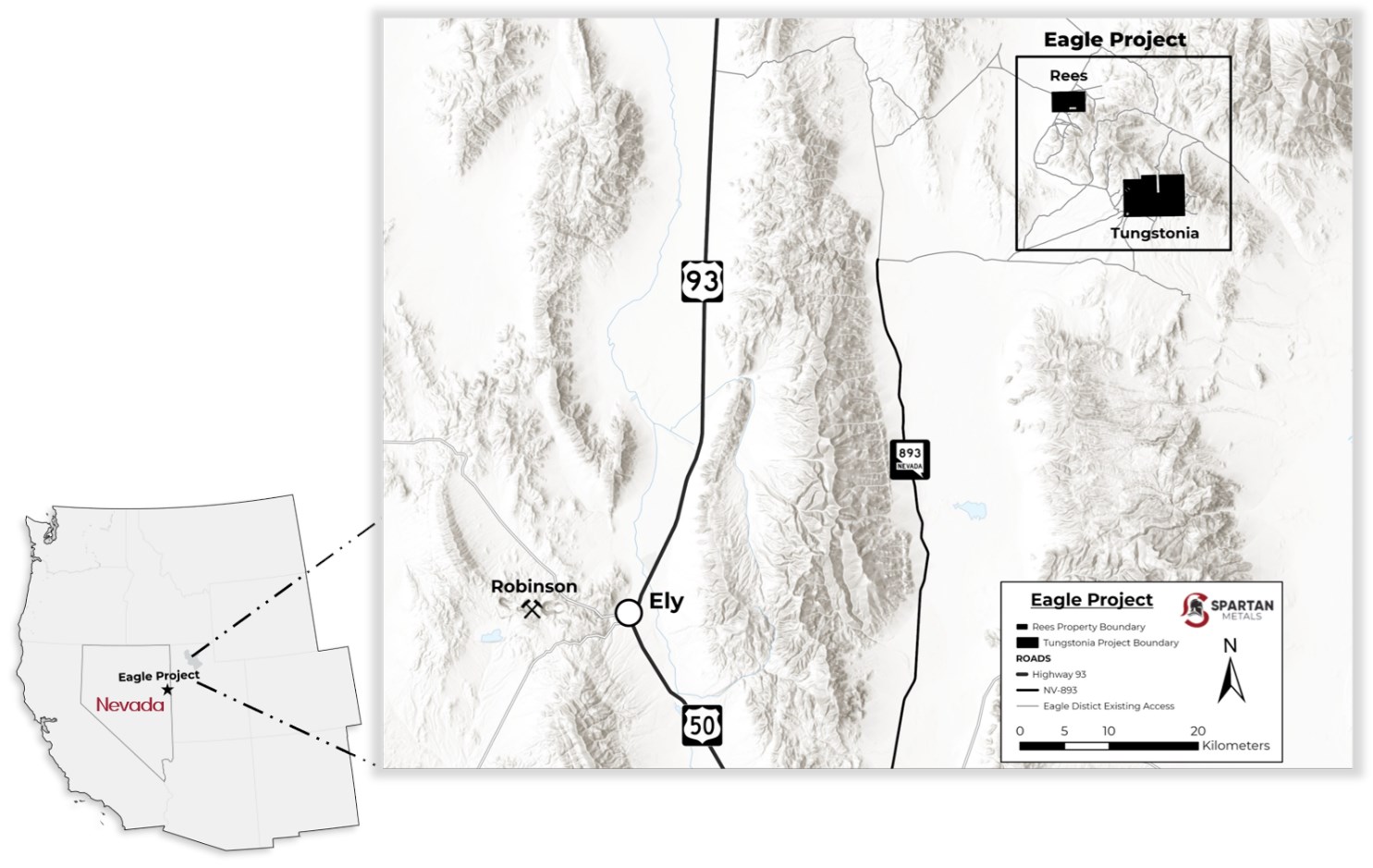
Figure 1 Location map for the Eagle Project showing the Rees and Tungstonia claims
To view an enhanced version of this graphic, please visit:
https://images.newsfilecorp.com/files/12484/305376_be8d417204efeb0e_001full.jpg
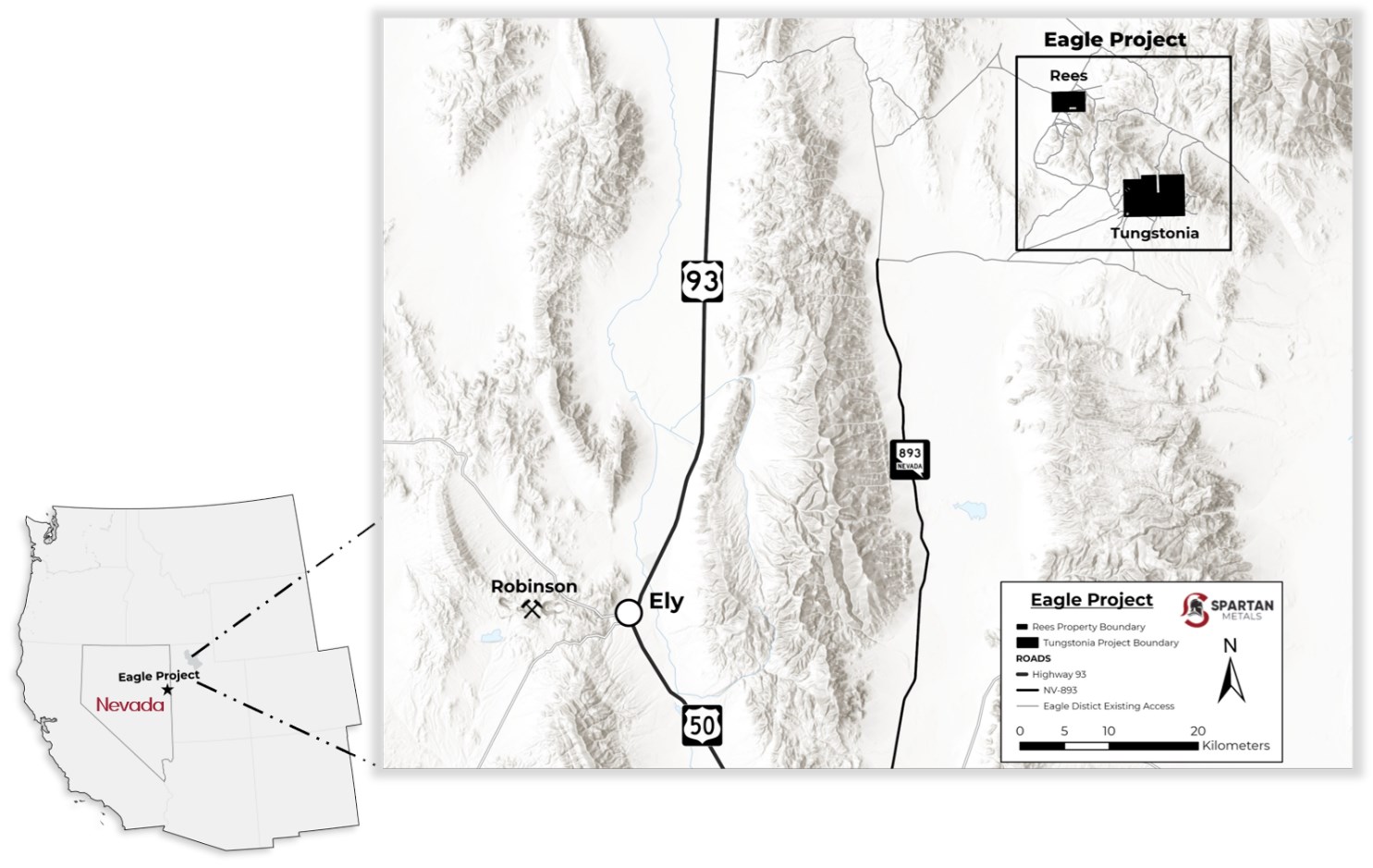
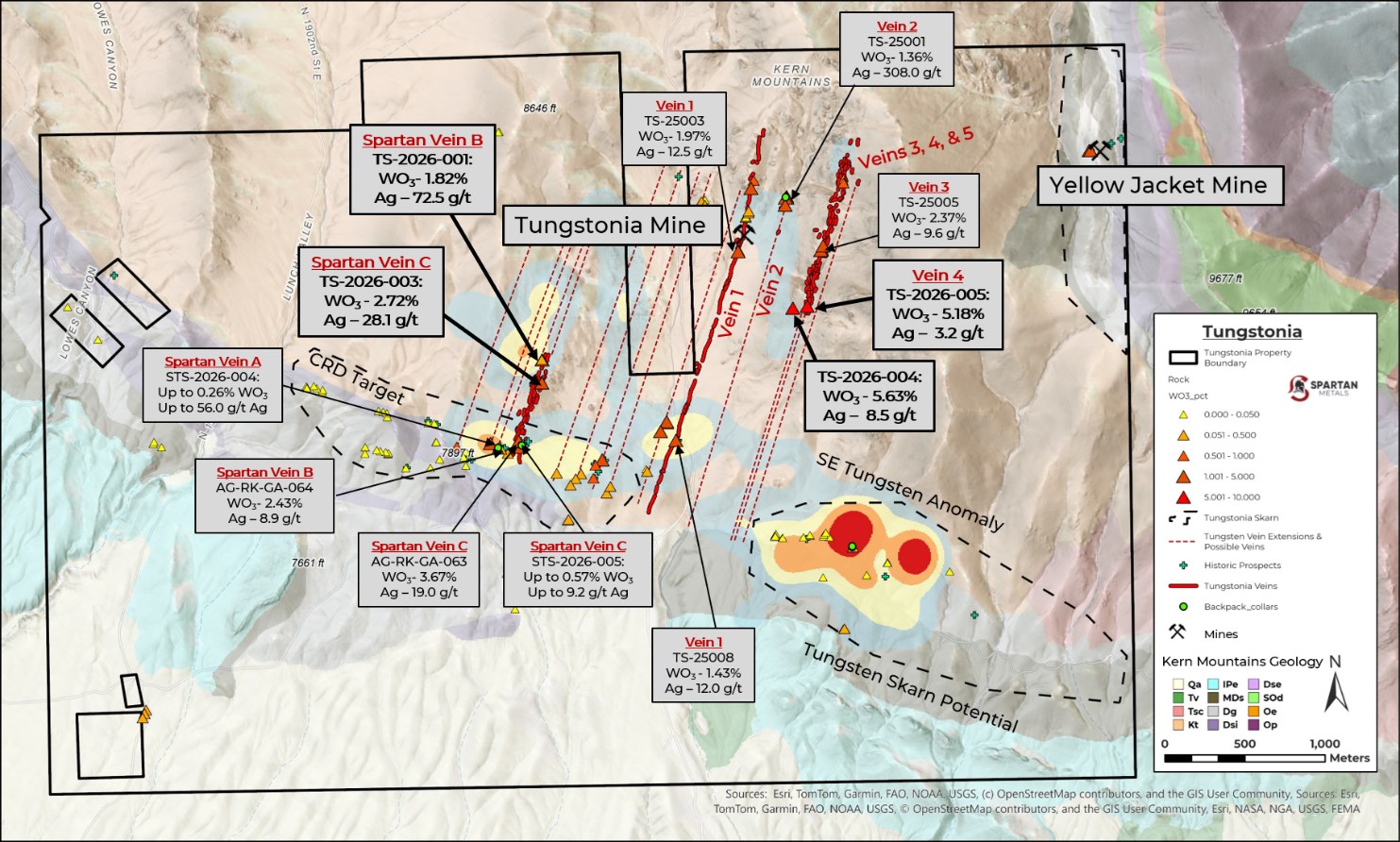
Figure 2 The Tungstonia claim block showing 2024 and 2025 tungsten rock chip with 2025 soil results shown as heat map contours. 2026 backpack drilling program locations shown in green. Newly discovered Spartan A, B, and C veins are approximately 1.1 km west of Vein 1.
To view an enhanced version of this graphic, please visit:
https://images.newsfilecorp.com/files/12484/305376_be8d417204efeb0e_002full.jpg
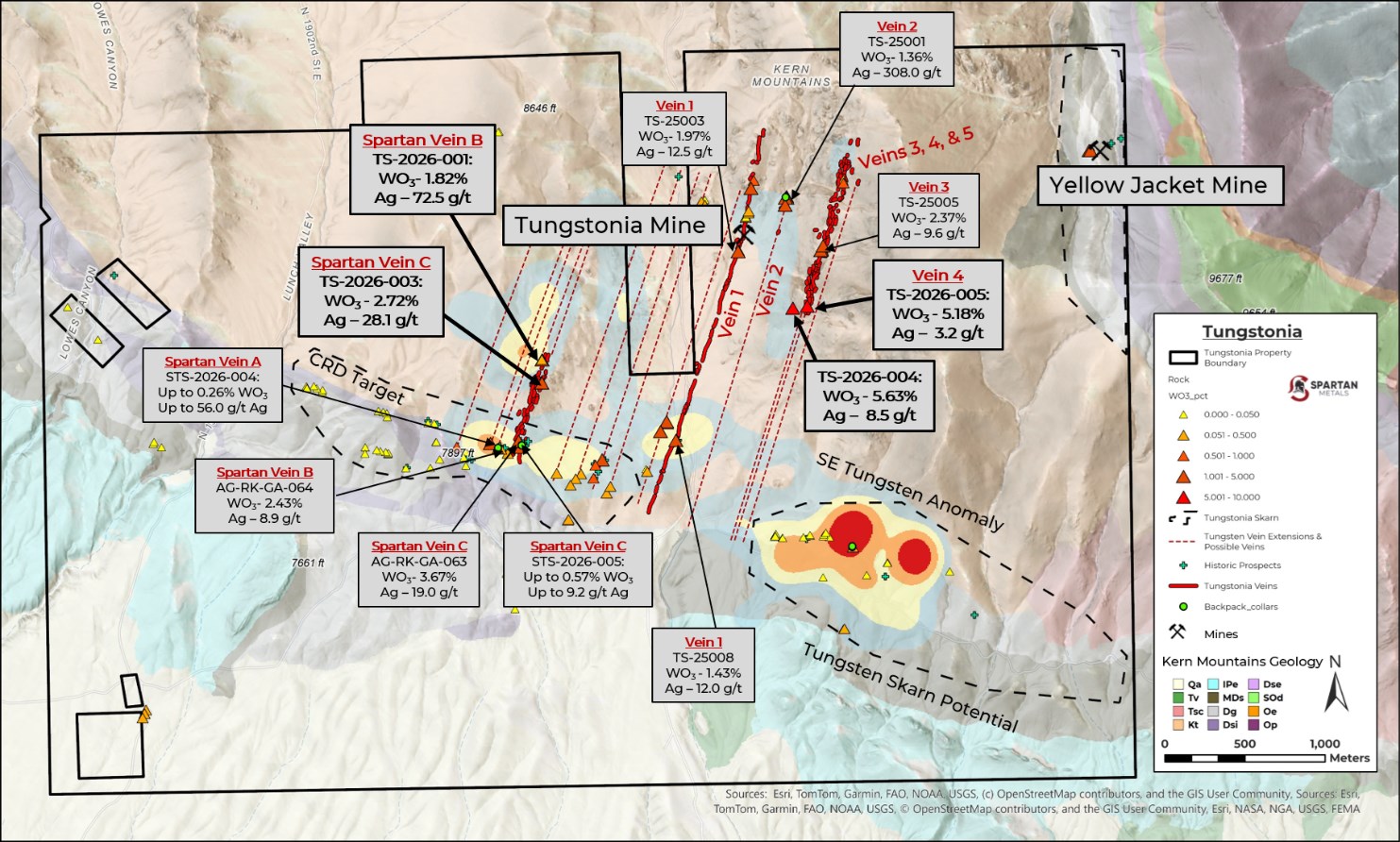
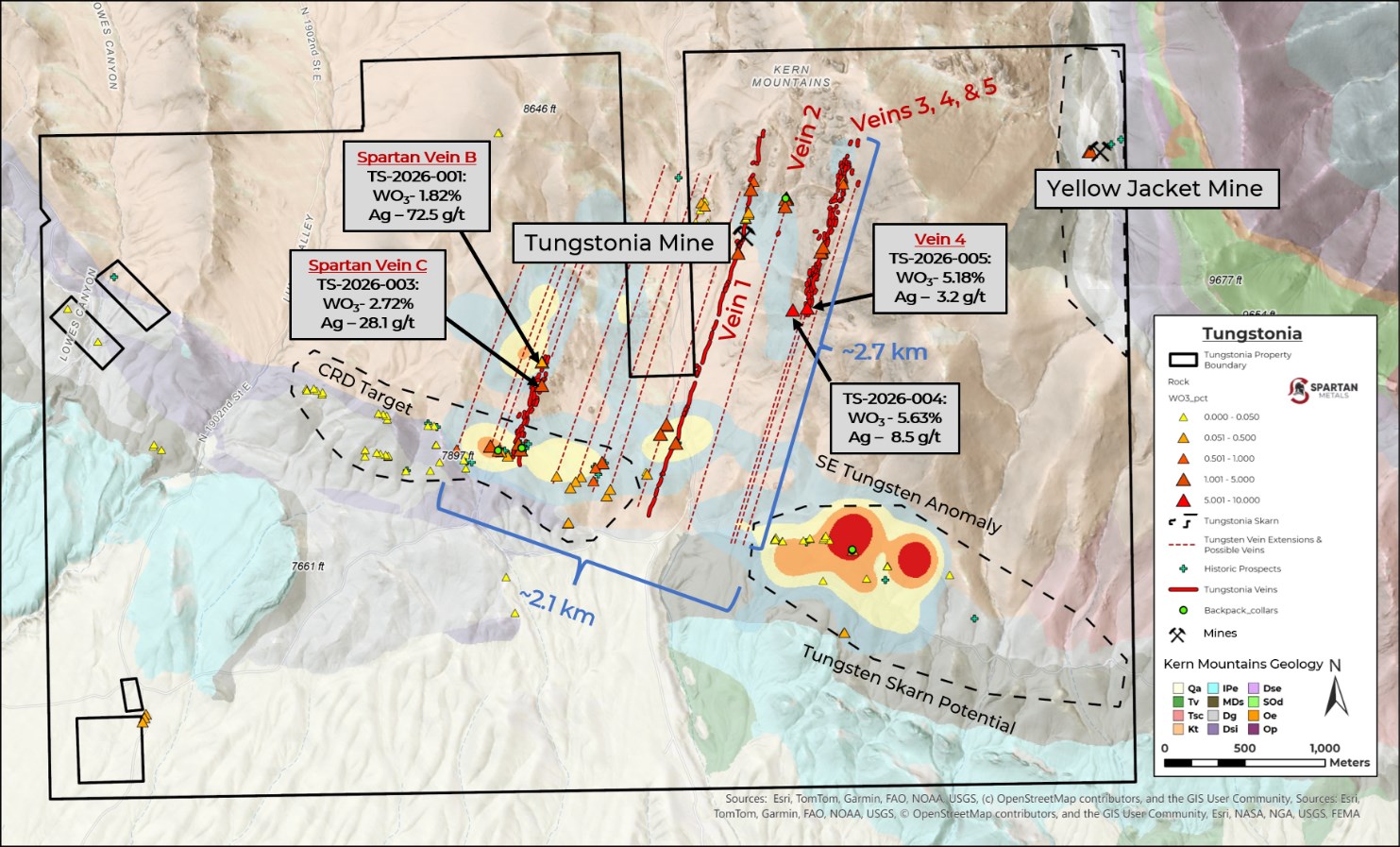
Figure 3 The Tungstonia Claim block showing the length and width of tungsten-silver vein and tungsten skarn mineralization. ~2.7 km by 2.1 km. Significant expansion over previously known veins system.
To view an enhanced version of this graphic, please visit:
https://images.newsfilecorp.com/files/12484/305376_be8d417204efeb0e_003full.jpg
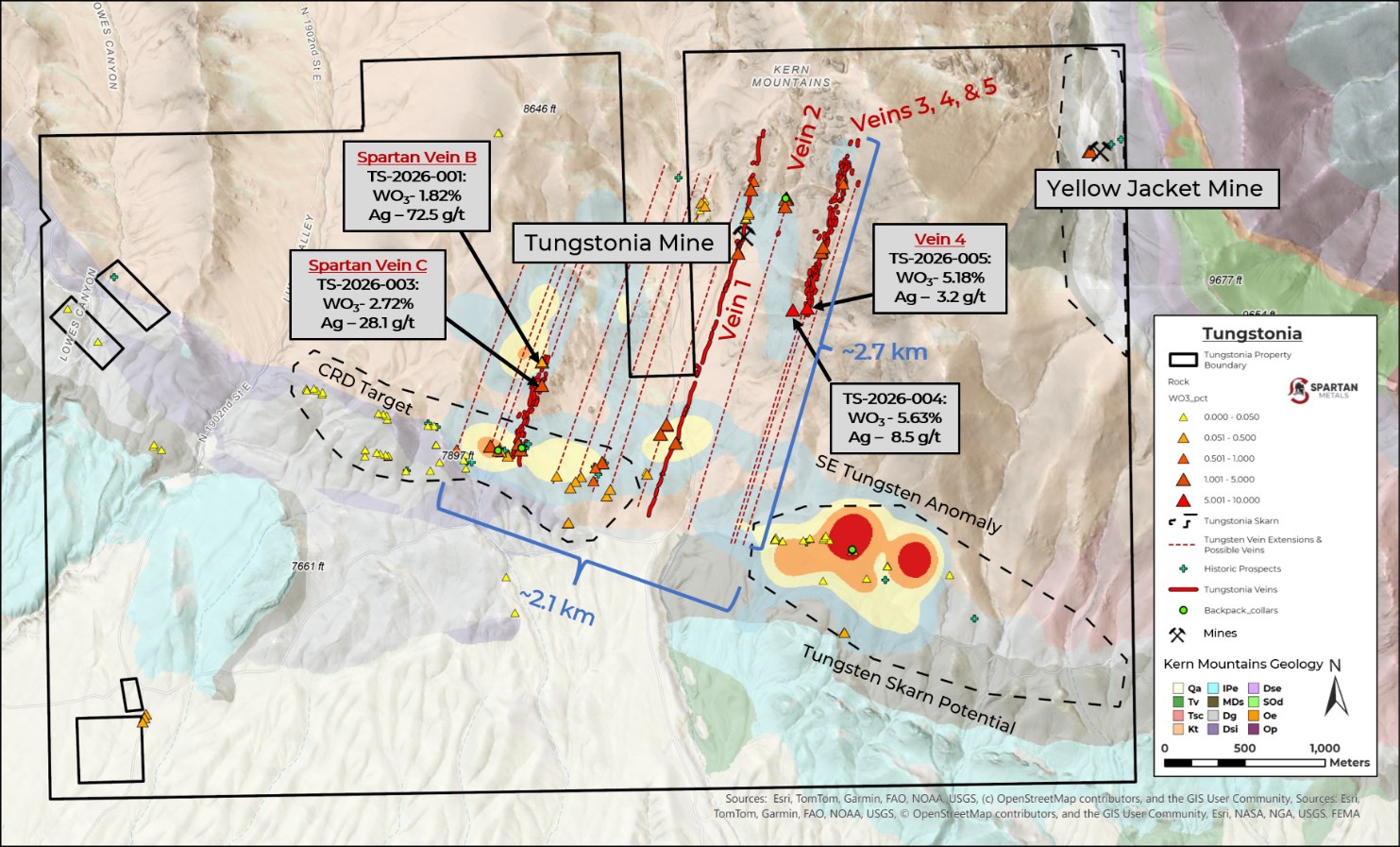
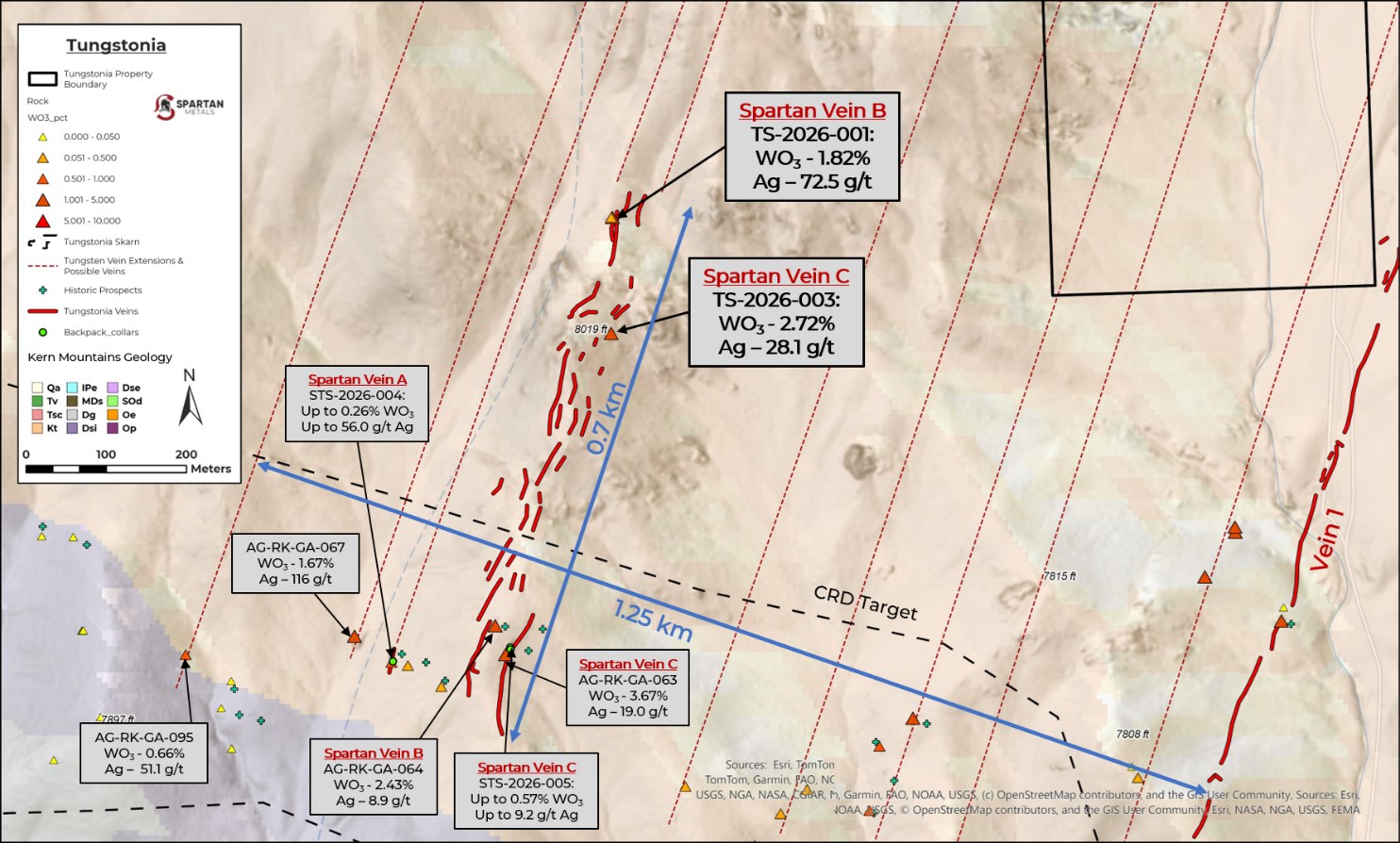
Figure 4 Spartan A, B, and C veins occurring as sheets or swarms of 0.5m veins over an area of approximately 50 m x 700m.
To view an enhanced version of this graphic, please visit:
https://images.newsfilecorp.com/files/12484/305376_be8d417204efeb0e_004full.jpg
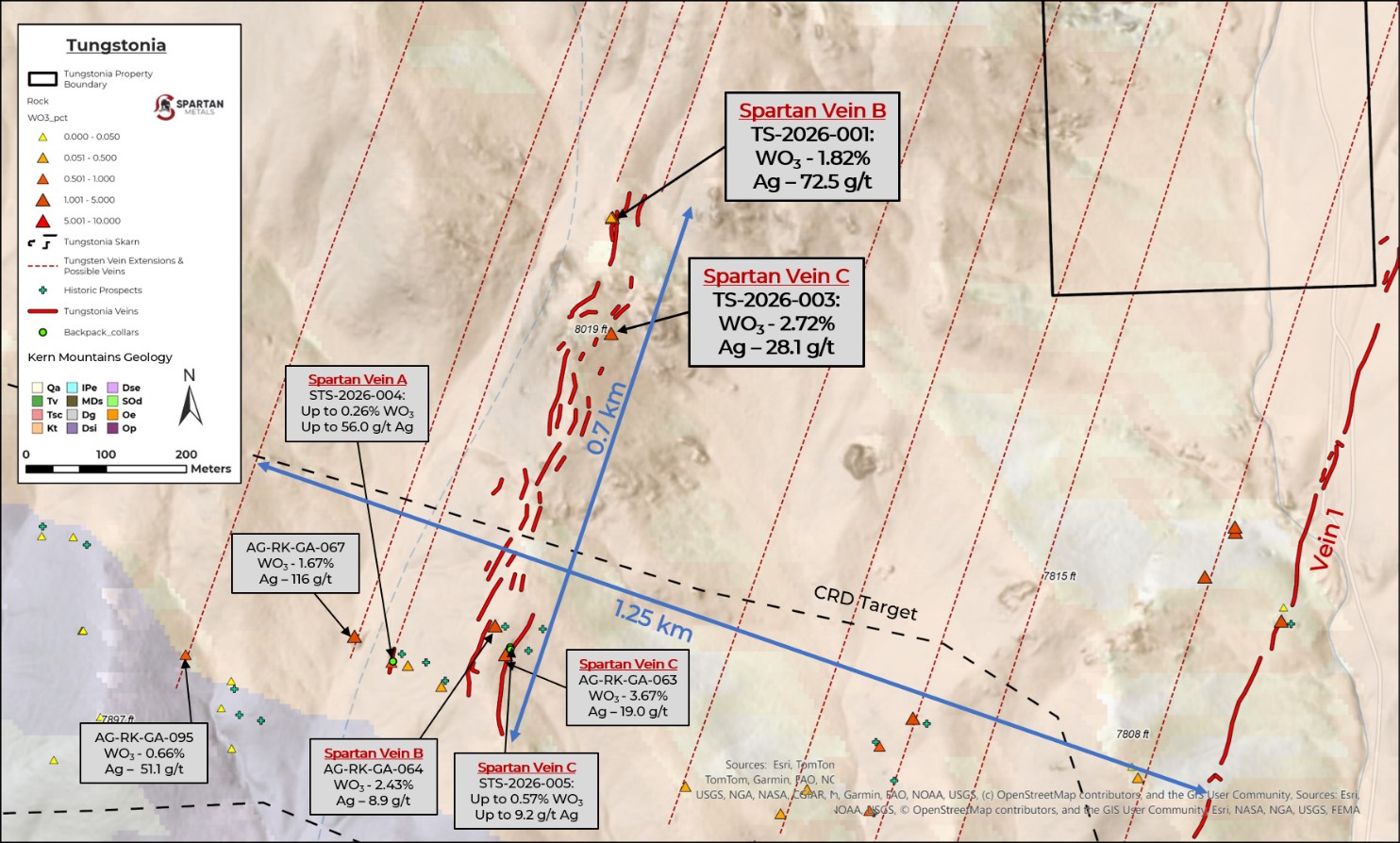
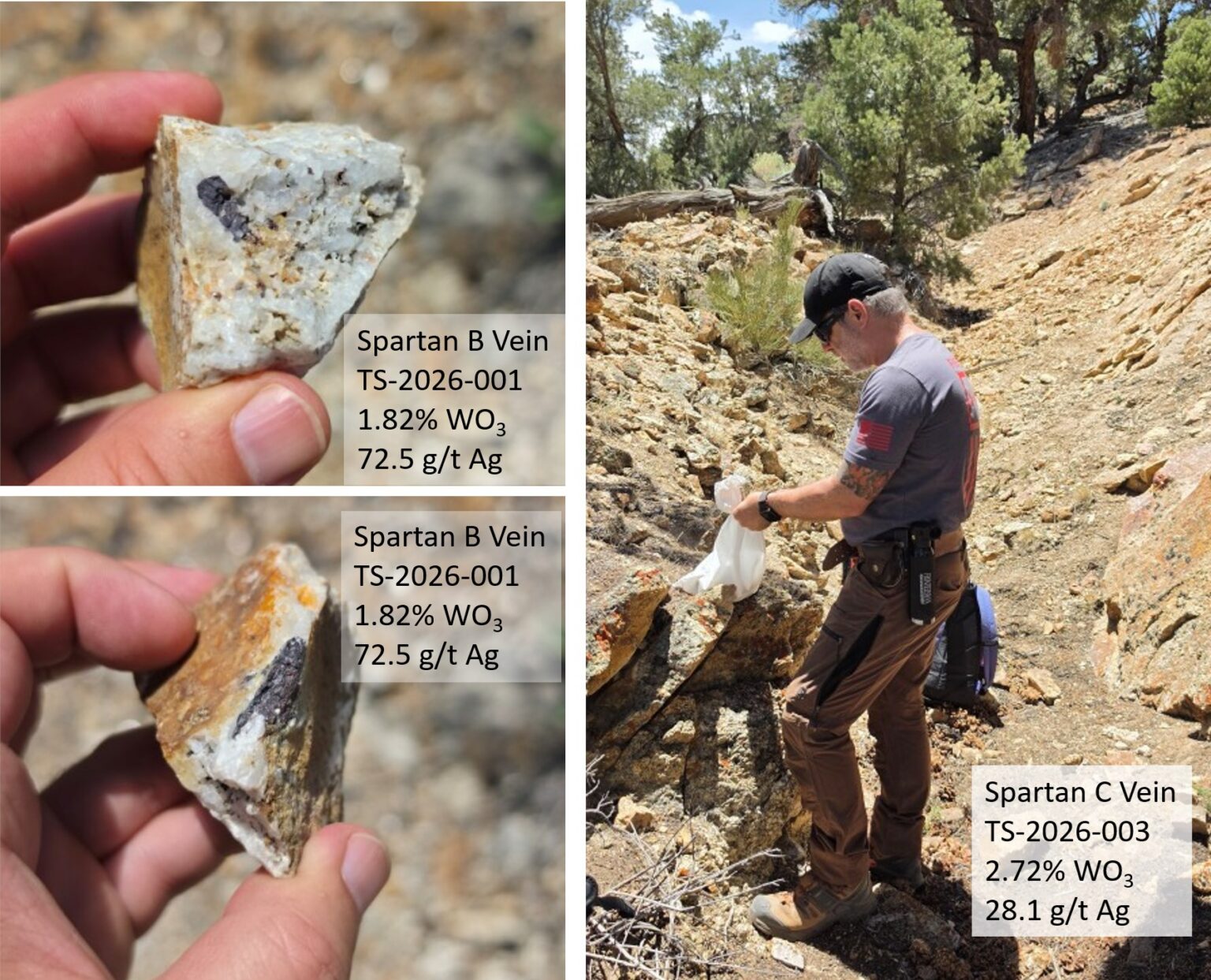
Figure 5 Spartan B and C Vein field samples showing 1-2-centimeter (cm) huebnerite crystals in quartz. Sample bag is sitting on quartz-huebnerite vein at Vein C.
To view an enhanced version of this graphic, please visit:
https://images.newsfilecorp.com/files/12484/305376_be8d417204efeb0e_005full.jpg
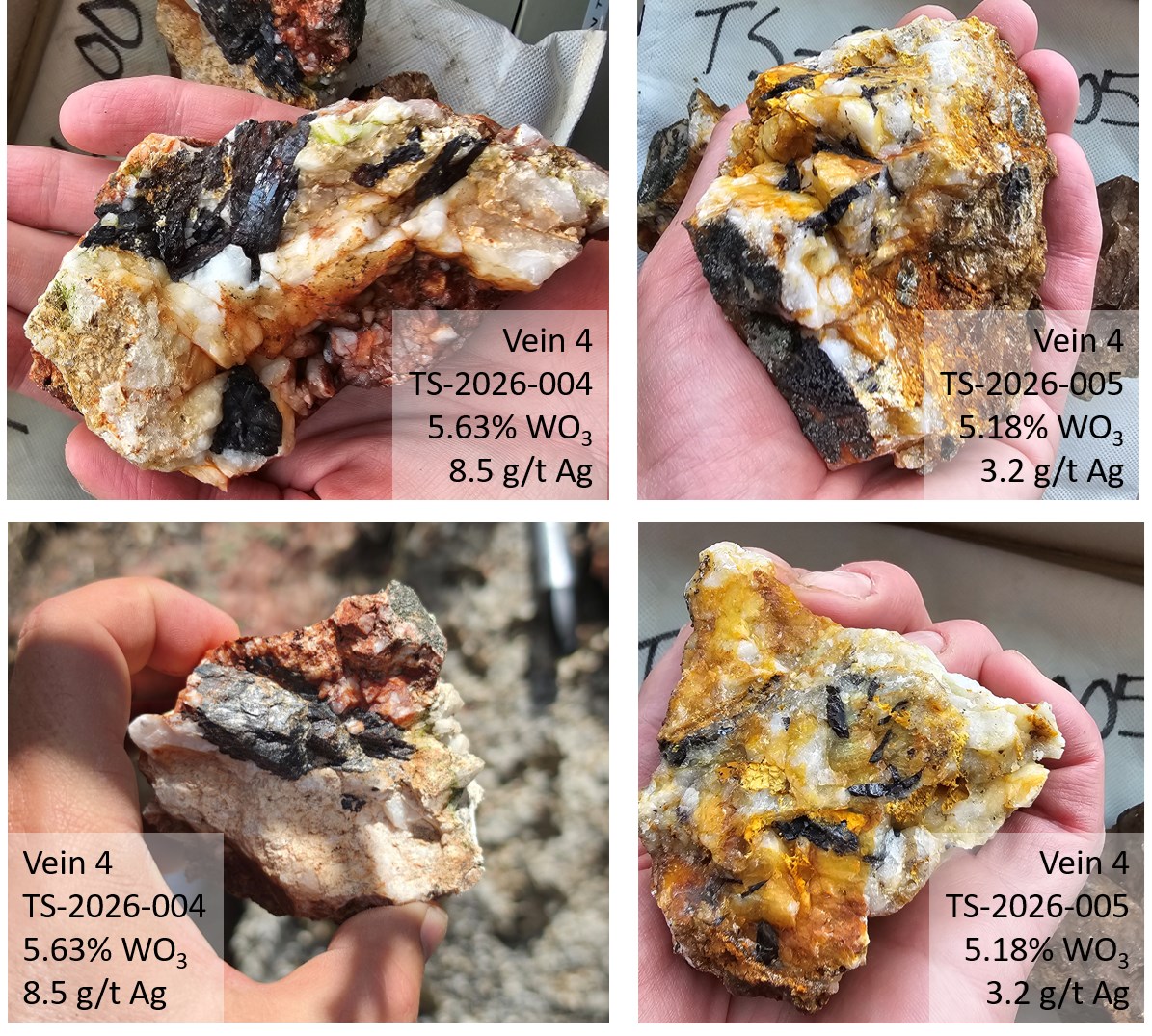
Figure 6 Vein 4 field samples showing 4-6 cm by 3 cm huebnerite crystals in a quartz vein matrix. TS-2026-004 was a float sample collected approximately 70m down slope from outcrop sample TS-2026-005.
To view an enhanced version of this graphic, please visit:
https://images.newsfilecorp.com/files/12484/305376_be8d417204efeb0e_006full.jpg
QA/QC Procedures
Samples were submitted to American Assay Lab (AAL) of Sparks, Nevada, which is a certified and accredited laboratory, independent of the Company. Samples are prepared using industry standard-prep methods and analyzed using method IM-4AB52 (52 element suite: 0.5g 4-acid plus boric acid hot block, ICP-OES + MS plus IO-NFEx [Sodium Peroxide Fusion, ICP-OES] for W over 500ppm). AAL undertakes its own internal coarse and pulp duplicate analysis to ensure proper sample preparation and equipment calibration. Spartan’s QAQC includes regular insertion of CRM standards, duplicates, and blanks with a stringent review of results completed by the Company’s Qualified Person, Brett R. Marsh, President and CEO of Spartan Metals.
Qualified Person Statement
The technical information contained in this news release has been prepared under the supervision of, and approved by Brett R. Marsh, CPG. Mr. Marsh is President and CEO of Spartan Metals Corp. and a “qualified person” as defined under National Instrument 43-101 – Standards of Disclosure for Mineral Projects.
References
1 https://pubs.usgs.gov/periodicals/mcs2026/mcs2026-tungsten.pdf
2 Nevada Bureau of Mines and Geology, 1988, Bulletin 105 p213-217
About The Eagle Project
The Eagle Project presents a unique opportunity to delineate one of the largest and highest-grade Tungsten (“W”) and Rubidium (“Rb”) districts in the United States. The Project consists of the past-producing2 high-grade Tungstonia, Yellow Jacket, and Rees/Antelope tungsten (W-Cu-Ag) mines. Operations at these mines were from 1915 to 1942 with intermittent small-scale production occurring until 1956. Tungsten production from these mines totaled 8,379 units at grades between 0.6%-0.9% WO3
The Project is ~36.5 km² in size and located approximately 120 kilometers northeast of the town of Ely, in the Kern Mountains of White Pine County, Nevada. The Project covers 9,033 acres consisting of 445 Bureau of Land Management (BLM) unpatented lode mining claims.
Three deposit types are present at Eagle; Porphyry, Skarn, and Carbonate Replacement (CRD) that contain significant or anomalous grades of Tungsten (W), Silver (Ag), and Rubidium (Rb) plus Cu-Sb±Au-Pb-Zn-Bi-As across three project focus areas that also includes the potential to recover W-Rb-Ag from the legacy Tungstonia Mill Tailings.
About Spartan Metals Corp.
Spartan Metals is focused on developing critical minerals projects in well-established and stable mining jurisdictions in the Western United States, with an emphasis on building a portfolio of diverse strategic defense minerals such as Tungsten, Rubidium, Antimony, Bismuth, and Arsenic.
Spartan’s high quality project portfolio includes an option to earn 100% of the Victorio Tungsten-Molybdenum Project in New Mexico and the 100% owned Eagle Tungsten-Silver-Rubidium Project in Nevada. Victorio hosts the largest tungsten resource in the United States and contains significant concentrations of beryllium and fluorspar, while the Eagle Project consists of the highest-grade historic tungsten resource in the USA which includes significant under-defined resources consisting of: high-grade silver; rubidium; antimony; bismuth; indium; as well as precious and base metals, and more information about Spartan Metals can be found at www.SpartanMetals.com.
On behalf of the Board of Spartan
“Brett Marsh”
President, CEO & Director
Further Information:
Brett Marsh, M.Sc., MBA, CPG
President, CEO & Director
1-888-535-0325
[email protected]
Jeff Walker
VP, The Howard Group
403-221-0915
[email protected]
Neither the TSX Venture Exchange nor its Regulation Service Provider (as that term is defined in the policies of the TSX Venture Exchange) accepts responsibility for the adequacy or accuracy of this press release
Forward-Looking Statements
This news release contains statements that constitute “forward-looking statements.” Such forward-looking statements involve known and unknown risks, uncertainties and other factors that may cause the Company’s actual results, performance or achievements, or developments in the industry to differ materially from the anticipated results, performance or achievements expressed or implied by such forward-looking statements. Forward-looking statements are statements that are not historical facts and are generally, but not always, identified by the words “expects,” “plans,” “anticipates,” “believes,” “intends,” “estimates,” “projects,” “potential” and similar expressions, or that events or conditions “will,” “would,” “may,” “could” or “should” occur. Forward-Looking Information in this news release, Spartan has applied several material assumptions, including, but not limited to, assumptions that: the current objectives concerning the Company’s projects can be achieved and that its other corporate activities will proceed as expected; that general business and economic conditions will not change in a materially adverse manner; and that all requisite information will be available in a timely manner.
Although the Company believes the forward-looking information contained in this news release is reasonable based on information available on the date hereof, by their nature forward-looking statements involve known and unknown risks, uncertainties and other factors which may cause our actual results, performance or achievements, or other future events, to be materially different from any future results, performance or achievements expressed or implied by such forward-looking statements. By their nature, these statements involve a variety of assumptions, known and unknown risks and uncertainties and other factors, which may cause actual results, levels of activity and achievements to differ materially from those expressed or implied by such statements.
Examples of such assumptions, risks and uncertainties include, without limitation, assumptions, risks and uncertainties associated with general economic conditions; adverse industry events; future legislative and regulatory developments; the Company’s ability to access sufficient capital from internal and external sources, and/or inability to access sufficient capital on favorable terms; the ability of the Company to implement its business strategies; competition; the ability of the Company to obtain and retain all applicable regulatory and other approvals and other assumptions, risks and uncertainties.
THE FORWARD-LOOKING INFORMATION CONTAINED IN THIS NEWS RELEASE REPRESENTS THE EXPECTATIONS OF THE COMPANY AS OF THE DATE OF THIS NEWS RELEASE AND, ACCORDINGLY, IS SUBJECT TO CHANGE AFTER SUCH DATE. READERS SHOULD NOT PLACE UNDUE IMPORTANCE ON FORWARD-LOOKING INFORMATION AND SHOULD NOT RELY UPON THIS INFORMATION AS OF ANY OTHER DATE. WHILE THE COMPANY MAY ELECT TO, IT DOES NOT UNDERTAKE TO UPDATE THIS INFORMATION AT ANY PARTICULAR TIME EXCEPT AS REQUIRED IN ACCORDANCE WITH APPLICABLE LAWS.