Top 5 Graphite Companies—Licence to Drill: A 00-Element Briefing on the James-Bond-Worthy Metal Behind Tomorrow’s Arsenal

I blame the hotel notepad. Somewhere between a second coffee and a boarding-gate ping, the scratch of HB-2 graphite set off a chain reaction of economic angst. We rank rare earths like pop-stars, lithium like a meme stock, and nickel like a geopolitical football, yet our humble “pencil lead” gets only the occasional cameo. The paradox? Graphite appears on 11 of the 12 national critical-mineral lists tracked by the Critical Minerals Institute (CMI), and the United States imports 100% of its supply—nearly half straight from China.

So, dear reader, sharpen your metaphorical pencil: we are overdue for a graphite spotlight. Below, meet five Western-listed pure-players fighting to pry open a supply chain long welded shut in Heilongjiang and Inner Mongolia. Then we’ll explore why every defence planner worth her Pentagon badge keeps graphite in the same sentence as hypersonic glide vehicles—and why NATO just enshrined it alongside cobalt and lithium on its first-ever defence-critical list.

Below is an updated snapshot of the five graphite pure-plays ranked by market-cap as on 9 July 2025.

(1) Syrah Resources Limited(ASX: SYR)
Market-cap math can be fickle (≈ US$182 million as of 9 July 2025), but Syrah’s strategic heft is anything but. It’s Balama mine in Mozambique can ship 350,000 t/y—enough flake to feed half the world’s ex-China anode demand. Yet the real coup sits 14,000 kilometres west in Vidalia, Louisiana, where North America’s first commercial 11.25 kt/y Active Anode Material (AAM) line came online in February 2024, backed by a US$102 million DOE loan and a US$165 million IRA tax credit.
A four-year offtake funnels the bulk of that AAM to Tesla’s Austin Gigafactory, with an option to triple volumes (to 45 kt/y) post-FID. Lucid Motors signed on this January, and Korean cell makers are eyeing the next tranche. Balama’s occasional insurgent unrest and logistics hiccups aside, Vidalia’s downstream moat affords Syrah a pricing premium few can match. A Louisiana ZIP code also pushes every tonne under the IRA’s domestic-content umbrella—catnip for U.S. defence programmes keen to keep supply chains far from the South China Sea.

(2) Nouveau Monde Graphite Inc.(NYSE: NMG | TSX: NOU)
With a US$251 million market tag, NMG sells investors the clean-energy dream in three acts: (1) the Matawinie open-pit, (2) the Bécancour anode refinery, and (3) a hydro-powered grid so green it could make Greta blush. The 2025 feasibility update pegs Phase 2 at 43 kt/y AAM, a 25-year mine life and a post-tax IRR north of 21%.
Panasonic, GM, Mitsui and Québec’s pension fund have collectively parked around US$100 million in equity so far, with options for another US$150 million. Caterpillar will supply an all-electric haul-truck fleet, positioning Matawinie as the world’s first zero-exhaust open-pit. A low-carbon anode earns premium points under NATO’s operational-energy doctrine, and Québec civil-law permits move faster than U.S. NEPA reviews—meaning first shovels could meet the 2028 battery super-cycle, if the US$1.6 billion financing closes in 2026.

(3) Talga Group Ltd. — (ASX: TLG)
Valued at roughly US$120 million, Talga’s swagger rests on geology: Sweden’s Vittangi ore averages ~23 %Cgr—triple the global norm. That grade lets Talga skip energy-hungry flotation, slicing future opex. Engineering heavyweight Worley signed the EPCM mandate in May 2025, vaulting Vittangi into pre-FID execution.
Commercial traction includes a 19 kt/y Talnode-C offtake to BMW, 3 kt/y to U.K. fast-charge start-up Nyobolt, and MOUs for another 60 kt with ACC, Mitsui and unnamed Korean cathode majors. Renewable electricity from Luleå’s grid (<€0.05/kWh) promises one of the EU’s lowest anode carbon footprints. A modular build starts with an 8 kt/y demo line in 2026, then scales to 19 kt/y by 2028—making Talga a prime EU takeover target if execution stays on track.

(4) Renascor Resources Limited — (ASX: RNU)
At about US$95 million, Renascor looks like a micro-cap, yet Canberra treats it like a strategic asset. The federal Critical Minerals Facility has conditionally approved an A$185 million loan—Australia’s first for a graphite project—towards the Siviour deposit and Whyalla Battery Anode Material (BAM) refinery.
Siviour’s flow-sheet targets 28 kt/y purified spherical graphite in Stage 1, doubling within a decade. MOUs with Korea’s POSCO and Japan’s Hanwa total ~60 kt/y—already overselling Phase 1. With South Australia running on ~74% wind-solar, Renascor’s Scope 1 + 2 emissions could be among the industry’s lowest. Execution risks linger (water rights, labour, inflation), but AUKUS supply-chain clauses increasingly specify “Five Eyes-friendly minerals”—etching Siviour into Canberra’s naval-logistics slide decks.

(5) Graphite One Inc. — (TSXV: GPH | OTCQX: GPHOF)
Sporting a US$71 million cap, Graphite One might seem small, yet Uncle Sam keeps handing it VIP passes. The Pentagon’s Title III Defense Production Act grant now covers 75% of the feasibility spend for Alaska’s Graphite Creek—the largest flake resource in the United States. The April 2025 FS shows a pre-tax NPV of ~ US$6.4 billion, 30% IRR and a 7-year payback on an integrated mine plus Washington-State anode plant.
Logistics are epic—ice roads, hovercrafts, and a proposed deep-water port at Nome—but federal enthusiasm is equally grand. The Pentagon wants domestic graphite for hypersonic glide-vehicle nose cones and next-gen Li-S batteries; Graphite One targets first production by 2031, mirroring the U.S. Navy’s unmanned-systems roadmap. Equity dilution and wildlife permits remain hurdles, yet a May 2025 White House order calling Graphite Creek a “resource of extraordinary potential” hints at more federal tailwinds to come.

Graphite’s Critical Mineral Credentials

Why the policy fuss? Because all of the Western lists—USGS, EU CRM, Canada, Australia, NATO—rank graphite essential for both energy security and defence resilience. China still mines ~78% of global supply and refines >90% of battery-grade output. When Beijing imposed an export-permit regime on high-purity grades in December 2023, battery and aerospace OEMs sweated through a six-month licence backlog.

Supply risk is amplified by surging civilian demand—industry forecasts suggest that global EV-battery anode requirements could multiply many-fold by 2030, rapidly outstripping all committed supply expansions. Every drone, soldier-worn radio, or hybrid Bradley IFV will soon fight the same procurement battle as your neighbour’s sedan. Diversifying feedstock isn’t an ESG nicety; it’s an operational necessity.

Carbon, Weaponised and Otherwise

Graphite’s military résumé reads like James Bond’s gadget drawer:

  • Airframe skeleton – The F-22 Raptor owes 27% of its structural weight to graphite-epoxy laminates, boosting agility and lowering radar cross-section. The latest B-21 Raider is rumoured to jump past 40%.
  • Hypersonic thermal shields – Carbon-carbon nozzles and nose tips shrug off 3,000°C boundary-layer heat, ablating in microscopic sacrificial layers that disperse infrared signature.
  • Quiet propulsion – Submarine pump-jets rely on graphite bearings that don’t corrode in saltwater or squeal under cavitation, key to Virginia-class stealth doctrine.
  • Carbon-carbon brakes – Fighter jets land hot; carbon discs save ~40% weight versus steel and eliminate brake fade on sorties two, three and four.
  • Smart munitions – Every NATO artillery propellant grain carries a graphite glaze to bleed off static charges in desert dust or Baltic freeze.
  • Graphite bombs (BLU-114/B) – A single canister over Baghdad (1991) or Belgrade (1999) cast microscopic filaments that shorted 70–85% of national grids within minutes, crippling radar and C3 without civilian casualties. China’s 2025 teaser of a next-gen 490 kg variant hints at A2AD tactics aimed at Taiwan’s substations.
  • Nuclear moderation – Ultra-pure isotropic graphite (<5 ppm B) remains the go-to neutron sponge in gas-cooled reactors producing weapons-grade plutonium. Export licences read like Cold-War spy novels; a stray shipment can trigger IAEA alarms.
  • Electromagnetic smoke – Micron-scale pyrolytic graphite clouds scatter Ka-band radar, a deployable anti-sensor screen for armoured advances—stealth on demand.

In each role, graphite’s layered crystal structure delivers the impossible combo of thermal headroom, electrical compliance, low mass and machinability. For a Pentagon chasing lighter, cooler, faster everything, carbon is the universal cheat code. To secure a CMI Military Applications for Graphite Reportclick here

Epilogue: Sharpening Strategy with Soft Carbon

The world’s hottest mineral drama is scripted not in lithium’s salar brines, nor cobalt’s Congolese hills, but in a carbon allotrope first sketched by Renaissance artists. Graphite’s irony is brutal: cheap enough for grade-school doodles, yet strategic enough for hypersonic glide vehicles and next-gen submarines. The five companies above are not mega-caps; combined, they’re worth less than a mid-tier copper producer. Still, they hold the keys to unclenching a brittle supply chain dominated by a single geopolitical rival.

Expect turbulence—cap-ex inflation, permitting battles, ESG audits and commodity mood swings will buffet each ticker. Yet the trajectory is clear: defence, energy transition and industrial policy are converging on a single conclusion—secure graphite, or forfeit strategic autonomy. When the next graphite export permit stalls in Tianjin customs, a Louisiana furnace, a Quebec haul truck or an Alaskan drill core might just keep the lights on—in the grid, the cockpit and the command centre alike.

So keep that dull pencil handy. In geopolitics, as on paper, graphite still makes the first—and often last—impression.

To secure a CMI Military Applications for Graphite Reportclick here


Danny Huh Discusses NEO Battery’s $100M Windsor Investment as Key Step in Building North American Production Facility for EV Supply Chain

February 18, 2025 — In a compelling interview with Tracy Hughes of Investor.News, Danny Huh, Senior Vice President of Strategy and Operations at NEO Battery Materials Ltd. (TSXV: NBM), revealed the exciting breakthroughs driving the company’s rapid growth. Huh attributed the company’s success to groundbreaking innovations in battery technology, particularly in the development of high-capacity silicon anode products, which have demonstrated superior cycling retention, ensuring stability during battery charge and discharge cycles. He highlighted the significance of their first joint development agreement with a Fortune Global 500 company and the announcement of their $100 million investment in Windsor, Ontario, to build Canada’s first advanced silicon anode manufacturing facility. “Silicon anodes are a key material to increase battery capacity in the short to mid-term, and we’re focused on commercializing this technology as soon as possible,” Huh explained.

NEO Battery Materials, which initially operated in South Korea to leverage the region’s advanced battery infrastructure, is now focused on establishing a major presence in Canada. Huh expressed strong confidence in the country’s potential to lead the battery value chain, referencing its top ranking in Bloomberg’s battery supply chain study. He underscored that NEO’s move to Windsor will play a pivotal role in reducing reliance on imported materials and strengthening North America’s battery supply chain. With major developments on the horizon, including updates on the company’s commercial operations and strategic partnerships, Huh indicated that shareholders can expect significant progress in the upcoming quarter.

To access the complete interview, click here

Don’t miss other InvestorNews interviews. Subscribe to the InvestorNews YouTube channel by clicking here

About NEO Battery Materials Ltd.

NEO Battery Materials is a Canadian battery materials technology company focused on developing silicon anode materials for lithium-ion batteries in electric vehicles, electronics, and energy storage systems. With a patent-protected, low-cost manufacturing process, NEO Battery enables longer-running and ultra-fast charging batteries compared to existing state-of-the-art technologies. The Company aims to be a globally-leading producer of silicon anode materials for the electric vehicle and energy storage industries.

To learn more about NEO Battery Materials Ltd., click here

Disclaimer: NEO Battery Materials Ltd. is an advertorial member of InvestorNews Inc.

This interview, which was produced by InvestorNews Inc. (“InvestorNews”), does not contain, nor does it purport to contain, a summary of all material information concerning the Company, including important disclosure and risk factors associated with the Company, its business and an investment in its securities. InvestorNews offers no representations or warranties that any of the information contained in this interview is accurate or complete.

This interview and any transcriptions or reproductions thereof (collectively, this “presentation”) does not constitute, or form part of, any offer or invitation to sell or issue, or any solicitation of any offer to subscribe for or purchase any securities in the Company. The information in this presentation is provided for informational purposes only and may be subject to updating, completion or revision, and except as may be required by applicable securities laws, the Company disclaims any intent or obligation to update any information herein. This presentation may contain “forward-looking statements” within the meaning of applicable Canadian securities legislation. Forward-looking statements are based on the opinions and assumptions of the management of the Company as of the date made. They are inherently susceptible to uncertainty and other factors that could cause actual events/results to differ materially from these forward-looking statements. Additional risks and uncertainties, including those that the Company does not know about now or that it currently deems immaterial, may also adversely affect the Company’s business or any investment therein.

Any projections given are principally intended for use as objectives and are not intended, and should not be taken, as assurances that the projected results will be obtained by the Company. The assumptions used may not prove to be accurate and a potential decline in the Company’s financial condition or results of operations may negatively impact the value of its securities. This presentation should not be considered as the giving of investment advice by the Company or any of its directors, officers, agents, employees or advisors. Each person to whom this presentation is made available must make its own independent assessment of the Company after making such investigations and taking such advice as may be deemed necessary. Prospective investors are urged to review the Company’s profile on SedarPlus.ca and to carry out independent investigations in order to determine their interest in investing in the Company.


InvestorTalk Alert: Danny Huh from NEO Battery Materials Ltd. to host on Thursday, October 10, 2024

Investor.News is pleased to announce an upcoming InvestorTalk scheduled for tomorrow, Thursday, October 10th, at 9 AM EST, featuring Danny Huh, Senior Vice President of Strategy and Operations at NEO Battery Materials Ltd. (TSXV: NBM). To participate in this engaging discussion, please click here

NEO Battery Materials, a Canadian company, develops silicon anode materials for lithium-ion batteries in electric vehicles and energy systems. Their patented, low-cost process enhances battery longevity and charging speeds. NEO aims to become a global leader in silicon anode production for electric vehicles and energy storage. The company currently has 115,657,506 shares outstanding and has a market capitalization of CAD$43,949,853.

In preparation for tomorrow’s InvestorTalk, here are the three most recent news releases from NEO Battery Materials for your review, which are listed below:

  • October 7, 2024 — NEO Battery Materials Signs Joint Development Agreement with Fortune Global 500 Chemical Materials Company — click here
  • September 6, 2024 — NEO Battery Materials Announces Closing of NBM Korea Co. Share Purchase Agreement — click here
  • September 5, 2024 — NEO Battery Materials and University of Windsor Sign Strategic MOU to Advance Novel Battery Technologies — click here

We found the October 7th news release titled, NEO Battery Materials Signs Joint Development Agreement with Fortune Global 500 Chemical Materials Company, particularly noteworthy and here 5 key data points from it:

  1. Joint Development Agreement: NEO Battery Materials has signed a Joint Development Agreement (JDA) with a confidential Fortune Global 500 chemical materials company to develop advanced silicon anode materials.
  2. Company Profile: The partner company is a multinational with multi-billion dollar annual revenue, operating in over 50 countries with more than 40,000 employees.
  3. Product Development Focus: The collaboration focuses on enhancing silicon anode products using advanced coating materials and methods to improve structural durability and reduce capacity degradation in lithium-ion batteries.
  4. Commercialization Goals: Upon successful completion of development objectives, NEO and its JDA partner intend to commercialize the enhanced silicon anode materials for use in electric vehicle lithium-ion batteries.
  5. Technological and Business Impact: The collaboration aims to achieve unmatched battery performance through unique technologies, setting a major business milestone for NEO and optimizing product offerings in the EV battery market.

(10.09.2024 at 6:00 AM EST, Source)

For more information on NEO Battery Materials Ltd., click here

For more information on the InvestorTalk pre-market series, go to InvestorTalk.com.


Westwater Resources Solidifies Position in the Graphite Anode Market

Westwater Resources, Inc. (NYSE American: WWR), an American graphite miner and manufacturer based in Colorado, recently made significant strides in solidifying its position in the graphite anode market. On February 5th, Westwater Resources inked a conditional offtake agreement with South Korean firm SK On Co., Ltd. securing a deal to supply up to 34,000 metric tons of natural graphite anode products to support SK On’s battery manufacturing operations across the United States.

SK On is a subsidiary of the SK Group, South Korea’s second-largest conglomerate which currently operates two electric vehicle (EV) battery plants located in Georgia and is working with both Ford Motor Co. and Hyundai Motor Group to construct two additional battery plants.

This move is part of Westwater’s strategic approach to vertically integrate the graphite anode supply chain, ensuring a steady and reliable source of graphite for key industries such as electric vehicles, military applications, and energy storage systems. Westwater Resources provides a compelling investment opportunity, as the company looks to capitalize on emerging geopolitical and macroeconomic factors contributing to increased graphite demand from domestic miners and producers.

About the Company

Founded in 1977 and headquartered in Colorado, Westwater Resources is a prospective graphite miner and producer with two graphite mining properties and a future anode production facility located in Alabama. The flagship Coosa Graphite Project is the largest graphite deposit in the lower United States and is located in the heart of the Alabama Graphite Belt, an area renowned for significant historic graphite production. The property covers 42,000 acres and contains 4.5 million metric tons of inferred and indicated graphite concentrate.

Alongside hosting graphite, the Coosa project hosts prospective vanadium mineralization, another critical mineral in the energy transition. Westwater is currently in the process of constructing one of the United States’ premier graphite processing facilities located in Kellyton, Alabama, which is planned to be online and producing 12,500 metric tons of graphite anode products by 2026 and will produce 50,000 metric tons of graphite anode products per year once operating at full capacity in 2028. The company’s vertical integration positions Westwater Resources as a key player in meeting industry needs while maintaining a balanced approach to growth and innovation.

Geopolitical and Macroeconomic Factors

Through strategic acquisitions and deal-making, Westwater now finds itself with a competitive advantage to become one of the United States’ premier graphite miners and producers by 2028. Geopolitical and macroeconomic developments have contributed to the urgency of the US government to take action in supporting the development of graphite mining and production infrastructure. Recent Chinese export controls on graphite underscore the national security concerns associated with a lack of graphite mining and processing within the United States. China – which already produces 70% and refines 90% of the world’s graphite supply – will now force exporters to seek permits for the shipment of two categories of materials, encompassing high-purity, high-hardness, and high-intensity synthetic graphite material, along with natural flake graphite and its associated products.

In the following months of the enactment of this policy, Chinese graphite exports slumped over 91% signaling tough times for foreign importers of the product. On the US side, graphite miners have recently lobbied the Office of the United States Trade Representative to include graphite on the list of Section 301 tariffs originally imposed by the Trump administration and further expanded by the Biden administration. This would see a 25% tariff added onto Chinese graphite. These policies leave Westwater Resources with the strategic advantage to capitalize on the US “friendshoring” initiatives which aim to produce and obtain raw materials either domestically or from a coalition of nations that uphold common principles and beliefs.

Management’s ability to develop a vertically integrated supply chain, will result in synergies which sees the graphite go from the ground to the manufacturer, affording the company the opportunity to fully capitalize on each stage of the production process without having to turn to third party miners or processors. The recent deal signed with SK On is the first step in ensuring Westwater will take advantage of this shift to domestic production and processing. As the company continues to penetrate the domestic graphite supply market, Westwater can ensure a consistent and stable access to essential graphite resources, reducing dependency on foreign sources and mitigating risks associated with geopolitical uncertainties.

Graphite Supply Deficits

Graphite demand is steadily increasing, and is estimated to grow by 70% over the next five years. It is assumed that by 2025 graphite demand will overtake supply and supply deficits will begin to take hold of the market. While previously mentioned geopolitical ramifications will only contribute to supply constraints. These price dynamics will inevitably result in a supply deficit as demand continues to outpace supply. The United States has already enacted import controls on other key battery materials, and any further escalations in US-Sino trade disputes would potentially see an even tighter squeeze on the graphite market, from both the Chinese and American side.

It is estimated that by 2030 the graphite supply of stable democracies – the key beneficiaries of ‘friendshoring’ policies – will face a 29,581 thousand metric ton shortfall, a cause for concern considering graphite currently composes approximately 30% of lithium-ion batteries and is the largest component by weight within the battery. Furthermore, graphite composes 95% of anode material used in lithium-ion batteries, making it a necessary anode component in any EV battery as currently there are no replacements. The necessity of graphite as an anode material in EV batteries ensures that Westwater’s graphite anode products will remain in high demand. Since Westwater plans to have both the Coosa Mine fully operational and their Kellyton Anode Plant operating at full capacity by 2028, the company will be able to benefit from the market shortfalls in an environment of increased demand and waning supply by being able to provide up to 50,000 metric tons per year of graphite anode to manufacturers.

Proprietary Production Process and Ultra High-Purity Graphite

Another strategic advantage that Westwater has is in its proprietary production process. The tailormade production process – which is currently patent pending – has resulted in lower production costs, decreased CO2 emissions, and increased product purity. Moreover, the process is significantly more environmentally friendly than traditional processing techniques which use toxic chemicals such as hydrofluoric and hydrochloric acid, neither of which are used in Westwater’s proprietary process.

The exclusion of these chemicals from the production process improves the overall footprint of the company while also decreasing the liability of dealing with these toxic chemicals. This production process results in an ultra high-purity product. Whereas battery manufacturers require 99.9% graphite purity for their batteries, Westwater will be able to produce anode products with 99.95% purity, putting it above the required purity for battery applications. Westwater will also be able to tap into expanding graphite markets such as military applications, and grid batteries which require ultra high-purity graphite. The ability to produce ultra high-purity graphite anode products coupled with the decreased environmental footprint ensures that Westwater upholds key Environmental, Social, and Governance (ESG) principles in line with industry standards without sacrificing product quality.

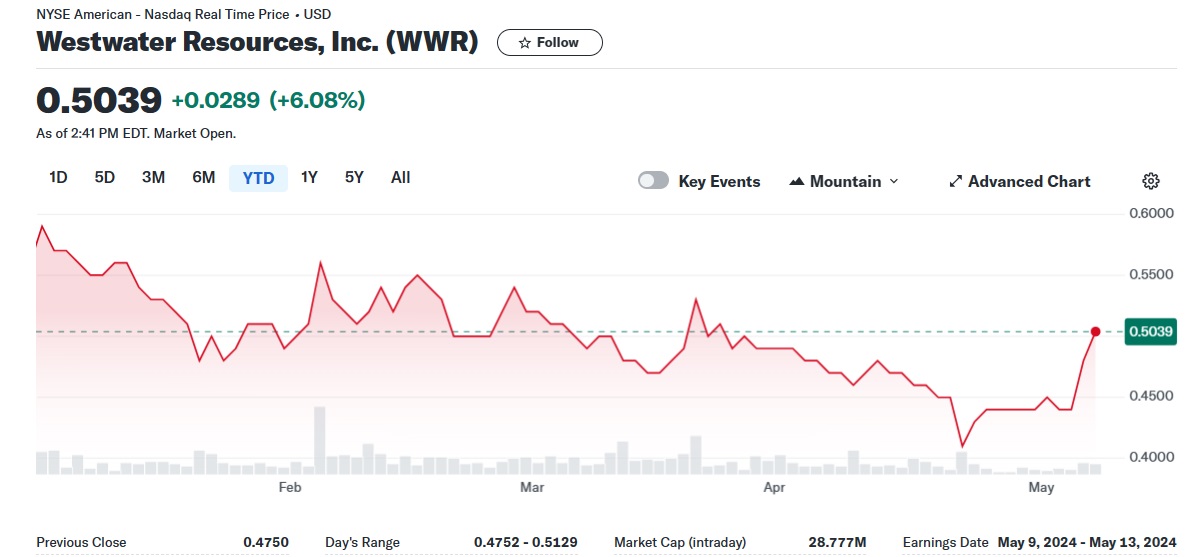
Ultimately, Westwater Resources’ ability to position itself as a vertically integrated graphite miner and producer has placed it in a prime position to take full advantage of emerging geopolitical and macroeconomic factors in the graphite market. Future graphite supply deficits ensure that demand for Westwater Resources’ graphite will remain elevated. Their proprietary production process enables the company to produce an ultra high-purity graphite anode product while maintaining environmental consciousness. Westwater’s market cap is approximately USD$28.78M and the WWR stock is trading at approximately $0.50 per share (recorded at 2:45 PM EST, May 7, 2024).


Danny Huh on Neo Battery Materials’ Process Innovation, 9th Patent and Position in NBM Korea

April 04, 2024 — In a recent enlightening interview with Tracy Weslosky of InvestorNews, Danny Huh, the Senior Vice President of Strategy and Operations at NEO Battery Materials Ltd. (TSXV: NBM | OTCQB: NBMFF) detailed the company’s strides in silicon anode technology for lithium-ion batteries, underlining their consistent progress over the past three years. Particularly notable was the discussion around the application for their 9th patent a month ago, marking a technological leap aimed at significantly enhancing their silicon anode materials’ production capacity and efficiency.

NEO Battery Materials has been actively engaged with evaluations of its anode active materials alongside global battery cell manufacturers, automotive OEMs, and major chemical material companies. The promising initial outcomes have ushered these collaborations into more extensive testing phases. This involves integrating NEO Battery’s silicon anode materials with traditional graphite anode materials in various larger cell formats, which are crucial for the batteries used in electric vehicles.

A standout achievement shared by Danny was the company’s successful pilot-scale capacity expansion to about 4,000 kilograms per year. Remarkably, this was accomplished without any need for additional equipment or alterations to the existing processes. This achievement not only underscores NEO Battery Materials’ innovative capabilities but also significantly boosts its production efficiency.

Further emphasizing the strategic maneuvers of NEO Battery Materials, Danny discussed the decision to increase the company’s ownership stake in NBM Korea. This move reflects the company’s determination to maximize the economic and technological gains from NBM Korea’s advancements and market penetration, showcasing NEO Battery Materials’ commitment to leveraging its silicone anode materials’ enhanced performance.

To access the complete interview, click here

Don’t miss other InvestorNews interviews. Subscribe to the InvestorNews YouTube channel by clicking here

About NEO Battery Materials Ltd.

NEO Battery Materials is a Canadian battery materials technology company focused on developing silicon anode materials for lithium-ion batteries in electric vehicles, electronics, and energy storage systems. With a patent-protected, low-cost manufacturing process, NEO Battery enables longer-running and ultra-fast charging batteries compared to existing state-of-the-art technologies. The Company aims to be a globally-leading producer of silicon anode materials for the electric vehicle and energy storage industries.

To learn more about NEO Battery Materials Ltd., click here

Disclaimer: NEO Battery Materials Ltd. is an advertorial member of InvestorNews Inc.

This interview, which was produced by InvestorNews Inc. (“InvestorNews”), does not contain, nor does it purport to contain, a summary of all material information concerning the Company, including important disclosure and risk factors associated with the Company, its business and an investment in its securities. InvestorNews offers no representations or warranties that any of the information contained in this interview is accurate or complete.

This interview and any transcriptions or reproductions thereof (collectively, this “presentation”) does not constitute, or form part of, any offer or invitation to sell or issue, or any solicitation of any offer to subscribe for or purchase any securities in the Company. The information in this presentation is provided for informational purposes only and may be subject to updating, completion or revision, and except as may be required by applicable securities laws, the Company disclaims any intent or obligation to update any information herein. This presentation may contain “forward-looking statements” within the meaning of applicable Canadian securities legislation. Forward-looking statements are based on the opinions and assumptions of the management of the Company as of the date made. They are inherently susceptible to uncertainty and other factors that could cause actual events/results to differ materially from these forward-looking statements. Additional risks and uncertainties, including those that the Company does not know about now or that it currently deems immaterial, may also adversely affect the Company’s business or any investment therein.

Any projections given are principally intended for use as objectives and are not intended, and should not be taken, as assurances that the projected results will be obtained by the Company. The assumptions used may not prove to be accurate and a potential decline in the Company’s financial condition or results of operations may negatively impact the value of its securities. This presentation should not be considered as the giving of investment advice by the Company or any of its directors, officers, agents, employees or advisors. Each person to whom this presentation is made available must make its own independent assessment of the Company after making such investigations and taking such advice as may be deemed necessary. Prospective investors are urged to review the Company’s profile on SedarPlus.ca and to carry out independent investigations in order to determine their interest in investing in the Company.


China’s Tightening Control over the Global Graphite Market

China’s Ministry of Commerce has announced that, effective December 1, export permits will be mandated for specific graphite products, citing national security reasons. Graphite, a pivotal component for electric vehicle (EV) batteries, finds China at its epicenter, producing 67% of the global supply of natural graphite. Additionally, China refines over 90% of the world’s graphite, which is integral to almost all EV battery anodes.

This decision unfolds in a backdrop of escalating tensions and increasing scrutiny from foreign nations. The European Union is considering tariffs on EVs originating from China, attributing unfair advantages due to state-backed subsidies. Concurrently, the U.S. has broadened its restrictions on Chinese firms accessing semiconductors and has prohibited the sale of advanced AI chips by Nvidia to Chinese companies.

The new regulatory framework targets two primary graphite types for export permits: high-purity synthetic graphite and natural flake graphite. This is reminiscent of earlier controls over “highly sensitive” graphite products, which are now integrated into the updated regulations. Analogous constraints were previously placed on semiconductor metals, gallium and germanium, which witnessed a marked reduction in exports from China.

Even though the U.S. and Europe are venturing into the graphite domain to counteract China’s monopoly, experts forecast a formidable path ahead. The central graphite importers from China currently include Japan, India, and South Korea.

These developments occur as the EV market is on an upward trajectory, with sales surging past 10 million units the previous year and predictions hovering around 14 million for the current year. This booming sector has amplified the demand for graphite, with the global market for battery use expanding by 250% since 2018. China’s contribution was a colossal 65% of the total production in the past year.

The growing EV market accentuates the criticality of raw materials like graphite. As China further consolidates its hold on the graphite industry, potential ramifications for the global EV landscape are imminent.

Right after writing this summary, I was able to reach Jack Lifton, Co-Chairman of the Critical Minerals Institute, to delve deeper into the repercussions and intricacies of these developments.

Lifton’s perspective on China’s recent announcements was direct: “This isn’t fundamentally about national security. It’s a manifestation of China’s discontent with the West’s ongoing rhetoric of reducing dependence and risks associated with their supply chain.” Lifton highlighted China’s pivotal role in graphite anode processing, suggesting that the dream of a rapid shift to EVs in the West could remain elusive without China’s involvement.

Addressing the challenges to China’s manufacturing supremacy, Lifton commented, “For years, the West prioritized cost-cutting, and China emerged as the answer. Today, the tables have turned, and the West is waking up to the consequences of its over-reliance on Chinese supply chains.”

On the topic of recent restrictions, Lifton opined, “China is fortifying its position in the critical minerals sector. The reality is that with China’s stronghold, the anticipated rapid transition of the West to EVs is looking increasingly optimistic.”

When quizzed about what minerals might be next in line, Lifton’s prediction was clear: “Post rare earths and graphite, my money would be on lithium or cobalt. The West’s ambitions for the EV transition are simply too vast for its current resources without China’s involvement.”


NEO Battery Materials Focuses on EV Market Transformation with Silicon Anodes

In this InvestorIntel interview, Tracy Weslosky talks with NEO Battery Materials Ltd.’s (TSXV: NBM | OTCQB: NBMFF) Strategy and Operations Manager Danny Huh about their South Korean commercial plant to manufacture silicon anode materials for lithium-ion batteries. With the pre-construction phase expected to start in August 2023, Danny explains how NEO Battery Materials has accelerated its commercialization efforts with targeted completion of the South Korean plant by the first half of 2024.

Highlighting the need for expanded production capacity due to their growing customer pipeline, Danny discusses NEO Battery Materials’ recent decision to upsize their R&D Scale-Up Centre in “one of the epicenters of battery production, as well as battery research, in South Korea.“

Danny goes on to provide an update on their American subsidiary, NEO Battery Materials America LLC (NBM America), to market NEO Battery Materials’ silicon anode materials in the US. Danny also discusses their plans to establish another R&D facility in either Ontario or Quebec, Canada, to establish closer ties with battery manufacturers and other battery material players involved in the Canadian EV battery supply chain.

To access the full InvestorIntel interview, click here

Don’t miss other InvestorIntel interviews. Subscribe to the InvestorIntel YouTube channel by clicking here

About NEO Battery Materials Ltd.

NEO Battery Materials is a Canadian battery materials technology company focused on developing silicon anode materials for lithium-ion batteries in electric vehicles, electronics, and energy storage systems. With a patent-protected, low-cost manufacturing process, NEO Battery enables longer-running and ultra-fasting charging batteries compared to existing state-of-the-art technologies. Building the first commercial plant in South Korea, the Company aims to be a globally-leading producer of silicon anode materials for the electric vehicle and energy storage industries.

To learn more about NEO Battery Materials Ltd., click here

Disclaimer: NEO Battery Materials Ltd. is an advertorial member of InvestorIntel Corp.

This interview, which was produced by InvestorIntel Corp., (IIC), does not contain, nor does it purport to contain, a summary of all the material information concerning the “Company” being interviewed. IIC offers no representations or warranties that any of the information contained in this interview is accurate or complete.

This presentation may contain “forward-looking statements” within the meaning of applicable Canadian securities legislation. Forward-looking statements are based on the opinions and assumptions of the management of the Company as of the date made. They are inherently susceptible to uncertainty and other factors that could cause actual events/results to differ materially from these forward-looking statements. Additional risks and uncertainties, including those that the Company does not know about now or that it currently deems immaterial, may also adversely affect the Company’s business or any investment therein.

Any projections given are principally intended for use as objectives and are not intended, and should not be taken, as assurances that the projected results will be obtained by the Company. The assumptions used may not prove to be accurate and a potential decline in the Company’s financial condition or results of operations may negatively impact the value of its securities. Prospective investors are urged to review the Company’s profile on Sedar.com and to carry out independent investigations in order to determine their interest in investing in the Company.

If you have any questions surrounding the content of this interview, please contact us at +1 416 792 8228 and/or email us direct at [email protected].


Danny Huh of NEO Battery Materials Discusses Silicon Nanocoating on Anodes for the 1000-Mile EV Battery

In this InvestorIntel interview, Tracy Weslosky talks with NEO Battery Materials Ltd.’s (TSXV: NBM | OTCQB: NBMFF) Strategy and Operations Manager Danny Huh about their ongoing commercialization and optimization process to achieve the 1000-Mile Electrical Vehicle Battery using silicon anode materials.

Having achieved a significant technology milestone of uniform nanocoating capability on silicon anodes, Danny explains how their technology can help increase the driving range of electric vehicles and enable ultra-fast charging.

The company is constructing a commercial plant in South Korea to expedite the commercialization process and aims to provide silicon anodes for battery manufacturers and EV automakers.

With a “top-notch R&D team”, NEO Battery Materials is currently constructing a plant in South Korea to expedite the commercialization process and aims to provide silicon anodes for battery manufacturers and EV automakers.

Danny provides an update on NEO Battery Materials’ expansion in the United States and also discusses how NEO Battery Materials plans to capitalize on the emergence of Ontario, Canada as a strategic battery hub with the battery gigafactories being built in the region.

To access the full InvestorIntel interview, click here

Don’t miss other InvestorIntel interviews. Subscribe to the InvestorIntel YouTube channel by clicking here

About NEO Battery Materials Ltd.

NEO Battery Materials Ltd. is a Vancouver-based company focused on electric vehicle lithium-ion battery materials. NEO has a focus on producing silicon anode materials through its proprietary single-step nanocoating process, which provides improvements in capacity and efficiency over lithium-ion batteries using graphite in their anode materials. The Company intends to become a silicon anode active materials supplier to the electric vehicle industry.

To learn more about NEO Battery Materials Ltd., click here

Disclaimer: NEO Battery Materials Ltd. is an advertorial member of InvestorIntel Corp.

This interview, which was produced by InvestorIntel Corp., (IIC), does not contain, nor does it purport to contain, a summary of all the material information concerning the “Company” being interviewed. IIC offers no representations or warranties that any of the information contained in this interview is accurate or complete.

This presentation may contain “forward-looking statements” within the meaning of applicable Canadian securities legislation. Forward-looking statements are based on the opinions and assumptions of the management of the Company as of the date made. They are inherently susceptible to uncertainty and other factors that could cause actual events/results to differ materially from these forward-looking statements. Additional risks and uncertainties, including those that the Company does not know about now or that it currently deems immaterial, may also adversely affect the Company’s business or any investment therein.

Any projections given are principally intended for use as objectives and are not intended, and should not be taken, as assurances that the projected results will be obtained by the Company. The assumptions used may not prove to be accurate and a potential decline in the Company’s financial condition or results of operations may negatively impact the value of its securities. Prospective investors are urged to review the Company’s profile on Sedar.com and to carry out independent investigations in order to determine their interest in investing in the Company.

If you have any questions surrounding the content of this interview, please contact us at +1 416 792 8228 and/or email us direct at [email protected].


Lomiko Metals’ Belinda Labatte on the global graphite shortfall expected in 2023

In this InvestorIntel interview, Tracy Weslosky interviews Lomiko Metals Inc.’s (TSXV: LMR | OTCQB: LMRMF) CEO and Director Belinda Labatte about how Lomiko is developing a sustainable approach to critical minerals development in North America. Providing an update on their La Loutre Graphite Project in Québec, Belinda explains how Lomiko is well positioned to be part of the solution for the global graphite shortage that experts anticipate we will start to see in 2023.

As interest in North American source for natural flake graphite continues to grow, Belinda discusses how the shortfall in graphite supply may increase to 8 million tons by 2040. Speaking on the strength of Lomiko’s management team that has experience in getting exploration plays to production, Belinda states, “We know how to take a project all the way through the stages of development.”

To access the full InvestorIntel interview, click here

Don’t miss other InvestorIntel interviews. Subscribe to the InvestorIntel YouTube channel by clicking here.

About Lomiko Metals Inc.

Lomiko Metals has a new vision and a new strategy in new energy. Lomiko represents a company with purpose: a people-first company where we can manifest a world of abundant renewable energy with Canadian and Quebec critical minerals for a solution in North America. Our goal is to create a new energy future in Canada where we will grow the critical minerals workforce, become a valued partner and neighbour with the communities in which we operate, and provide a secure and responsibly sourced supply of critical minerals.

In addition to La Loutre, Lomiko is working with Critical Elements Lithium Corporation towards earning its 70% stake in the Bourier Project as per the option agreement announced on April 27th, 2021. The Bourier project site is located near Nemaska Lithium and Critical Elements south-east of the Eeyou Istchee James Bay territory in Quebec which consists of 203 claims, for a total ground position of 10,252.20 hectares (102.52 km2), in Canada’s lithium triangle near the James Bay region of Quebec that has historically housed lithium deposits and mineralization trends.

To learn more about Lomiko Metals Inc., click here

Disclaimer: Lomiko Metals Inc. is an advertorial member of InvestorIntel Corp.

This interview, which was produced by InvestorIntel Corp., (IIC), does not contain, nor does it purport to contain, a summary of all the material information concerning the “Company” being interviewed. IIC offers no representations or warranties that any of the information contained in this interview is accurate or complete.

This presentation may contain “forward-looking statements” within the meaning of applicable Canadian securities legislation. Forward-looking statements are based on the opinions and assumptions of the management of the Company as of the date made. They are inherently susceptible to uncertainty and other factors that could cause actual events/results to differ materially from these forward-looking statements. Additional risks and uncertainties, including those that the Company does not know about now or that it currently deems immaterial, may also adversely affect the Company’s business or any investment therein.

Any projections given are principally intended for use as objectives and are not intended, and should not be taken, as assurances that the projected results will be obtained by the Company. The assumptions used may not prove to be accurate and a potential decline in the Company’s financial condition or results of operations may negatively impact the value of its securities. Prospective investors are urged to review the Company’s profile on Sedar.com and to carry out independent investigations in order to determine their interest in investing in the Company.

If you have any questions surrounding the content of this interview, please contact us at +1 416 792 8228 and/or email us direct at [email protected].


King discusses Global Graphite Shortage and Lomiko Metals with Belinda Labatte and Gordana Slepcev

In this InvestorIntel interview, Byron W King interviews Lomiko Metals Inc.’s (TSXV: LMR | OTCQB: LMRMF) CEO and Director Belinda Labatte, and COO Gordana Slepcev about the coming global graphite shortage. With the recent drill results further extending graphite mineralization in multiple zones at the La Loutre Graphite Project in Québec, Belinda provides an update on Lomiko’s portfolio of critical minerals projects in Quebec.

With the Canadian Government announcing that all new vehicle sales will be electric by 2035, Belinda explains how the graphite supply shortage may increase to 8 million tons by 2040. Gordana says that 95% of the anode in a lithium-ion battery is composed of graphite. She goes on to discuss how graphite from Lomiko’s La Loutre Project may be suitable for anode battery applications which require graphite concentrate of 99.95%.

To access the full InvestorIntel interview, click here

Don’t miss other InvestorIntel interviews. Subscribe to the InvestorIntel YouTube channel by clicking here.

About Lomiko Metals Inc.

Lomiko Metals has a new vision and a new strategy in new energy. Lomiko represents a company with purpose: a people-first company where we can manifest a world of abundant renewable energy with Canadian and Quebec critical minerals for a solution in North America. Our goal is to create a new energy future in Canada where we will grow the critical minerals workforce, become a valued partner and neighbour with the communities in which we operate, and provide a secure and responsibly sourced supply of critical minerals.

In addition to La Loutre, Lomiko is working with Critical Elements Lithium Corporation towards earning its 70% stake in the Bourier Project as per the option agreement announced on April 27th, 2021. The Bourier project site is located near Nemaska Lithium and Critical Elements south-east of the Eeyou Istchee James Bay territory in Quebec which consists of 203 claims, for a total ground position of 10,252.20 hectares (102.52 km2), in Canada’s lithium triangle near the James Bay region of Quebec that has historically housed lithium deposits and mineralization trends.

To learn more about Lomiko Metals Inc., click here

Disclaimer: Lomiko Metals Inc. is an advertorial member of InvestorIntel Corp.

This interview, which was produced by InvestorIntel Corp., (IIC), does not contain, nor does it purport to contain, a summary of all the material information concerning the “Company” being interviewed. IIC offers no representations or warranties that any of the information contained in this interview is accurate or complete.

This presentation may contain “forward-looking statements” within the meaning of applicable Canadian securities legislation. Forward-looking statements are based on the opinions and assumptions of the management of the Company as of the date made. They are inherently susceptible to uncertainty and other factors that could cause actual events/results to differ materially from these forward-looking statements. Additional risks and uncertainties, including those that the Company does not know about now or that it currently deems immaterial, may also adversely affect the Company’s business or any investment therein.

Any projections given are principally intended for use as objectives and are not intended, and should not be taken, as assurances that the projected results will be obtained by the Company. The assumptions used may not prove to be accurate and a potential decline in the Company’s financial condition or results of operations may negatively impact the value of its securities. Prospective investors are urged to review the Company’s profile on Sedar.com and to carry out independent investigations in order to determine their interest in investing in the Company.

If you have any questions surrounding the content of this interview, please contact us at +1 416 792 8228 and/or email us direct at [email protected].