
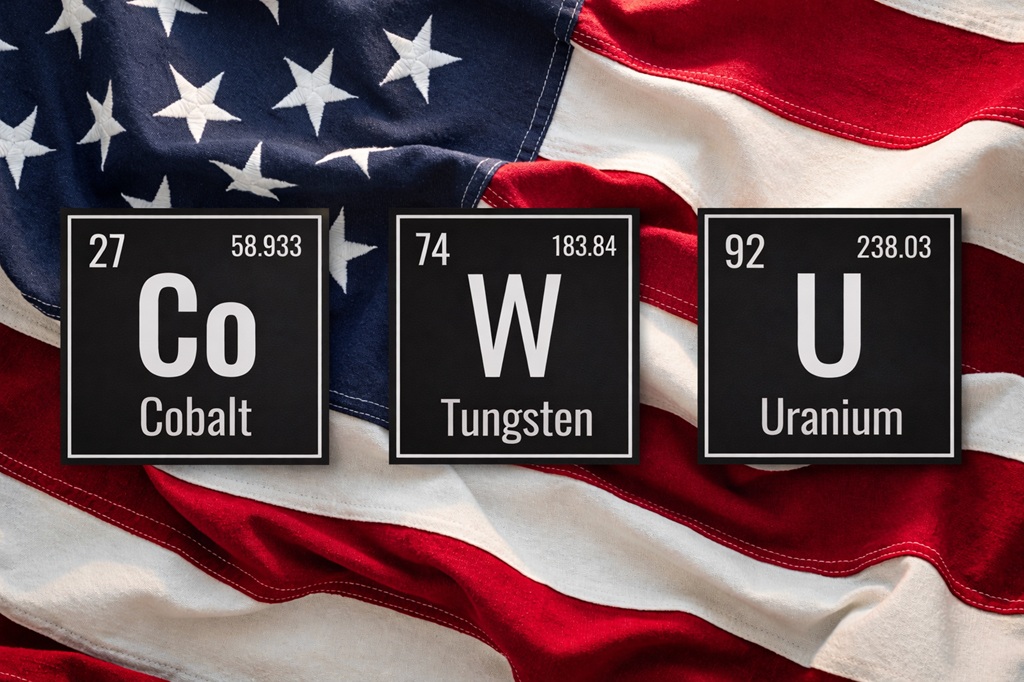
As conflict flares with Iran, the global race for critical minerals has shifted into overdrive. In Washington, the urgency is palpable: just one day before U.S. forces launched strikes on Iran this month, the Pentagon quietly urged mining companies to boost output of 13 strategic minerals – from nickel and graphite to tungsten and yttrium – vital for semiconductors, batteries and weapons. It was a telling prelude. The war’s shockwaves are underscoring how quickly supply lines can be choked off, spurring capitals and corporations into accelerating deals that once inched along at peacetime speed.
In the past week, from Accra to Tokyo, governments have moved to cement new footholds in these supply chains. Ghana’s parliament ratified a mining lease for Atlantic Lithium Ltd. to develop the Ewoyaa lithium deposit – set to be Africa’s only lithium mine oriented toward U.S. supply chains, whereas nearly all other African lithium projects feed China [Source]. The Ewoyaa project will ship its spodumene concentrate to North America, a strategic win for Washington’s drive to secure battery minerals outside Beijing’s orbit. Ghana negotiated a sliding royalty up to 12% at high prices and a 13% state equity stake, leveraging resource nationalism even as it welcomes Western investors [Source]. For a country known more for gold, this “watershed” lithium deal signals a broader shift to critical minerals tied to the U.S. – a clear counterpoint to China’s long-running dominance in Africa.
Allied coordination is likewise ramping up in Asia. The United States and Japan unveiled a new action plan on critical minerals cooperation during Prime Minister Sanae Takaichi’s visit to Washington [Source]. Ostensibly, the pact avoids naming China, but its intent is obvious: to blunt Beijing’s leverage by establishing price floors and joint supply arrangements for key minerals [Source]. The plan calls for coordinated trade measures – a border-adjusted price floor mechanism – “focusing in the first instance on a select group of critical minerals” [Source]. In practice, that means the two allies will try to prevent China’s state-subsidized producers from undercutting prices. The action plan also encourages joint investment in mining and processing projects that adhere to higher standards [Source]. For example, U.S. officials highlighted potential Japanese backing for Albemarle Corp.’s (NYSE: ALB) new lithium processing plant in North Carolina, while Tokyo’s Mitsubishi Materials (TYO: 5711) is in talks to take a stake in an Indiana rare earth recycling venture [Source]. By coordinating supply chain financing and even stockpiling policy, Washington and Tokyo are effectively building a critical minerals NATO – a defense against what they diplomatically describe as “pervasive non-market practices” [Source].
Beijing, for its part, is hardly standing down. New customs data from China illustrate both its strength and its strategic selectivity: Chinese exports of rare earth magnets – essential for electric vehicles, wind turbines and missiles – surged 8.2% year-on-year in the first two months of 2026 [Source]. Yet shipments to the United States plunged by 22.5% over the same period [Source]. In other words, China is selling more rare earths to global markets, just not to America. This drop in U.S.-bound supply follows Beijing’s imposition of export permits on certain rare earth products last year, a retaliatory move that has made high-tech industries in the West acutely aware of their vulnerability [Source]. Chinese officials insist normal exports continue to “friends,” but the message to Washington is pointed. Meanwhile, Chinese companies are pouring capital into overseas mines to solidify long-term supply. Chinese outbound investment hit a seven-year high in 2025, with firms announcing $124 billion in new projects – much of it targeting energy and raw materials in emerging economies [Source]. In lithium alone, Chinese enterprises have dramatically expanded their global footprint in recent years. Beijing’s strategy is two-pronged: ensure domestic industries have the minerals they need (even if that means squeezing U.S. consumers), and keep buying up resources from Africa, Latin America and anywhere else willing to sell.
Nowhere is this great-power contest more apparent than in Africa’s mineral belt. The Democratic Republic of Congo, source of 70% of the world’s cobalt, this week approved the sale of one of its largest cobalt and copper companies – Chemaf SA – to U.S.-backed Virtus Minerals Inc. [Source]. Virtus, reportedly led by former U.S. security officials, will pay a token $30 million for equity but has pledged a further $750 million to finish developing Chemaf’s projects [Source]. This marks a significant win for Washington’s new critical minerals pact with Kinshasa [Source]. Chemaf’s prize asset is the Mutoshi project, among the world’s richest cobalt deposits, which had stalled amid Chemaf’s financial woes and even drew a failed bid from a Chinese firm in 2024. Congo’s government, after signing a strategic minerals partnership with the U.S. late last year, pointedly blocked that Chinese takeover [Source]. The Virtus deal thus not only secures a non-Chinese source of cobalt for U.S. supply chains; it also cements growing U.S.-Congo ties in an era when even security alliances are linked to mineral access. Kinshasa gets an infusion of capital and, implicitly, Washington’s goodwill at a time of internal security concerns [Source]. For cobalt markets, tighter U.S. alignment with the DRC could be a game-changer – though it is sure to rankle Beijing, which has long invested heavily in Congolese mining.
Just south of Congo, Zambia is drawing Western investment of a different kind. Silicon Valley-backed KoBold Metals – a startup funded by billionaires including Jeff Bezos and Bill Gates – has begun developing the Mingomba copper deposit, touting the use of AI to pinpoint riches [Source]. KoBold’s CEO in Africa confirmed that mine development is “in full swing,” with shaft-sinking set for 2027 and first copper output targeted in the early 2030s [Source]. The Mingomba project will require an estimated $2.3–2.5 billion in capital and aims to produce a hefty 300,000 tonnes of copper annually when in operation [Source]. That would make it one of the continent’s largest copper mines. Zambia is counting on such ventures to help triple its copper output by 2031 [Source] – an ambitious goal in line with soaring demand for electric vehicle metals. For the U.S. and allies, KoBold’s presence is a welcome development: a Western-aligned company securing future copper supply without Chinese finance. Indeed, the project’s timing dovetails with Washington’s broader push to loosen China’s grip on critical minerals [Source]. Notably, KoBold is also hunting for lithium and nickel in neighboring countries [Source], effectively staking out a sphere of influence in southern Africa’s mineral heartlands before Chinese firms can claim everything.
In the Americas, shifts are afoot both north and south. In Chile – the world’s top copper producer – U.S. miner Freeport-McMoRan Inc. (NYSE: FCX) has filed for a massive $7.5 billion expansion of its El Abra copper mine [Source]. The plan, submitted to regulators this week, would include a new concentrator and desalination plant and could quadruple El Abra’s output, adding over 300,000 tonnes of copper per year by the 2030s [Source]. It’s the largest mining investment application Chile has seen in over three decades [Source]. The backdrop is a new, more mining-friendly administration in Santiago that is urging investors to “go on the offensive” after years of regulatory delays [Source]. Freeport’s project – 51% owned alongside Chile’s state copper company Codelco – would catapult El Abra from a mid-sized operation to one of Chile’s top three copper mines [Source]. That expansion underscores how critical copper is to the energy transition – and how countries like Chile, with pragmatic policies, stand to gain from the West’s hunger for reliable supplies.
Brazil, by contrast, offered a reminder that not all U.S. outreach is warmly received. At a U.S.-sponsored Critical Minerals Forum in São Paulo, conspicuous by its absence was any official representative of President Luiz Inácio Lula da Silva’s government [Source]. The forum – intended to connect American investors with Brazilian mining projects – went ahead with participation from industry (even the state of Goiás signed a cooperation deal with the U.S. embassy) [Source], but Brasília’s no-show spoke volumes. A Lula spokesperson claimed a scheduling conflict [Source], yet insiders noted rising diplomatic frictions between Brazil and the U.S. – including a spat over a visiting U.S. envoy – that have put the brakes on a federal-level critical minerals MOU [Source]. Brazil holds rich caches of nickel, rare earths, niobium and other strategic minerals, and Washington sees it as a linchpin of non-Chinese supply in the Western Hemisphere [Source]. Still, Lula’s priorities lean toward asserting Brazil’s autonomy over its resources (he has warned against “surrendering” critical minerals to foreign control). The U.S. may ultimately secure a partnership – a potential Lula visit to Washington is rumored – but the episode highlights the geopolitical tug-of-war over Latin America’s resources. Even close partners are calibrating how to benefit from the critical minerals boom without being seen as aligning too closely with one side or the other.
Meanwhile, global corporations are grappling with immediate supply crunches. In the cobalt market, commodities giant Glencore plc (LSE: GLEN) had to tap an unusual source to honor its contracts: cobalt stockpiles held on a Chinese exchange [Source]. Glencore drained a large portion of the cobalt inventories from the Wuxi exchange in China this quarter to supply its Chinese battery-making clients [Source]. The company simply couldn’t ship enough cobalt out of the Congo due to that country’s export curbs – Kinshasa suspended exports last year to prop up prices and now rations exports under quotas [Source]. Glencore had already redirected some of its cobalt stockpiled offshore into China, but it still fell short of its delivery obligations. By mid-March, available cobalt tonnage on the Wuxi exchange had halved compared to January, largely from Glencore’s drawdown [Source]. Cobalt prices have since skyrocketed – up 160% from a year ago to around $57,000 per tonne [Source] – as electric vehicle demand stays robust but supply is constrained by both geology and geopolitics. Glencore’s scramble hints at the frailty of seemingly solid supply deals when governments (even friendly ones like the DRC) suddenly change the rules. It’s a vivid example of how resource nationalism and great-power rivalry can collide in commodity markets, leaving Western firms to scrounge material from wherever they can – even if that means begging from Chinese warehouses.
Another niche metal is experiencing an even more dramatic squeeze: tungsten, a dense element used in armor-piercing munitions and specialized electronics, often called the “war metal.” Tungsten prices have exploded, rising over 500% in the past year to record highs [Source]. According to the European benchmark, ammonium paratungstate (APT) now sits above $2,250 per metric ton unit – more than double its level just since January [Source]. The immediate trigger is China’s implementation of export restrictions. China is by far the world’s top tungsten producer (responsible for roughly 79% of global supply [Source]), and since late last year it has tightened controls on exports of certain high-purity tungsten products, citing national security. Chinese shipments of those restricted forms have plunged 40% [Source]. At the same time, military demand for tungsten alloys is climbing – expected to jump about 12% this year amid global rearmament trends [Source]. The result is a rush by manufacturers to find alternate sources. In South Korea, Almonty Industries Inc. (TSX: AII | ASX: AII | NASDAQ: ALM | OTCQX: ALMTF | Frankfurt: ALI1) just opened a major new tungsten mine to serve non-Chinese buyers, and the company is pushing to develop a long-awaited tungsten project in Utah as well [Source] [Note: Almonty CEO Lewis Black will be speaking at the CMI Summit V on May 13-14 in Toronto.]. The U.S. Defense Department’s call for new tungsten supply (as reflected in that Pentagon list before the Iran strikes [Source]) has junior miners in Nevada dusting off old projects. Still, bringing significant non-Chinese tungsten capacity online will take years. For now, this obscure market – worth only $15–20 billion globally – has suddenly become a front line in the broader economic war. Each uptick in tungsten’s price is a reminder that even the smallest cogs in the supply chain can seize up under geopolitical pressure.
Finally, nuclear energy – often left out of the critical minerals conversation – is reasserting itself as a strategic factor. With oil markets rattled by Middle East turmoil, nuclear power’s allure as a stable domestic energy source is rising, and so is the importance of uranium supply. The United States, which astonishingly imports about 95% of its uranium fuel, is taking steps to change course [Source]. In January, the White House issued a rare Section 232 proclamation deeming uranium a national security priority [Source]. This designation paves the way for potential import quotas or tariffs, price supports, and direct federal backing for domestic uranium mining and enrichment [Source]. It’s a clear response to the risks of reliance on Russia (still a major uranium enricher for the world) and other geopolitical rivals. Already, we’ve seen a $900 million award to Centrus Energy to expand a U.S. enrichment facility – part of a broader effort to rebuild the full nuclear fuel cycle on U.S. soil [Source]. Parallel to this, the U.S. Department of Energy just launched an initiative to boost the output of the nation’s nuclear reactor fleet for the first time in decades. The new UPRISE program will fund reactor uprates, life extensions, and even restarts of dormant nuclear plants [Source]. The goal is to add 5 GW of nuclear capacity by 2029 (roughly five new reactors’ worth) and set the stage for much larger expansion by mid-century [Source]. After years of decline, America’s nuclear generating capacity actually ticked up in 2026 – a notable milestone driven by reactor restarts and power upgrades. This nuclear mini-renaissance, modest as it is so far, feeds directly into the critical minerals saga: more reactors mean more uranium demand, more enrichment infrastructure, and heightened strategic attention on fuel supply security. Washington’s message is that energy security now hinges as much on obscure metals and isotopes as on oil and gas.
The complex developments of this week all share a common theme. Whether it’s lithium in Ghana, cobalt in Congo, rare earths in Asia, or uranium at home, the world’s major powers are maneuvering faster and further to secure the critical minerals of the future. A hot war in the Middle East has only sharpened the edges of this contest. The stakes – industrial primacy, military readiness, clean-energy goals – are undeniably high. And as the scramble for critical minerals intensifies, every new deal or policy is suffused with geopolitical calculation. In this arena, neutrality is a luxury few can afford. Each nation and company must play the game, or risk being left at the mercy of those who do. The coming months will test just how far this strategic decoupling can go – and whether the lofty talk of “resilient supply chains” truly translates into secure access when the next crisis hits. In the meantime, investors and strategists would do well to watch not just the price of oil, but the price of cobalt, tungsten, and uranium. They are fast becoming the real barometers of global turbulence.
Do you enjoy the Critical Minerals Report?
Click here to become a Critical Minerals Institute member and get each edition delivered straight to your inbox.
InvestorNews Critical Minerals Institute (CMI) Directorial Headline Picks for the Past Week:
- March 20, 2026 – Ghana Approves Lithium Project That Will Ship Ore to the US (Source)
- March 19, 2026 – US, Japan to focus rare earths cooperation on select group of minerals at first (Source)
- March 19, 2026 – China’s rare earth exports rise, shipments to US fall (Source)
- March 19, 2026 – Freeport seeks permit for $7.5 billion mine expansion (Source)
- March 18, 2026 – China’s multibillion-dollar minerals investment lifts foreign economies: report (Source)
- March 18, 2026 – US Snubbed by Lula Government at Critical Minerals Summit (Source)
- March 18, 2026 – KoBold Metals targets early-2030s copper output at Zambia project (Source)
- March 17, 2026 – Congo OKs US Firm’s Deal for Cobalt Miner in Minerals Pact Boost (Source)
- March 16, 2026 – Resolution Copper completes historic land exchange (Source)
- March 16, 2026 – Copper Dips as LME Stockpiles Rise to Highest in Over Six Years (Source)
- March 16, 2026 – Glencore turns to China exchange stocks to meet cobalt commitments, sources say (Source)
- March 15, 2026 – Munitions Metal Tungsten Eclipses Gold, Copper in 557% Rally (Source)
- March 12, 2026 – The Nation’s Nuclear Reactor Fleet Is on the Rise (Source)
InvestorNews.com Media Updates:
- March 20, 2026 – Losing Out on Jurisdictional Roulette https://bit.ly/4lDf0SQ
- March 18, 2026 – Strait of Hormuz is chokepoint for sulphuric acid and critical metal processing https://bit.ly/4bEMYlA
InvestorNews (YouTube) Interview Updates:
- March 19, 2026 – Marcy Kiesman Highlights Quantum Critical Metals’ Babine South Silver and Mica-Based Gallium Extraction at PDAC 2026 https://youtu.be/MH_uepwPEIk
- March 18, 2026 – John Slaven of MineSense on Turning Every Shovel into a Data Engine https://youtu.be/JQMYjvPZ2Jg
- March 17, 2026 – Christopher Berlet on Stakeholder Gold and the Infrastructure-Driven Revival of Yukon’s White Gold District https://youtu.be/4ramGFlAN48
- March 17, 2026 – Grid Metals’ Robin Dunbar on the Rare Critical Mineral Called Cesium https://youtu.be/RulZXwyK1J0
- March 17, 2026 – Darren Hazelwood Discusses Panther Metals’ Ontario Projects and Winston Tailings Opportunity at PDAC 2026 https://youtu.be/X8RhyR40DpM
- March 16, 2026 – Silver Bullet Mines Announces Five-Year Offtake Deal with Ocean Partners at PDAC 2026 https://youtu.be/rrbaup-yFQ0
- March 16, 2026 – David Stein on Kuya Silver’s Production Growth and the Opportunity in Peru’s Silver Sector https://youtu.be/XhjYEOvuIJw
- March 16, 2026 – Spartan Metals’ Brett Marsh on Reviving Nevada’s Tungsten District https://youtu.be/4CD-8iNeSf4
- March 16, 2026 – Fox Tungsten’s Stephen Gray on the World’s Highest-Grade Tungsten Resource in British Columbia https://youtu.be/QJ9ZOVq0rMY
- March 16, 2026 – ABx Group’s Mark Cooksey on Dysprosium, Terbium and the Race for Heavy Rare Earths https://youtu.be/sWaPsbSBQsc
- March 16, 2026 – At PDAC 2026, Power Metallic’s Terry Lynch Discusses Lion’s High-Grade Copper Results https://youtu.be/GWvKE6ThuGk
InvestorNews.com News Release Updates:
- March 20, 2026 – Quantum Critical Metals Secures U.S. Defense Consortium Membership https://bit.ly/4s2RNvb
- March 20, 2026 – Deep Sea Minerals Corp. Submits Response to U.S. Defense Industrial Base Consortium Solicitation for Critical Minerals https://bit.ly/40IvY8U
- March 19, 2026 – Stakeholder Gold Closes Two Tranches of Flow-Through Financing https://bit.ly/4blCfgR
- March 19, 2026 – Trinity One Metals Appoints Jaime Delgado as Director https://bit.ly/4sm5are
- March 19, 2026 – Neo Performance Materials Reports Fourth Quarter 2025 Results https://bit.ly/4slYDwL
- March 19, 2026 – Resouro Strategic Metals Inc. (ASX:RAU) Board Changes and Corporate Update https://bit.ly/4dtqBlk
- March 18, 2026 – American Tungsten Completes C$40 Million Bought Deal Financing https://bit.ly/4biaRjL
- March 18, 2026 – Renforth Retains Specialist Geochemical Consultant for Victoria Ni Sulphide Polymetallic Deposit in Quebec https://bit.ly/4by8XKE
- March 18, 2026 – Resolution to Commence Major 45-Diamond Hole Drilling Program to Test Scale of Golden Gate System https://bit.ly/4sB152B
- March 17, 2026 – American Tungsten Completes Strategic Investment in Viking Mines https://bit.ly/4bshdvF
- March 17, 2026 – Deep Sea Minerals Corp. Clarifies Disclosure at the Request of the BCSC https://bit.ly/4dsOREc
- March 17, 2026 – Scandium Canada Announces Closing of $17.3 Million Bought Deal Life Offering, Including Full Exercise of Over-Allotment Option https://bit.ly/3PdOq6K
- March 17, 2026 – Spartan Metals Acquires the Largest(1) Tungsten Resource in the United States https://bit.ly/3P9Vlhn
- March 17, 2026 – Oreterra Confirms Two Broad Zones of Epithermal Gold Mineralization with Assays to 50.5 g/t Au Overlying Porphyry Targets at the Kinkaid Project, Nevada https://bit.ly/4bwhCxk
- March 17, 2026 – Antimony Resources Corp. (ATMY) (ATMYF) (K8J0) Announces Work on Maiden Mineral Resource Estimate – Hires SRK Consultants https://bit.ly/4dnuV5B
- March 17, 2026 – Nano One Advances Candiac LFP Production Capacity Expansion Project, Detailed Engineering & Equipment Procurement https://bit.ly/4sNH0Wj
- March 16, 2026 – Critical Minerals Americas Inc. Announces a Service Agreement with NRCan Research Agency CanmetENERGY to Review Critical Mineral and Rare Earths Data and Research for the SBH Project in Northern Alberta https://bit.ly/4bdMns2
- March 16, 2026 – Silver Bullet Mines Corp. Reports Antimony Results from Its Washington Mine in Idaho https://bit.ly/4ux309u
- March 16, 2026 – Halleck Creek Ore Selected for Feedstock for the DoE METALLIC Research Consortium https://bit.ly/4bAectA
- March 16, 2026 – Voyageur Announces Advancements on its Barium & Iodine Contrast Media Projects https://bit.ly/4dpsOyd
About the Critical Minerals Institute (CMI):
The Critical Minerals Institute (CMI) is a global brain trust for the critical minerals economy, serving as a hub that connects companies, capital markets, and policymakers. Through CMI Masterclasses, the weekly Critical Minerals Report (CMR), bespoke research, and board-level advisory services, CMI delivers actionable intelligence spanning exploration finance, supply chains, and geopolitics.
CMI also convenes the flagship Annual Critical Minerals Institute Summit, a global gathering of government leaders, institutional investors, and industry executives. The next event, CMI Summit V, themed “The New Critical Minerals Economy,” will take place May 13–14, 2026, in Toronto, Canada.

For more information, visit CriticalMineralsInstitute.com contact CMI Membership Director Chrissy Hessam at [email protected].


Leave a Reply