

June 21, 2026 (Source) — Trinity One Metals Ltd. (TSXV: TOM) (OTCID: TOMXF) (FSE: 5D5) (“Trinity One” or the “Company“) is pleased to announce the compilation and initial interpretation of six historic diamond core drill holes completed at the Company’s Silver-1 Mine in Ecuador as part of a United Nations exploration program in 1978.
The reported results are from the previously mined Ocashuaico sector. The Company has also located additional historic drill logs from the Shunaste sector, where no historical mining is known to have occurred. These records, which are not included in the current release, are undergoing verification and geological interpretation.
The drilling was completed approximately 11 years before underground mining commenced at Silver-1 in 1989. Historical information indicates that mining continued until approximately 1994 and reached a reported maximum depth of approximately 90 m.
The newly compiled records include high grade silver-lead-zinc intersections at calculated vertical depths exceeding the reported maximum depth of historical mining. Notably, Ocashuaico hole SB-18 intersected a principal high grade zone beginning at 152.15 m downhole.
The records were recovered by the Company’s in-country geological team through a systematic review and digitisation of original paper drill logs and technical documents held in the archives of Ecuador’s Geological and Energy Research Institute (Instituto de Investigación Geológico y Energético, or “IIGE”).
The results provide Trinity One with an important new dataset for evaluating the potential continuation of high grade mineralisation beneath and surrounding the historical Silver-1 mine workings.
Highlights
Historic drilling highlights include:
- Ocashuaico hole SB-18:
- 2.60 m at 36.16 oz/t silver (1,240 g/t), 1.57% lead and 3.08% zinc from 152.15 m (107.6 m VD), including:
- 0.25 m at 233.40 oz/t silver (8,002 g/t), 7.80% lead and 11.70% zinc from 154.50 m (109.2 m VD).
- 2.60 m at 36.16 oz/t silver (1,240 g/t), 1.57% lead and 3.08% zinc from 152.15 m (107.6 m VD), including:
- Ocashuaico hole SB-19
- 0.50 m at 60.56 oz/t silver (2,076 g/t), 1.66% lead and 5.00% zinc from 48.20 m (34.1 m VD);
- 5.30 m at 5.30 oz/t silver (182 g/t), 0.69% lead and 1.44% zinc from 55.00 m (38.9 m VD);
- 0.15 m at 65.00 oz/t silver (2,229 g/t), 1.46% lead and 9.00% zinc from 131.05 m (92.7 m VD); and
- 0.23 m at 29.48 oz/t silver (1,011 g/t), 1.74% lead and 11.10% zinc from 155.12 m (109.7 m VD).
- Ocashuaico hole SB-20
- 5.45 m at 6.33 oz/t silver (217 g/t), 0.35% lead and 1.35% zinc from 38.35 m (27.1 m VD), including:
- 0.97 m at 22.00 oz/t silver (754 g/t), 0.82% lead and 3.80% zinc from 38.35 m (27.1 m VD).
- 0.40 m at 10.20 oz/t silver (350 g/t), 2.80% lead and 1.90% zinc from 164.40 m (116.2 m VD).
- 5.45 m at 6.33 oz/t silver (217 g/t), 0.35% lead and 1.35% zinc from 38.35 m (27.1 m VD), including:

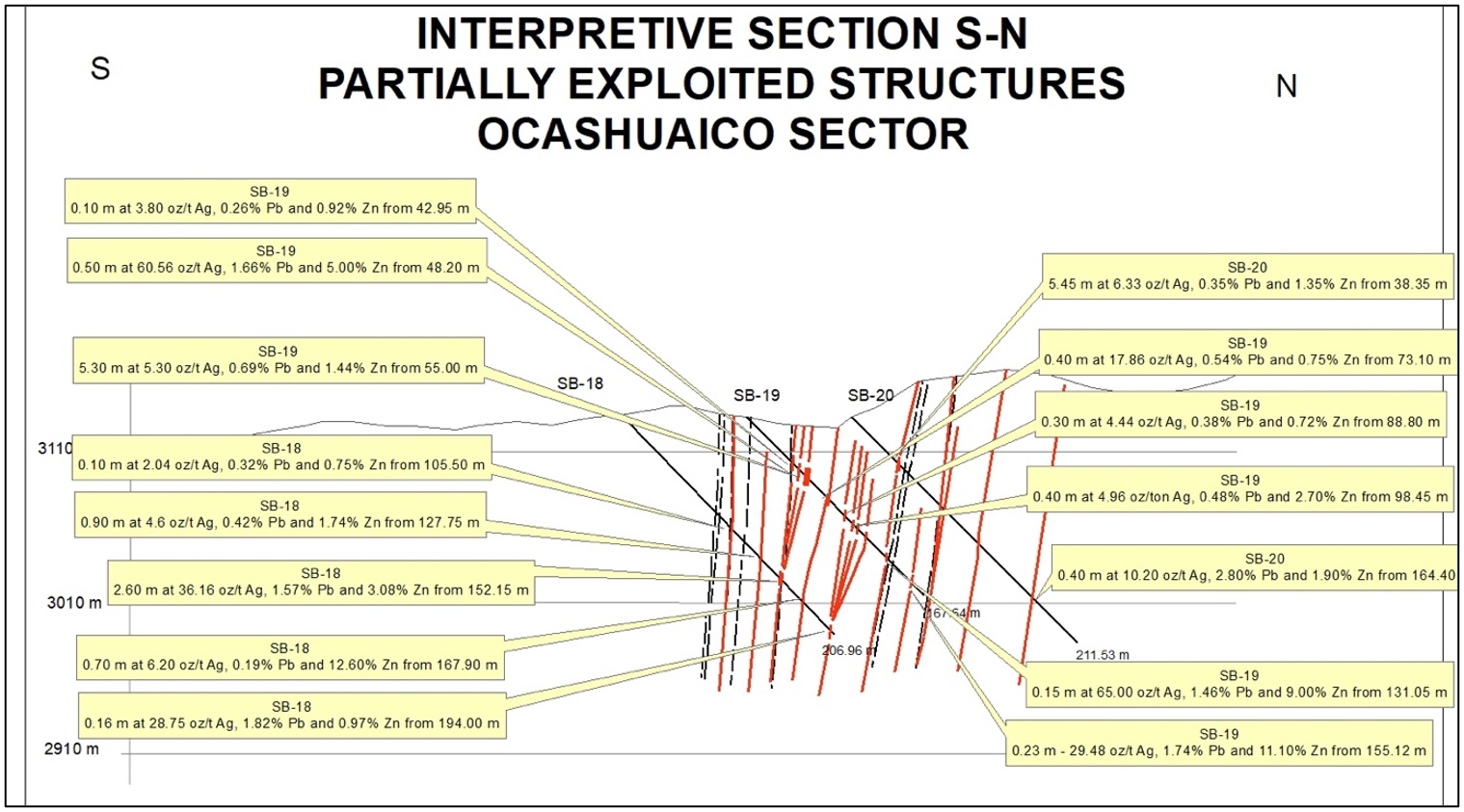
To view an enhanced version of this graphic, please visit:
https://images.newsfilecorp.com/files/4933/305929_trinityonefig1072126.jpg
Holes SB-18, SB-19 and SB-20 as shown in the diagram above were drilled at a dip of approximately -45 degrees. For the purposes of this release, vertical depth below the drill collar (“VD”) has been calculated using this approximate drill inclination and assumes no material drill hole deviation.
The calculated vertical depths of multiple mineralised intersections, including the principal high grade zone in SB-18, are numerically greater than the approximate 90 m maximum mining depth reported in the available historical records.
Several of the deeper intersections occur across multiple drill holes, providing a number of distinct targets for further geological interpretation and modern exploration.
Results from the remaining three Ocashuaico holes were generally of a lower grade than the highlighted intersections. SB-25 returned 1.90 m grading 3.64 oz/t silver (125 g/t) from 127.70 m, SB-25B returned trace silver in the two recorded sample intervals, and SB-27 returned 1.50 m grading 1.88 oz/t silver (64 g/t) from 229.00 m.
Management commentary
Thomas Wood, CEO of Trinity One Metals, commented:
“The recovery of these 1978 United Nations drilling records represents an important breakthrough in our understanding of Silver-1.
“These holes were drilled more than a decade before mining commenced and reveal exceptional silver-lead-zinc mineralisation at calculated vertical depths exceeding the approximately 90 m depth reportedly reached by historical mining.
“SB-18 is particularly significant. It intersected 2.60 m grading 1,240 g/t silver, including 0.25 m grading 8,002 g/t silver, from a downhole depth of 152.15 m.”
Historical information and verification
The results reported in this release were compiled from original paper records held by IIGE and checked by the Company’s geological team against the available historical figures and drill information. The Company has not independently verified the results through resampling of original drill core or confirmation drilling. The available records do not identify the analytical laboratory, analytical methods, sample preparation procedures, core diameter, sample security protocols, or complete information regarding drilling procedures, core recovery and QA/QC. Accordingly, the historical results should not be treated as equivalent to results generated under current exploration and analytical standards. The Company nevertheless considers the records relevant and sufficiently reliable to guide ongoing geological interpretation and exploration planning.
Silver values originally reported in ounces per ton have been converted to grams per tonne using a conversion factor of 34.2857 grams per tonne for each troy ounce per short ton. Reported widths are historical sampled or downhole widths, and true widths have not yet been determined. Composite grades are length weighted averages calculated using the recorded from-and-to depths of the constituent historical sample intervals.
The historic collar survey records, drilling orientations, total depths and coordinates in WGS 84 / UTM 17S, for the Ocashuaico drill holes are as follows:
| Drill hole | Easting (m) | Northing (m) | Collar elevation (m ASL) | Azimuth | Dip | Total depth (m) |
| SB-18 | 738,060 | 9,667,892 | 3,135.07 | 016° | −45° | 206.96 |
| SB-19 | 738,074 | 9,667,974 | 3,134.00 | 010° | −45° | 167.64 |
| SB-20 | 738,076 | 9,668,044 | 3,133.20 | 008° | −45° | 211.53 |
| SB-25 | 738,172 | 9,668,121 | 3,194.30 | 357° | −45° | 152.40 |
| SB-25B | 738,172 | 9,668,121 | 3,194.30 | 001° | −45° | 365.76 |
| SB-27 | 738,009 | 9,668,137 | 3,131.50 | 191° | −63° | 240.20 |
Qualified Person
The scientific and technical information contained in this news release has been reviewed and approved by Enkhtuvshin Khishigsuren, P.Eng., an independent geological consultant to the Company and a Qualified Person as defined by National Instrument 43-101.
The Qualified Person reviewed the available historical drill logs and records, the Company’s compilation and transcription of those records, and the calculations and conversions presented in this news release. The Qualified Person has not independently verified the historical drilling results through resampling of original drill core or confirmation drilling. Information concerning certain historical drilling, sampling, analytical and quality-control procedures is incomplete. Accordingly, the historical results will require confirmation through systematic modern exploration and drilling incorporating appropriate QA/QC procedures.
About Trinity One Metals Ltd.
Trinity One Metals Ltd. (TSXV: TOM) (OTC: TOMXF) (FSE: 5D5) is a precious and base metals explorer focused on building a portfolio of high growth projects with exposure to some of the world’s most in demand metals. The Company’s strategy is to acquire and advance assets with strong geological fundamentals, clear catalysts, and the ability to deliver discovery and growth through disciplined modern exploration. The Company owns a 100% interest in the Silver-1 Mine.
For further information
Thomas Wood
CEO
[email protected]
Cautionary statement regarding forward-looking information
This news release contains “forward-looking information” and “forward-looking statements” within the meaning of applicable Canadian securities legislation, collectively referred to as “forward-looking information”. Forward-looking information is generally identified by words such as “believes”, “expects”, “anticipates”, “intends”, “estimates”, “plans”, “potential”, “may”, “could”, “would”, “will”, “should”, “continue”, “target”, “indicate”, “suggest” and similar expressions. Forward-looking information in this release includes statements regarding: the significance, reliability and usefulness of the historical drilling information; the potential scale, grade, continuity, orientation, geometry and extension of mineralisation at the Silver-1 Project; the possible continuation of mineralisation at depth, along strike or around the historical mine workings; whether historically intersected mineralisation was accessed, extracted or depleted; the reconstruction and interpretation of historical drilling and mine workings; the identification of exploration targets; the potential reproduction of historical results by modern exploration; the recovery of additional historical records or sample material; and the scope, timing, cost and results of future surveying, compilation, mapping, geophysics, sampling, drilling, assaying, metallurgical testing and other technical work. Forward-looking information is based on management’s current expectations, estimates, interpretations, assumptions and beliefs, including that: the available historical records are substantially complete and accurate; drill-hole locations, orientations, intervals and assays were correctly recorded and transcribed; “oz/t” means troy ounces per short ton; the reported historical mine depth is materially accurate; drill holes and mine workings can be reconstructed within a common coordinate and elevation system; the historical information is sufficiently reliable for exploration targeting; required property rights, access, community support, permits and approvals will be obtained and maintained; qualified personnel, contractors, laboratories, equipment and services will be available on acceptable terms; and sufficient financing will be available. Forward-looking information is subject to known and unknown risks and uncertainties that may cause actual results to differ materially. These include: incomplete, inconsistent, inaccurate or erroneous historical records; transcription, calculation, translation or interpretation errors; uncertainty regarding historical unit conventions; the absence of original assay certificates, laboratory records, drill core, pulps or rejects; incomplete information concerning drilling, core recovery, sampling, sample security, preparation, analytical procedures and quality-control measures; unreliable, inaccurate, biased or contaminated historical assays; and the possibility that modern resampling or confirmation drilling will not reproduce the reported grades or widths. Risks also include uncertainty regarding drill-hole collar locations, elevations, coordinate systems, azimuths, inclinations, deviation and actual trajectories; uncertainty regarding the location, elevation, configuration, extent and depth of historical workings; the possibility that workings extended deeper or into different areas than presently understood; the possibility that reported intersections were mined, disturbed, depleted or inaccessible; differences in surface elevation or measurement datum; and the possibility that calculated vertical depths do not represent actual elevations or establish that an intersection lies beneath or outside the historical workings. Mineralisation may be narrow, irregular, discontinuous, structurally complex or more limited than interpreted. Reported sampled or downhole widths may not represent true widths, which may be materially smaller. High-grade intervals, including the reported 8,002 g/t silver interval, may be isolated, affected by a high-grade or nugget effect, or unrepresentative of broader mineralisation. Geological correlations are interpretive and may prove incorrect, and future exploration may not identify mineralisation of similar grade, width, continuity or economic significance. The Silver-1 Project does not currently contain a mineral resource or mineral reserve. Historical results do not establish economic viability, mineability or economically recoverable mineralisation. Additional risks include uncertainty regarding metallurgy and recoveries; mining and processing methods; capital and operating costs; infrastructure and water; ground conditions and underground safety; historical environmental liabilities; and geological, geotechnical, hydrological, environmental or other conditions affecting exploration or potential development. Other risks include delays in or failure to obtain permits, approvals, access agreements or community support; changes in Ecuadorian laws, regulations, taxation, royalties, governmental policy or political conditions; title, tenure, boundary and surface-right risks; environmental and social risks; weather, natural events, security and logistical constraints; contractor, labour and equipment availability; equipment failure and laboratory delays; commodity prices, foreign exchange, inflation, financing, dilution and market conditions; and the possibility that planned activities may be changed, postponed, reduced or discontinued. Although the Company believes its assumptions and expectations are reasonable, they may prove incorrect. Readers should not place undue reliance on forward-looking information, which speaks only as of the date of this release. Except as required by applicable securities laws, the Company undertakes no obligation to update or revise such information as a result of new information, future events or otherwise.
Neither TSX Venture Exchange nor its Regulation Services Provider, as that term is defined in policies of the TSX Venture Exchange, accepts responsibility for the adequacy or accuracy of this release.


Leave a Reply