
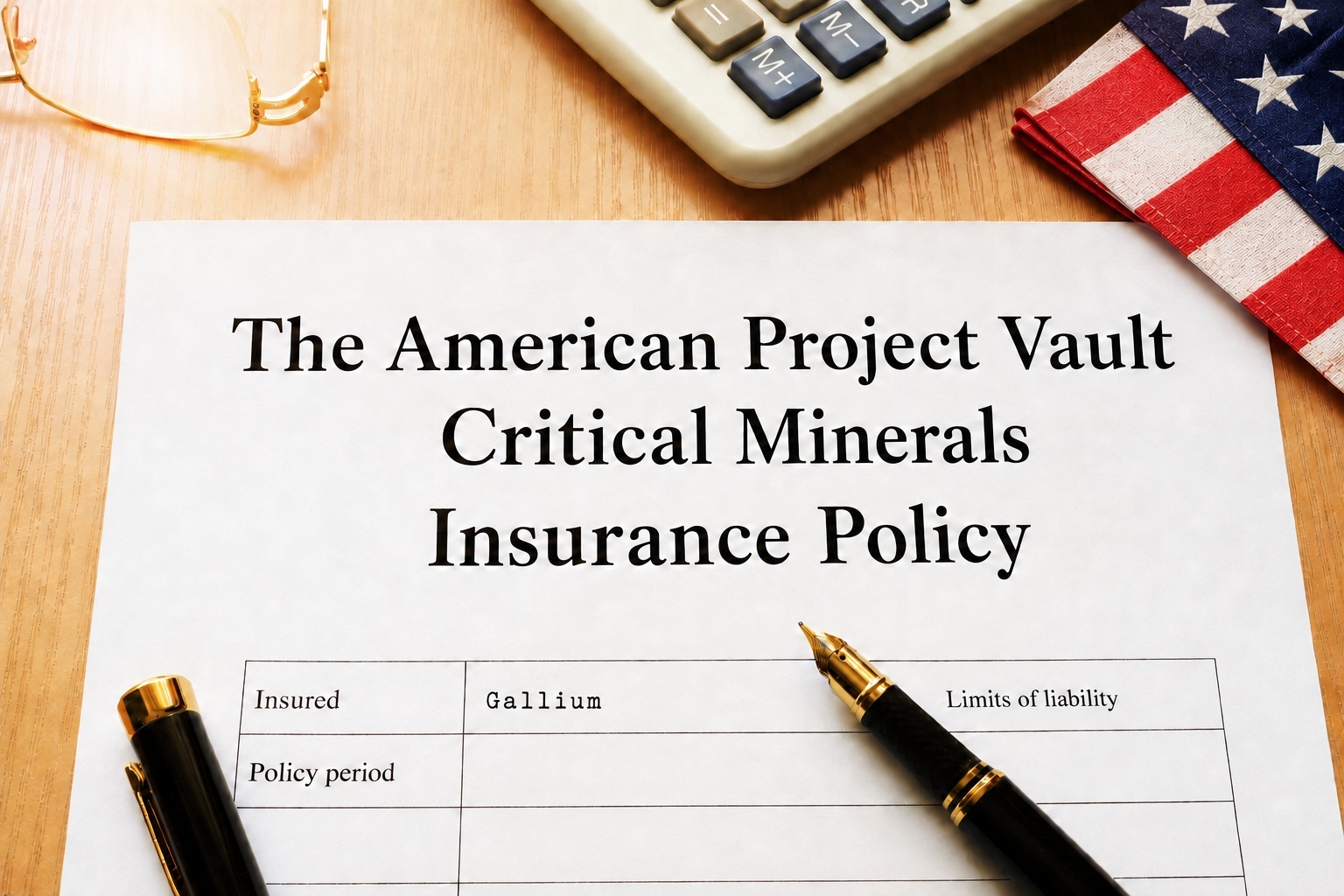
I asked myself: What effect would reserve diversification by the U.S. Treasury and other governments have on the global pricing of critical minerals?
The short answer is that it depends…it depends, entirely on how the reserve is designed, what it purchases, and the chemical and physical forms in which those materials are held. A government that simply enters thin commodity markets with several billion dollars can raise prices without creating a single unit of new productive capacity. A government that buys countercyclically, publishes exact technical specifications, rotates usable inventory through qualified manufacturers, and enters into bankable purchase commitments can change the economics of an entire industrial supply chain.
Strictly speaking, Project Vault is not a diversification of the Treasury’s monetary reserves. It is the U.S. Strategic Critical Minerals Reserve, organized as an independently governed partnership and financed through a $10 billion loan from the Export Import Bank of the United States and nearly $2 billion in private capital. Treasury Secretary Scott Bessent has described it as a market based mechanism for protecting American manufacturers from supply shocks. That distinction is important. Gold and foreign exchange reserves preserve monetary value and liquidity. Project Vault is supposed to preserve industrial continuity. Its success should therefore be measured not by the market value of the material it owns, but by how long that material can keep essential American factories operating.
The current pricing system is not a normal market
Prices for most critical minerals are established in small, fragmented, and frequently opaque markets. Unlike copper, gold, or crude oil, there is no deep and universally accepted exchange traded benchmark for dysprosium oxide, terbium oxide, gallium metal, scandium oxide, high purity manganese sulfate, or most other specialized industrial materials. Transactions are commonly negotiated through private contracts. Volumes are small, delivery terms differ, and prices can change materially according to purity, particle size, impurity profile, packaging, country of origin, and whether the material has been qualified by the customer.
This is not a minor technical distinction. Dysprosium oxide at a stated purity is not necessarily interchangeable with another producer’s dysprosium oxide at the same stated purity. The identity and concentration of the remaining impurities may determine whether the material can be used in a particular metallurgical process. A published price may therefore describe a chemical category without describing a commercially interchangeable product. Banks cannot finance a refinery or metal plant on the assumption that every kilogram bearing the same chemical name has the same industrial value.
The scale of the economic exposure is much larger than the apparent size of the mineral markets. The U.S. Geological Survey reported that American nonfuel mineral production was valued at $112 billion in 2025, while the industries dependent on those materials represented approximately $4.09 trillion of economic activity. The value of net imports of processed metals and materials rose from $77 billion in 2024 to $185 billion in 2025. The vulnerability is therefore not the value of the mineral at the mine gate. It is the value of the manufacturing activity that can be interrupted when a relatively small quantity of a specialized material is unavailable.
Rare earths illustrate the problem. In 2025, China produced an estimated 270,000 metric tons of rare earth oxide equivalent, compared with 51,000 metric tons in the United States and approximately 390,000 metric tons worldwide. The United States is therefore not without rare earth mineral production. Yet USGS data show that the country remained heavily dependent on imports of rare earth compounds and metals. The contradiction disappears once one understands that mining concentrate is not the same business as separating individual rare earth oxides, reducing those oxides to metals, making alloys, and manufacturing qualified magnets. The mine is only the first step in a much longer chemical and metallurgical system.
Gallium is an even more concentrated example. USGS estimates that China accounted for 99% of worldwide primary low purity gallium production in 2025. The average unit value of imported gallium metal in the United States reached approximately $580 per kilogram, about 30% above the 2024 level. Gallium is not normally mined from a gallium orebody. It is recovered in small concentrations as a byproduct of processing other materials, principally bauxite and zinc ores. A strategic gallium policy must therefore address recovery circuits, refining, purification, and customer qualification. Announcing a new gallium mineral resource does not create a gallium supply chain.
Antimony demonstrates how quickly geopolitical behavior can be transmitted into price. According to USGS, the average U.S. antimony metal price rose from approximately $10.24 per pound in 2024 to $25 per pound in 2025 following Chinese export controls and the subsequent prohibition on exports to the United States. That increase did not result from a comparable expansion in the underlying industrial demand for flame retardants, alloys, ammunition, batteries, and semiconductor applications. It reflected the sudden repricing of supply risk in a market with few immediately available alternatives.
This is the environment in which Project Vault will operate. Prices are affected by Chinese production decisions, export licensing, temporary surpluses, inventory liquidation, government announcements, and the purchasing decisions of a relatively small number of consumers. A modest surplus can make a Western project uneconomic. A modest shortage can multiply prices even when end use demand has barely changed. The result is a market that routinely destroys the capacity it later discovers it needs.
What Project Vault could change
A properly managed reserve would introduce something these markets rarely possess: a credible, permanent, countercyclical buyer. Project Vault should not guarantee profits or attempt to legislate a single price for a chemically diverse product. It should establish transparent purchasing ranges within which it is prepared to acquire specification compliant material when prices fall below levels capable of sustaining strategically necessary production. The central bank analogy is imperfect because critical materials are not currencies and Project Vault cannot create unlimited purchasing power. Nevertheless, a disciplined institutional bid would place a floor beneath qualified production without promising to rescue every mine, refinery, or promotional venture.
That would change the cost of capital, but only if the government’s commitments were legally and financially bankable. The mere possibility that Project Vault might purchase material someday will not finance a separation plant. A defined purchase agreement, minimum volume commitment, or advance market commitment may. Lenders must be able to identify the product, the qualification standard, the delivery schedule, the price formula, the term of the agreement, and the government or commercial entity legally obligated to take delivery. Without those elements, Project Vault is a warehouse. With them, it can become an instrument of industrial finance.
The immediate beneficiaries should not be limited to mines. In many critical minerals supply chains, mining is neither the most difficult nor the most strategically important stage. The real bottlenecks are separation, purification, metallization, alloying, powder production, component manufacturing, and qualification. Financing another mine that must ship its concentrate to China for processing may diversify geology while reinforcing industrial dependence. Project Vault should direct purchasing power toward the points in the supply chain where technical capability is scarce and replacement times are longest.
Strategic reserve buying would also make market predation more expensive. China’s scale gives its producers the ability to maintain production during periods when competitors cannot survive prevailing prices. Whether every period of oversupply is deliberate is beside the point. The commercial result is the same: competing projects lose financing, facilities close, skilled personnel leave, and customers return to the dominant supplier. If Project Vault absorbs qualified non Chinese production during a price collapse, an oversupply strategy must be sustained for longer and at greater cost before it can eliminate competitors.
Average prices would probably be somewhat higher under such a system, but they should also be less volatile. Manufacturers generally prefer a stable and financeable input price to an artificially low price that can multiply without warning. The antimony market has already shown the difference. A manufacturer can incorporate a known material cost into a contract. It cannot easily manage a price that more than doubles in a year because an export control has suddenly removed commercially available supply. Price stability reduces emergency inventory, redesign costs, substitution programs, contract disputes, and the working capital required to protect production.
Project Vault could also improve price discovery. Every purchase would require the reserve to define material form, purity, acceptable impurities, assay procedures, packaging, delivery, title, origin, and storage conditions. Competitive tenders could create real transaction data in markets now dominated by private quotations and price assessments based on small numbers of trades. Those data would be useful to lenders and manufacturers, provided the government did not commit the common analytical error of combining different chemical forms and specifications into one misleading benchmark.
Where the reserve could fail
Governments are notoriously poor commodity traders because political time horizons and industrial time horizons are not the same. Officials may be pressured to buy when prices are high because a shortage is in the news, then sell when prices are low because the inventory appears expensive to maintain. Political influence may determine which companies qualify. Purchases may be distributed according to congressional geography rather than metallurgical necessity. Material may be released to reduce a headline price even when doing so would bankrupt the domestic producer the reserve was created to protect.
There is also the physical problem of inventory. Materials are not abstract entries on a balance sheet. Metals oxidize. Fine powders can become contaminated or agglomerated. Battery chemicals may absorb water. Magnets corrode and can become obsolete when designs change. Gallium requires appropriate containment because it can attack certain other metals. Even a chemically stable oxide can lose commercial value if the customer changes its process or impurity tolerances. A certificate issued when material entered storage does not guarantee that an aerospace company, semiconductor manufacturer, or defense contractor will accept it years later.
Qualification is equally important. Government can verify chemistry, but it cannot simply order an industrial consumer to accept an unfamiliar material in a safety critical application. Qualification may require repeated production runs, process adjustments, destructive testing, reliability data, and customer approval. The July 20, 2026, executive order on defense supply chains recognizes this issue by directing contractors to map supply chains from raw materials to end products and by requiring a strategy to accelerate testing and qualification of alternative sources. Project Vault must be integrated with that qualification system or risk accumulating technically correct materials that remain commercially unusable.
Treasury assets and industrial reserves are different things
Treasury reserve diversification seeks to preserve national wealth through liquid assets expected to retain value. An industrial reserve exists to preserve production during war, embargo, natural disaster, political disruption, or market failure. These purposes overlap, but they are not interchangeable. Gold is primarily a monetary reserve asset. Neodymium metal is primarily an industrial input. Gallium may retain financial value, but its strategic usefulness depends on its purity, form, packaging, certification, and availability to the user who needs it.
Critical minerals also impose carrying costs that monetary reserves do not. They require specialized storage, inspection, insurance, assay, security, and inventory rotation. Their markets may be too small to liquidate large quantities without destroying the price. Project Vault should therefore never represent its holdings as the equivalent of gold or foreign exchange. Its value is the economic loss it prevents, not merely the price at which the inventory might be sold.
That is why Project Vault should be operated as industrial insurance. Insurance is not judged by whether the premium would have earned more money elsewhere. It is judged by whether the policy responds when the insured event occurs. The relevant measure is not tons accumulated or dollars committed. It is the number of weeks or months that designated American production lines can continue operating after their ordinary supply has been interrupted.
Reserve industrial capability, not geology
Here is where I believe the discussion becomes genuinely novel. Project Vault should reserve qualified industrial materials, not merely minerals. It should hold separated oxides, specification certified metals, master alloys, high purity semiconductor materials, battery grade chemicals, magnetic powders, aerospace grade samarium cobalt alloys, and, where appropriate, finished NdFeB magnet blocks. These are the forms manufacturers consume.
Holding monazite concentrate or mixed rare earth carbonate provides little immediate protection if the United States lacks the separation capacity required to produce individual oxides. Holding an oxide provides limited protection if there is no available metallization capacity. Holding neodymium and praseodymium metal is insufficient if the required alloy, strip casting, powder production, pressing, sintering, machining, coating, and magnet qualification must still occur in China. A supply chain is secure only when the material can move through every necessary transformation into the component the manufacturer actually uses.
In chemical terms, Project Vault should favor the lowest entropy practical form: the most ordered, specification constrained, and immediately usable material consistent with reasonable storage life. Every industrial transformation adds energy, knowledge, capital, quality control, and skilled labor. That accumulated value is why a kilogram of qualified alloy or semiconductor grade metal is strategically different from a kilogram of mineral concentrate containing the same element.
The reserve must also rotate its inventory through real manufacturers. Material approaching the end of its designated storage period should be sold to qualified domestic users and replaced with new production. Rotation confirms that the inventory remains usable, gives alternative suppliers recurring commercial experience, maintains customer qualifications, and prevents the reserve from becoming a geological museum.
My conclusion
This leads me to what I would call Lifton’s Third Law of Strategic Reserves:
A strategic reserve should stabilize productive capability, not merely accumulate commodities.
- Project Vault should not be judged by the tonnage stored in secure buildings. It should be judged by whether American manufacturers can continue producing when commercial markets fail. A reserve that contains raw materials but lacks the chemical, metallurgical, manufacturing, and qualification capability required to use them is not a strategic reserve. It is an inventory report.
- Project Vault should buy products, not promises. It should support operating producers, qualified processing routes, and complete domestic or allied supply chains. Its objective must be to preserve the technical capability to transform matter into useful industrial form. That is where the economic value resides, where the strategic vulnerability is greatest, and where China’s competitive advantage remains most formidable.
Lifton Policy Plan of Action for Project Vault — To Do List
- Define the legal mission. Establish by charter that Project Vault exists to maintain essential American industrial production during a verified supply disruption. It is not a commodity speculation fund, a political subsidy program, or a mechanism for manipulating short term market prices.
- Map the production chains. Begin with the defense, semiconductor, energy, transportation, communications, aerospace, and medical systems that cannot tolerate interruption. Trace every material and component backward to its original feedstock and identify every single point of failure.
- Calculate requirements from actual consumption. Determine the quantities required to sustain designated production lines for 30, 90, 180, and 365 days. Do not substitute arbitrary tonnage targets for verified industrial demand.
- Specify the material precisely. Publish the required chemistry, acceptable impurities, physical form, particle size, packaging, testing procedures, country of origin, and storage conditions for every eligible product.
- Buy qualified material, not geological potential. Do not purchase ore, unprocessed concentrate, or mixed chemical products unless an available and contractually secured processing route can convert them into usable material within the required emergency period.
- Purchase countercyclically. Accumulate inventory when prices are weak, material is commercially available, and strategically necessary producers are at risk. Do not compete with manufacturers during a shortage merely to satisfy a government purchasing target.
- Create bankable purchase commitments. Use minimum volume agreements, advance market commitments, and clearly defined price formulas that qualified producers can present to lenders as part of project financing.
- Finance the missing industrial steps. Direct support toward separation, refining, purification, metallization, alloying, powder production, component manufacturing, recycling, testing, and qualification. Another mine does not solve a processing shortage.
- Require a complete non Chinese route. Do not describe a project as supply chain diversification if its product must be sent to China for an essential transformation before it can reach an American manufacturer.
- Include reliable allies. The United States cannot economically produce every required material in every required form. Project Vault should purchase from qualified allied producers when they provide secure, traceable, and diversified supply.
- Integrate qualification with purchasing. Require participating manufacturers and defense contractors to test and qualify alternative materials before an emergency occurs. Stored material that no customer has approved is not usable inventory.
- Rotate the stock. Move aging material through qualified American manufacturers while it remains within specification, then replace it with new production. Inventory rotation should be a permanent operating function, not an emergency disposal exercise.
- Establish strict release rules. Define in advance the supply disruptions, national emergencies, force majeure events, and market failures that permit a release. Political concern about a high price should not, by itself, be sufficient.
- Protect technical integrity. Place purchasing and release decisions under independent chemical, metallurgical, financial, and legal review. Political sponsorship, corporate promotion, or the location of a deposit must never substitute for technical qualification.
- Publish meaningful performance data. Report eligible materials, approved specifications, supplier concentration, inventory condition, rotation activity, and months of protected industrial production without disclosing classified defense requirements.
- Preserve productive capability. Use Project Vault to maintain the operating plants, process knowledge, skilled workforce, customer approvals, and supplier relationships required for American industrial independence.
“Project Vault should not become a warehouse filled with materials that appear valuable on a government balance sheet. It should become a functioning industrial insurance system for the United States. You’re welcome, Project Vault” — Jack Lifton, Co-Chair, Critical Minerals Institute (CMI)


Leave a Reply