
Atlanta’s metropolitan area is home to nearly 6.5 million people, and Georgia gives the critical minerals debate a factory floor. The state’s expanding battery and vehicle manufacturing industries, alongside investment in metals recycling, make Atlanta a compelling place to connect mineral developers with the processors and industrial customers their projects need.
I was in Atlanta last week representing the Critical Minerals Institute (CMI), where I serve as Co-Founder and Executive Director, for the Critical Minerals Expo North America. Held October 28–29 at the Cobb Galleria Centre alongside the Battery Recycling Expo and E-Waste World Expo, the gathering brought mineral development, processing technology and materials recovery into the same conversation. For investors, that combination offers a useful way to assess a sector whose strategic importance is easier to establish than its commercial readiness.
On Wednesday, October 28, from 10:45 to 11:25 a.m. ET, I moderated a 40-minute fireside chat with Melissa “Mel” Sanderson, Co-Chair of CMI and a Non-Executive Director of American Rare Earths Limited (ASX: ARR | OTCQX: ARRNF | ADR: AMRRY), and Constantine Karayannopoulos, President of Kloni Inc. and a member of the CMI Board of Directors. The discussion examined the direction of North America’s critical minerals supply chain.
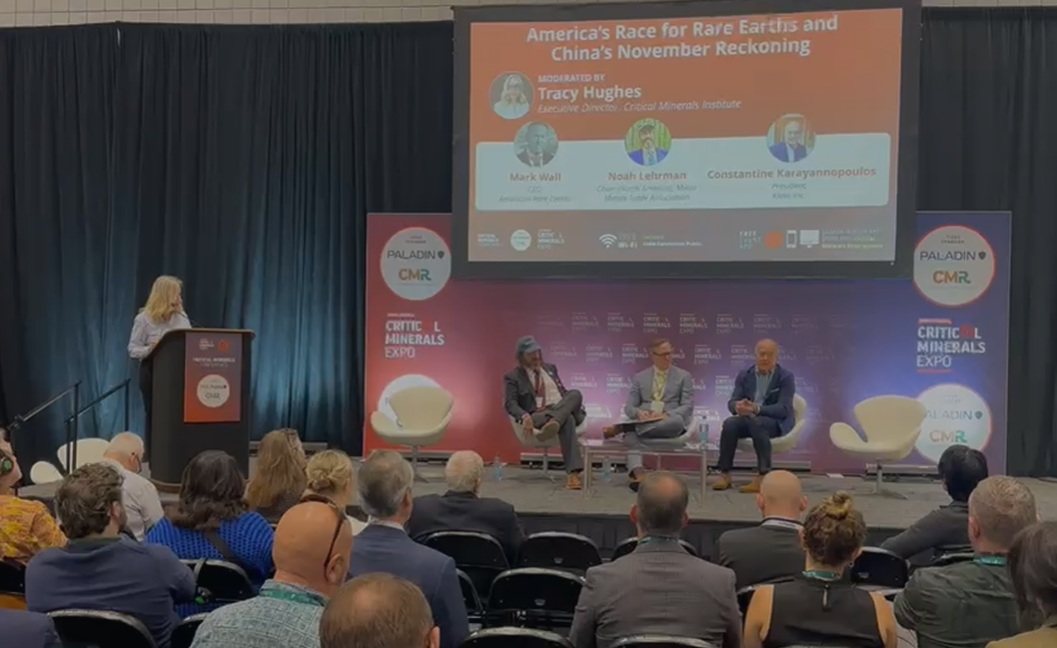
On Thursday, October 29, from 10:20 to 11:05 a.m. ET, I moderated the 45-minute panel “America’s Race for Rare Earths and China’s November Reckoning” with Mark Wall, CEO of American Rare Earths Limited; Noah Lehrman, Chair (North America) of the Minor Metals Trade Association; and Constantine. Both sessions took place in Main Expo Hall A, as listed in the published agenda.
Those two sessions provided the framework for my assessment of the companies present. North America’s supply challenge extends from identifying a mineral resource through permitting, financing, processing and customer qualification. Each stage requires its own evidence, and a credible company should be able to explain precisely where it stands.
Almonty Industries Inc. (NASDAQ: ALM) offers an established producer’s perspective on tungsten supply security. Lewis Black, its Chairman, President and CEO, was listed on the published agenda for a keynote on innovation and human capital. In September, the company announced that its Sangdong processing plant in South Korea had received the certificates required for commercial operation and concentrate sales. That milestone directs attention toward ramping production and delivering tungsten concentrate to industrial customers.
American Tungsten Corp. (TSXV: TUNG | OTCQX: TUNGF), whose CEO Ali Haji appeared on the expo program, deserves particular attention. Its IMA Mine Project in Idaho is a past-producing underground tungsten asset. On October 29, the company reported continued drilling, a new vein discovery and work toward a preliminary economic assessment. The potential to restore a domestic tungsten source gives IMA strategic relevance. The commercial case will depend on the technical studies, economics and development work required to support a possible restart.
American Rare Earths Limited (ASX: ARR | OTCQX: ARRNF), led by Mark, brings the discussion back to Wyoming and the Halleck Creek project, with the Cowboy State Mine planned as its first phase. The company’s presence gave the rare earths panel a direct connection to an American development project. As with other rare earths developers, progress must be assessed across the processing route, permitting, financing and eventual delivery of material that meets customer specifications.
Georgia itself supplied an important industrial example. Aurubis AG (Xetra: NDA), represented on the program by Aurubis Richmond LLC President and Managing Director David Schultheis, has invested approximately $800 million in its multimetal recycling facility in Augusta. Designed to process about 180,000 tonnes of complex recycling materials annually, the plant demonstrates the scale of capital required to expand regional processing capacity. Its extended ramp-up also illustrates why investors need to distinguish installed capacity from sustained operating performance.
The Chemours Company (NYSE: CC) offers another route through existing operations. Its announced alliance with Energy Fuels Inc. (NYSE American: UUUU | TSX: EFR | ASX: EF2) seeks to combine the company’s heavy mineral sands capabilities in Florida and Georgia with downstream processing to create a domestic supply chain for rare earths, titanium and zirconium. Recovering additional value from established mineral streams can broaden the supply response, provided the partners can connect recovery, processing and end markets economically.
The equipment and technology companies were equally relevant. Metso Corporation (Nasdaq Helsinki: METSO) supplies mineral processing systems and technology for recovering battery metals from black mass. MAIRE S.p.A. (Euronext Milan: MAIRE), through Nextchem S.p.A., is expanding its metals recovery capabilities, including an October agreement to acquire MEAB AB in Sweden and MEAB GmbH in Germany. These companies direct attention toward the processing expertise required to turn varied feedstocks into consistent products. Separation and recovery technology will determine how much useful material emerges from both mines and recycling plants.
American Battery Technology Company (NASDAQ: ABAT), led by Ryan Melsert, connects that processing theme to commercial battery recycling near Reno, Nevada. On October 1, the company announced an export license permitting sales of up to $100 million of recycled black mass under specified terms. Black mass is an intermediate containing recoverable battery materials that require further refining. Its development therefore points to the importance of building dependable relationships between recyclers and downstream processors, as well as securing the necessary feedstock.
Privately held Electronic Recyclers International, Inc. and Critical Materials Recycling Inc. also warrant attention. John Shegerian and Daniel Bina, their respective CEOs, appeared on the conference program, bringing electronics recycling and materials recovery into the discussion. Their presence alongside mining and processing businesses reinforced the value of examining discarded electronics as a source of materials, with collection, sorting and recovery forming an industrial chain of their own.
The private developers offered a view of the next potential entrants to public markets. Sio Silica Corporation, whose CEO Feisal Somji spoke at the expo, is pursuing high-purity silica in Manitoba. Its announced offtake agreement must be considered alongside the extraction licensing process. U.S. Critical Materials Corp. is advancing its Sheep Creek rare earths and gallium project in Montana, where an exploration application entered public scoping in October. Fermi Critical Minerals Inc., with Wyoming projects including Blue Rim, outlined a TSX Venture Exchange listing objective for the first quarter of 2027 in its September presentation. These remain development and financing stories, with proposed public-market transactions subject to completion.
A further group of companies supplied the industrial infrastructure around those projects. Linde plc (NASDAQ: LIN) provides industrial gases and engineering; Scantech Limited, an unlisted public company, supplies bulk material measurement systems. Heat-transfer specialist Kelvion Holding GmbH is the subject of an announced acquisition by SLB N.V. (NYSE: SLB), with closing expected in the first half of 2027. AI company Upstage Co., Ltd. adds document processing to the mix. Measurement, heat management, gases and usable information all influence how effectively an industrial operation can be built and run.
My thanks to the UK-based organizers, Trans-World Events Ltd., including Event Director Peter Sarno, Conference Manager Gabriel Day and the wider team, for bringing these connected industries together in Atlanta. I would also like to recognize CMI Member Marcy Kiesman, CEO and Chair of Quantum Critical Metals Corp. (TSXV: LEAP | OTCQB: ATOXF), who helped at the CMI booth. Her support was much appreciated.
For CMI, the value of being in Atlanta was the opportunity to consider these businesses within a connected supply chain. Public companies, private developers, recyclers and technology suppliers each address a different requirement. The next phase of this industry will be judged by the links between them: projects that secure financing, plants that achieve reliable recoveries, and materials that customers can qualify and purchase. That is where strategic ambition becomes industrial capability.


Leave a Reply