
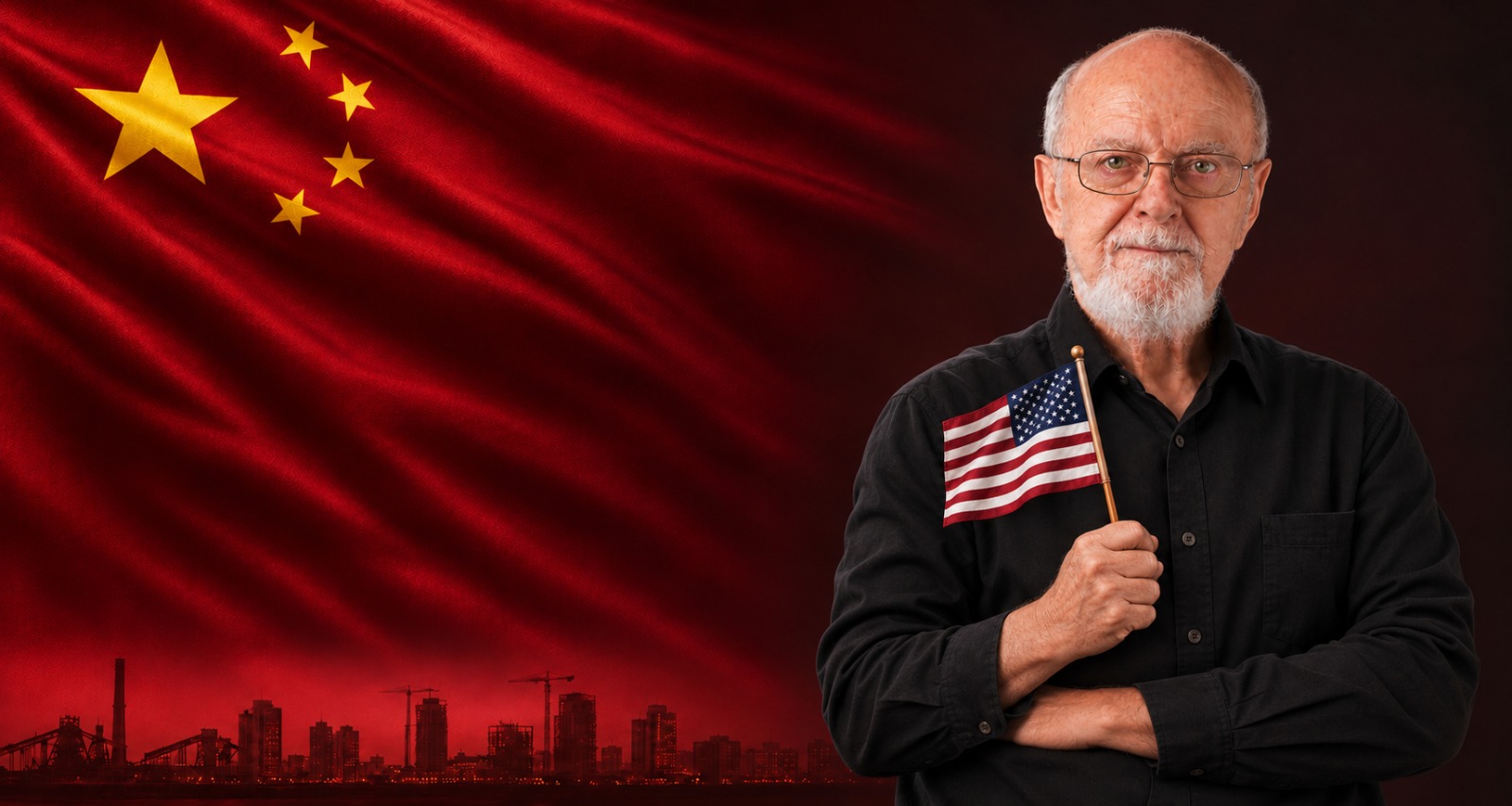
“The world is not deciding whether it wants to trade with China. It is deciding how much dependence upon China it can afford. China, in turn, may soon have to decide how much dependence upon the rest of the world’s consumers its own industrial economy can afford.” — Jack Lifton, Co-Founder & Co-Chair, Critical Minerals Institute (CMI).
I recently had a fascinating conversation with a European-born colleague who has spent the last thirty years living and working in East Asia as a metals trader and observer of Asian industrial economies. He has studied and worked in both China and Japan, speaks Mandarin and Japanese fluently, maintains a business office in China, and now lives with his family in Singapore. I mention his background because he has gained his understanding of China’s economy through participation in its industrial and commercial life, not simply by reading the pronouncements of economists, politicians, or financial analysts. His conclusion about China’s economic future struck me as both provocative and worthy of serious consideration. He believes that China, through its deliberate pursuit of economic and industrial dominance, may have brought about the international reaction that will ultimately undermine the very system responsible for its extraordinary growth.
I began our discussion by positing that the globalization of world trade, which now appears to be disintegrating, was, in my opinion, largely an artifact of the overwhelming American military, industrial, and financial predominance that emerged from the Second World War. The United States found itself in an unprecedented position in modern history. Its industrial infrastructure was intact, its potential enemies had been defeated, its allies were economically exhausted, and its currency had become the foundation of the international financial system. The United States shaped the postwar economic order in ways that reflected its own interests and capabilities. The globalization that followed was not inevitable. American power made it possible, American policy encouraged it, and nations whose industrial recovery and growth depended on access to international markets eventually embraced it.
The irony, in my view, is that the United States ultimately became the world’s greatest consumer economy while allowing an increasing proportion of the industrial production necessary to satisfy that consumption to move abroad. What began as the reconstruction of Europe’s and Japan’s industrial economies evolved into the international redistribution of manufacturing. China was the greatest beneficiary of the later stages of this process, particularly after its admission to the World Trade Organization in 2001.
My colleague approached the subject from a different direction. He believes that China’s economic development was facilitated by a fundamental failure of foresight on the part of the industrial nations that transferred manufacturing, technology, capital, and technical expertise to China. The Americans, Europeans, Japanese, and Koreans who participated in this transformation were primarily concerned with immediate commercial advantages. They wanted lower manufacturing costs, access to an enormous potential market, and increased profitability. They did not adequately consider the consequences of helping create an industrial competitor whose government regarded economic development not merely as a means of increasing national prosperity but also as an instrument of national power.
China, of course, did not become an industrial power simply because foreigners transferred factories and technology to it. Its government made enormous investments in infrastructure, education, industrial development, and the organization of manufacturing supply chains. Chinese engineers, scientists, entrepreneurs, and workers developed formidable capabilities. The country’s achievement is real, and it would be foolish to dismiss it as merely the product of Western mistakes. Nevertheless, the Western assumption that commercial integration would eventually make China resemble the liberal market economies with which it traded has proved to be a serious miscalculation.
My colleague believes that the consequences of this miscalculation are now becoming apparent. The industrial nations that encouraged China’s rise have begun to regard their dependence upon Chinese production as a threat to their economic and national security. This is especially apparent in the markets for critical minerals, metals, and materials, but the concern extends far beyond them. It encompasses chemicals, pharmaceuticals, electronic components, machinery, batteries, transportation equipment, and an increasing range of manufactured products. Governments that once celebrated the economic efficiencies of global sourcing now speak of domestic supply chains, strategic independence, industrial resilience, and national security.
My colleague’s proposition is that the world has begun to ask a question that would have seemed absurd twenty years ago: If we lived without China as the center of global manufacturing before the beginning of this century, why can we not learn to do so again?
This is an attractive proposition, but it requires qualification. The industrial world of 2026 is not the industrial world of 1990. China is now deeply embedded in producing intermediate goods, components, machinery, and materials incorporated into products manufactured elsewhere. Replacing a Chinese supplier is not necessarily a matter of finding another factory. It may require recreating an entire industrial ecosystem, including skilled workers, specialized equipment, qualified materials, engineering services, and a sufficiently large customer base to support competitive production. The passage of time has not merely changed the location of manufacturing. It has changed the distribution of industrial knowledge and capability.
This brings me to what I find most interesting in my colleague’s argument. He disputes the commonly expressed view that China’s economy is relatively independent of exports because exports represent only a modest percentage of its gross domestic product. He argues that this statistical approach misrepresents how China’s industrial economy is organized.
The frequently repeated figure of approximately 8 percent is not, in fact, the conventional measure of China’s total exports as a share of GDP. The World Bank’s measure of exports of goods and services was approximately 21 percent in 2025. But even that figure does not settle the question my colleague raises. A nation’s dependence upon international markets cannot be understood simply by comparing the recorded value of exports with the recorded value of domestic production.
A manufacturer producing goods for export purchases materials, machinery, energy, transportation, engineering services, and numerous other inputs from domestic suppliers. The economic activity supporting exports therefore extends well beyond the factories shipping finished products abroad. Employment, investment, local government revenues, and the financial viability of entire industrial districts may depend upon maintaining international demand. Not all of this supporting activity represents additional value attributable to exports, and it would be wrong to count every transaction as a separate contribution to national output. Nevertheless, the industrial consequences of a substantial decline in foreign demand could be far greater than a superficial reading of export statistics might suggest.
China has an enormous domestic market, and it would be equally mistaken to suggest that Chinese consumers are economically insignificant. The issue is whether domestic consumption can absorb the output of an industrial system built to supply both China and the rest of the world. China’s emphasis on investment, manufacturing capacity, and industrial competitiveness has not been matched by an equivalent development of household consumption as a source of final demand. This imbalance helps explain why Chinese manufacturers continue to seek foreign customers even in industries where domestic production capacity already exceeds domestic demand.
In this respect, I think my colleague has identified a genuine vulnerability. An industrial economy organized around expanding production must ultimately find customers who can buy what it produces. If its foreign customers begin deliberately reducing their dependence upon its products, the resulting problem cannot necessarily be solved by building additional factories, increasing productivity, or reducing prices. Those measures may actually intensify the difficulties of an economy already struggling to absorb its industrial output.
My colleague also directed my attention to the Chinese Communist Party’s Document Number Nine, an internal Party communication circulated in 2013, early in Xi Jinping’s leadership. The document warned against Western constitutional democracy, universal values, civil society, economic liberalism, independent journalism, and other ideas the Party considered threats to its authority. It is an extraordinary statement of the Party’s determination to preserve its political and ideological control.
I do not interpret Document Number Nine as a literal declaration of an intention to conquer or dominate the world economically. Its immediate purpose was to protect Communist Party rule within China. But it matters because it shows how far the Party rejects the assumption that economic integration with the West requires political or ideological convergence. The Western nations expected commercial globalization to encourage China to adopt their economic and political values. The Chinese Communist Party intended to participate in globalization while preserving its own system and strengthening its ability to resist foreign influence.
The distinction is fundamental. China accepted the benefits of globalization without accepting the Western political expectations attached to them. Indeed, the Chinese government increasingly treated industrial development and technological self-sufficiency as essential components of national security and political independence.
The succession of Chinese five-year plans makes this direction unmistakable. The emphasis on indigenous technological development, the localization of industrial supply chains, and the pursuit of leading positions in strategically important manufacturing sectors has become increasingly explicit. China’s current Fifteenth Five-Year Plan continues this policy, emphasizing technological self-reliance, industrial competitiveness, and leadership in key technologies. These objectives are not concealed. They are openly stated elements of Chinese national economic policy.
I would distinguish, however, between China’s desire to become independent of foreign industrial capabilities and the proposition that it intends to make every other nation permanently dependent upon China. The former is clearly established policy. The latter is a reasonable concern arising from the consequences of Chinese industrial dominance in certain sectors, but it should not automatically be treated as proof of a single, comprehensive plan for global economic control.
The distinction matters because it helps explain the international reaction. The United States, Japan, South Korea, and the European industrial nations do not have identical interests. They compete with one another in many of the same markets, and their economic relationships with China differ substantially. Yet they increasingly share a concern that dependence upon Chinese industrial production can become a source of political vulnerability.
I have spent much of my professional life in the technology metals markets, and I regard the rare earth industry as perhaps the clearest illustration of this problem. China did not acquire its commanding position in rare earth separation, metal making, alloy production, and permanent magnet manufacturing simply by possessing mineral deposits. It built an integrated industrial system that connected raw materials with finished products and, most importantly, with customers. The industrial nations that allowed much of this capability to disappear from their own economies now find that reopening a mine is not the same as rebuilding a supply chain.
This is why I have consistently argued that industrial capability, rather than announced capacity, must measure progress in restoring domestic critical-material supply chains. A mine without qualified downstream customers is not a supply chain. A separation plant without a commercially viable destination for its products is not a supply chain. A metal or alloy producer without the technical capability to meet manufacturers’ specifications is not a supply chain. Government subsidies cannot indefinitely substitute for the commercial relationships and technical qualifications that make industrial production economically sustainable.
China understands these relationships because it has spent decades developing them. The United States, by contrast, is trying to recreate selected portions of an industrial economy it allowed to decline, assuming access to the world market would always be available on acceptable terms.
There is another irony here. China has been seeking technological and industrial self-sufficiency for years. Its trading partners now pursue the same objective, in part because they worry about China’s success. What China regards as a legitimate national development strategy is increasingly regarded by other nations as an essential response to their dependence upon China.
The result is not necessarily the end of international trade. It is the possible end of the assumption that economic efficiency alone should determine the international organization of industrial production. Governments are increasingly willing to accept higher costs in exchange for greater supply security. Businesses are being asked to consider political risk, geographic concentration, and the reliability of foreign suppliers alongside price and quality. The globalization that developed under American leadership is being replaced, at least in part, by a system in which national security considerations increasingly determine industrial investment and trade relationships.
But a substantial difference exists between deciding to reduce dependence on China and having the means to do so. Political declarations cannot manufacture skilled metallurgists, chemical engineers, industrial equipment, or experienced production managers. Nor can legislation instantly create the customers required to sustain new industrial enterprises. Rebuilding industrial capabilities will take years, perhaps decades, and will require levels of coordination and commercial discipline that Western governments have not recently demonstrated.
China, meanwhile, is not standing still. It has its own domestic market, substantial financial and industrial resources, and the ability to redirect trade toward countries that do not share American or European strategic priorities. Its exporters can also establish manufacturing operations abroad, complicating the distinction between dependence upon Chinese imports and dependence upon Chinese-owned industrial capabilities. A reduction in China’s share of particular Western markets would not necessarily mean its exclusion from the global economy.
I therefore agree with the central insight of my colleague’s thesis, but not necessarily with its most sweeping implication. China has helped create the conditions for an international reaction against its industrial dominance. The use, or threatened use, of concentrated industrial capabilities as instruments of political leverage has made that reaction more likely. But the world cannot simply return to the economic arrangements that existed before China’s emergence as a manufacturing superpower.
Nor does it follow that China will necessarily suffer more from this transformation than its former customers. That will depend upon the relative abilities of China and its trading partners to reorganize production, develop domestic demand, maintain technological competitiveness, and absorb the economic costs of restructuring their industries.
The deeper question is whether China has created an industrial economy whose productive capacity requires a degree of international market access that its own political and strategic ambitions now help restrict. If so, the country may discover that industrial dominance and economic security are not synonymous.
I return, finally, to my original proposition about the American origins of postwar globalization. The United States created and sustained an international economic order under which other nations could become industrial competitors while retaining access to the American consumer market. China became the greatest beneficiary of that system’s later development. Now the United States and its allies are reconsidering the wisdom of the arrangements that made China’s extraordinary growth possible.
The irony is that China may have pursued the benefits of globalization so successfully, and sought to convert those benefits into strategic independence so visibly, that it has persuaded its principal customers to pursue strategic independence from China.
My colleague’s thesis is therefore not that China has already lost its position in the world economy. It is that China may have initiated the process by which its customers will attempt to make that position less indispensable.
I think he may be right.
But I would add one final observation. The world is not deciding whether it wants to trade with China. It is deciding how much dependence upon China it can afford. China, in turn, may soon have to decide how much dependence upon the rest of the world’s consumers its own industrial economy can afford.
Those are two sides of the same problem, and neither side can solve it merely by declaring itself independent.


Leave a Reply