
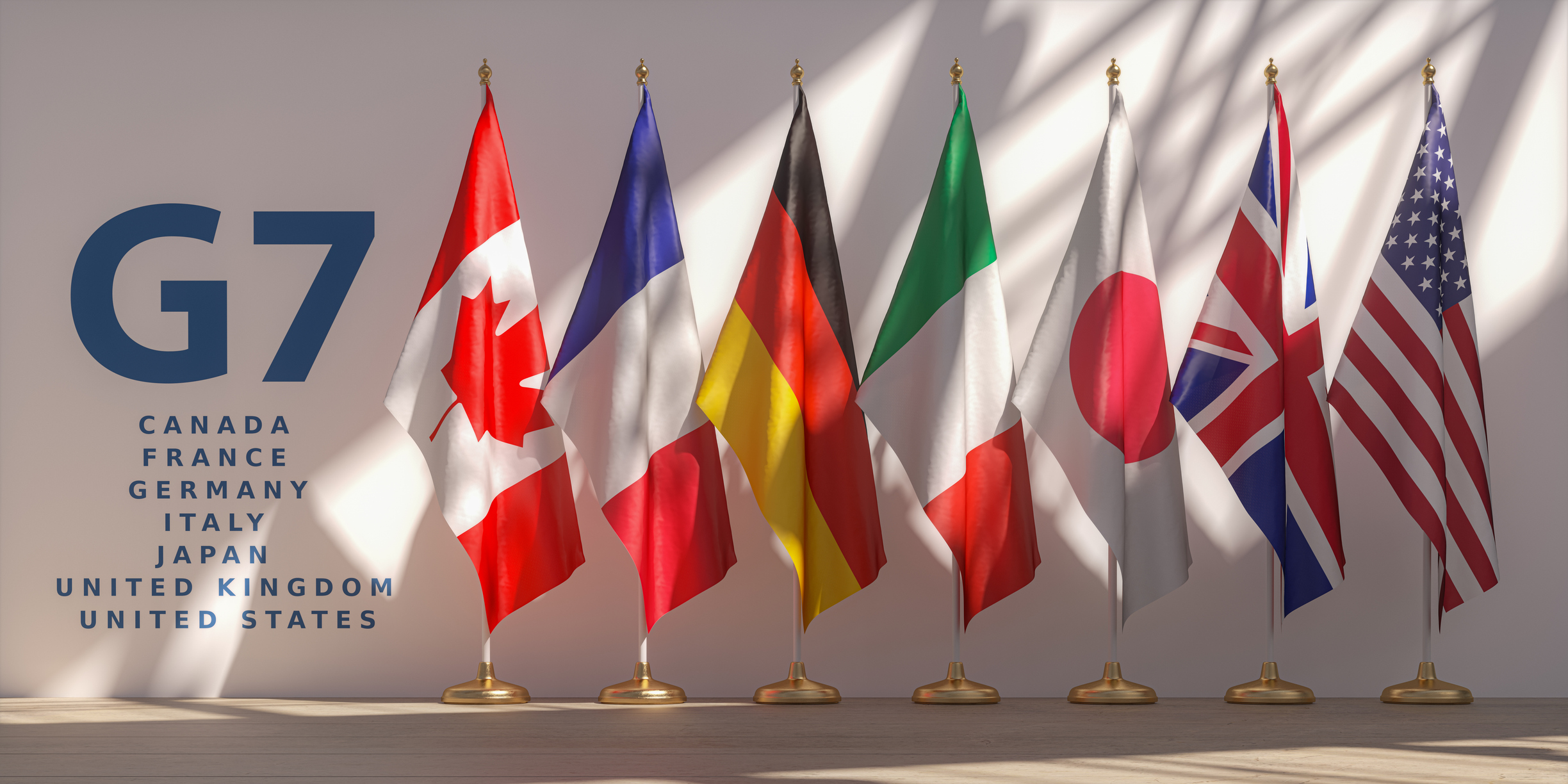
The most consequential development in critical minerals today is not geological. It is geopolitical: the quiet emergence of an international alliance dedicated to securing critical mineral supply chains.
Over the past three years, the G7 has constructed what appears, at first glance, to be a collection of disconnected initiatives focused on critical minerals security. There has been Japan’s Five-Point Plan for Critical Minerals Security, Italy’s work on stockpiling and supply-chain resilience, Canada’s G7 Critical Minerals Action Plan and Critical Minerals Production Alliance, and, most recently France’s efforts to deepen investment coordination and supply-chain cooperation. Viewed individually, these initiatives can appear incremental, bureaucratic, and difficult to follow. Viewed collectively, however, they reveal something much more consequential: the gradual construction of an allied framework designed to secure critical mineral supply chains across the democratic world.
The comparison that continually came to mind as I worked through the G7 documentation was NATO.
Not because the G7 is creating a military alliance around minerals. It is not. Nor is there a treaty, a headquarters, or a formal collective-defence commitment. Yet the underlying logic is remarkably familiar. NATO emerged from the recognition that the security of individual nations could no longer be separated from the security of their allies. The G7’s critical minerals framework begins with a similar premise: that no single Western nation can independently secure the mineral supply chains upon which modern economies, advanced manufacturing, artificial intelligence infrastructure, energy systems, and defence industries increasingly depend.
The chronology itself is revealing. The initiative formally began in April 2023 when G7 ministers meeting in Sapporo adopted the Five-Point Plan for Critical Minerals Security. At the time, the focus was relatively narrow: forecasting supply and demand, supporting new mining and processing projects, encouraging recycling, mobilizing investment, and preparing for potential disruptions. By 2024, however, the agenda had expanded considerably. Italy’s presidency introduced discussions around voluntary stockpiling, traceability systems, circular economy initiatives, market distortions, and strategic dependencies. When Canada assumed the presidency in 2025, the initiative moved decisively from agenda-setting toward implementation through the launch of the G7 Critical Minerals Action Plan and, later, the Critical Minerals Production Alliance. France’s presidency has since pushed the framework further into the realm of coordinated investment, industrial policy, and supply-chain security.
What is striking is not simply the evolution of the initiative, but the evolution of its language. Early discussions focused primarily on resilience and sustainability. More recent documents increasingly reference economic security, strategic vulnerabilities, non-market practices, export restrictions, market concentration, and what policymakers now openly describe as the weaponization of dependencies. These are not the traditional concerns of mining ministries. They are the concerns of governments confronting a world in which supply chains have become instruments of geopolitical leverage.
The framework’s stated objectives now extend well beyond resource development. Critical minerals are increasingly being discussed alongside economic security, industrial resilience, advanced manufacturing, digital infrastructure, defence preparedness, and strategic competition. In effect, governments are no longer treating critical minerals simply as commodities. They are treating them as strategic assets.
This shift helps explain why projects such as those being advanced by First Phosphate Corp. (CSE: PHOS | OTCQX: FRSPF | FSE: KD0) have attracted increasing attention within policy circles. The significance of such projects is no longer measured solely by their economics or geology. They are increasingly evaluated according to their potential role within a broader allied supply-chain architecture. Governments are beginning to ask not merely where critical minerals are located, but whether those minerals can be mined, processed, financed, and delivered within trusted jurisdictions and allied industrial ecosystems.
Perhaps the strongest evidence for the “critical minerals NATO” thesis lies in the institutions that are increasingly orbiting the initiative. The International Energy Agency has been tasked with market intelligence, disruption preparedness, and security planning. The World Bank’s RISE Partnership is mobilizing capital and development support in producing nations. The Minerals Security Partnership is facilitating project-level cooperation among allied governments. Export credit agencies, development finance institutions, sovereign investment vehicles, and multilateral lenders are increasingly being aligned toward common objectives. What emerges is not a single organization, but an ecosystem of institutions performing complementary functions in pursuit of a shared strategic goal.
The parallel becomes even more intriguing when one considers NATO itself. In late 2024, NATO identified twelve defence-critical raw materials and subsequently incorporated access to critical minerals, friend-shoring strategies, and multinational stockpiling discussions into its updated Defence Production Action Plan. No formal connection exists between NATO and the G7 framework. Yet both institutions are responding to the same strategic reality: industrial resilience has become inseparable from national security. The supply chains that produce magnets, batteries, semiconductors, aerospace components, and advanced defence systems are increasingly viewed as strategic assets rather than purely commercial networks.
Yet this is also where the analogy begins to break down.
NATO functions because its members accept, however imperfectly, the principle that collective security sometimes requires subordinating narrow national interests to broader alliance objectives. The critical minerals framework has not yet reached that stage.
Indeed, one of the most interesting observations emerging from the G7’s work is the tension between collective ambition and national self-interest.
The communiqués speak the language of allied cooperation. The reality of implementation often looks rather different.
Canada has its Critical Minerals Strategy. The European Union has the Critical Raw Materials Act. Japan has pursued its own supply-chain security initiatives. Australia continues to strengthen its position as a strategic supplier. The United States, meanwhile, has deployed a powerful combination of industrial subsidies, procurement preferences, investment screening mechanisms, trade measures, tax incentives, and national-security authorities designed primarily to strengthen American industrial competitiveness.
This is not a criticism. It is an observation.
Every nation participating in the framework is pursuing its own interests. The question is whether those interests ultimately converge sufficiently to create something resembling a genuine alliance.
The United States sits at the centre of that question.
Washington has been a driving force behind many of the initiatives supporting critical minerals diversification. The United States participates actively in the Minerals Security Partnership, supports the G7 Critical Minerals Action Plan, and consistently advocates for reducing dependence on concentrated supply chains. At the same time, many of the most consequential policies emerging from Washington remain fundamentally national in character. They are designed first and foremost to secure inputs for American industry, American technology companies, and American defence production.
That reality creates an unresolved tension at the heart of the framework.
Can a truly allied critical minerals system emerge when the largest participant retains the ability—and often the incentive—to prioritize domestic outcomes?
The answer remains unclear.
The report identifies numerous structural weaknesses. There is no permanent secretariat, no common financing authority, no harmonized critical minerals list, no shared stockpiling mechanism, and no binding implementation framework. The initiative remains politically ambitious but institutionally thin. Much of the actual work continues to be performed by national governments, development banks, export credit agencies, and multilateral organizations operating under separate mandates.
Yet that observation may also miss the larger point.
The most consequential international institutions rarely emerge fully formed. NATO did not. The European Union certainly did not. Both began as frameworks for cooperation that gradually evolved into more durable structures as circumstances demanded deeper integration.
What makes the G7 initiative worthy of attention is not what it is today, but what it appears to be becoming.
The democratic world is slowly moving away from a model that assumed global supply chains would always function efficiently, predictably, and free from geopolitical interference. In its place, governments are constructing new frameworks designed to secure access to the materials that underpin economic growth, technological leadership, industrial competitiveness, and national defence.
Whether that effort ultimately produces a genuine alliance or merely a loose collection of national strategies remains an open question.
Investors would be wise to pay attention to the answer.
The future winners in critical minerals may not simply be the companies with the best deposits. They may be the companies, projects, and jurisdictions that become integrated into the emerging architecture of allied economic security. If that proves to be the case, the most important story in critical minerals over the coming decade may not be about geology at all.
It may be about whether the world’s leading industrial democracies can move beyond rhetoric and build an alliance capable of securing the strategic materials upon which their future prosperity depends.


Leave a Reply