
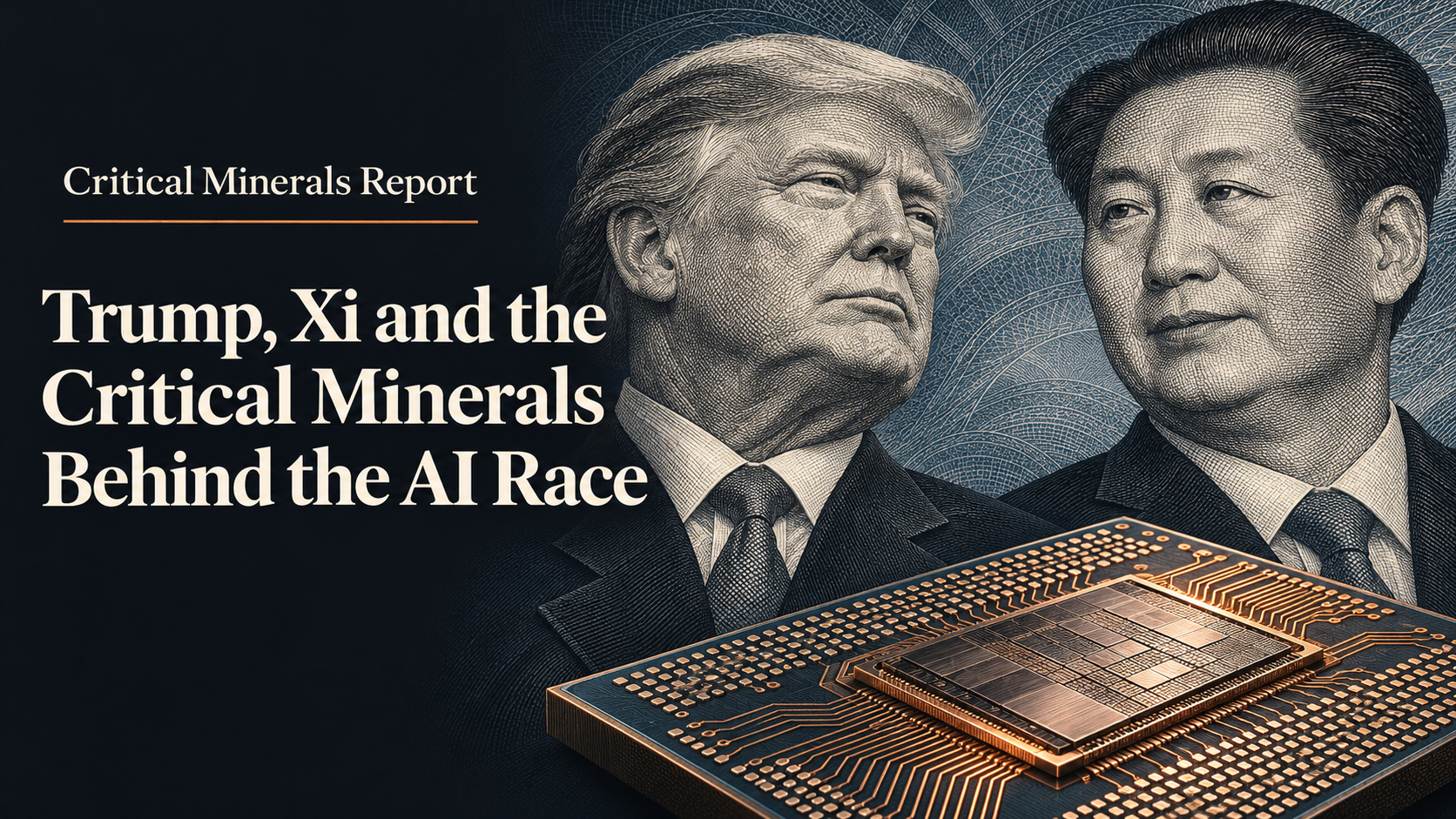
Critical Minerals Report, Edition Covering November 9, 2026 – November 22, 2026
When President Xi Jinping went to the Shenzhen airport on November 18 to meet President Donald Trump, he explained the gesture himself. In September, the American president and the first lady had come to the airport to welcome him to Washington. He was returning the courtesy. It was a strikingly personal exchange between the leaders of two countries still deciding what they can sell each other. Washington decides which advanced American chips Chinese companies may buy. Beijing decides whether Chinese suppliers may ship some of the materials American manufacturers need to make semiconductors and electric motors. For a company such as NVIDIA Corporation (NASDAQ: NVDA), those decisions reach in both directions. Its customers in China need access to American processors. Its suppliers need access to materials Beijing controls.
President Trump held separate talks with President Xi and Russian President Vladimir Putin on November 19, and the three leaders sat down together on the sidelines of the Asia-Pacific Economic Cooperation summit. Their joint declaration included a plan to increase supplies of refined petroleum products and open a dialogue on nuclear risks. In their bilateral meeting, Presidents Trump and Xi agreed to draw up an action plan for the relationship. U.S. Trade Representative Jamieson Greer later described a more pointed exchange over rare earths. President Xi, he said, acknowledged the need to respond to American requests for export licences. Washington had neither sought nor secured a further extension of the trade truce in Shenzhen. Its willingness to extend the arrangement beyond January would depend in large part on how much material arrived and how quickly.
So, what did the better relationship buy? The two presidents had already used it to gain time. At their October 2025 meeting in Busan, they struck a bargain under which Beijing would suspend a new package of export controls and Washington would pause several trade measures of its own. This September, during President Xi’s U.S. visit, their negotiators worked out a two-month reprieve. Beijing announced the January 10, 2027 date on September 28. By the time the presidents met in Shenzhen, the extension was in force. What the November meeting offered was a chance for President Trump to put delayed licences directly to the man with the authority to act on them. The next evidence of success will come from exporters and their customers.
For those customers, the distinction between two Chinese notices is worth more than a general assurance of goodwill. Under the November 9 decision, six measures announced in October 2025 stay suspended from November 11 through January 10. They include restrictions on rare earth technology and on certain products made outside China. This spared an overseas manufacturer the prospect of a new layer of controls taking effect on November 11. Beijing’s April 2025 licensing rules still apply to specified products containing seven medium and heavy rare earths, including some dysprosium and terbium-bearing magnets. A manufacturer that needed a licence for those magnets on November 9 still needed one when the presidents left Shenzhen.
The nearer deadline is November 27, 2026, five days from publication. That is the last day of a separate suspension covering U.S.-bound exports. Unless Beijing acts again, the underlying rule calls for licences for certain gallium, germanium, antimony and superhard materials to be denied in principle, and for closer scrutiny of end users and end uses for covered graphite. An American buyer of covered gallium products has a decision to make this week. An automotive supplier waiting for licensed magnets needs to know when its particular order will clear. Neither can put January 10 on a purchase order as a promised delivery date.
This is where the two clocks of the rare earth trade come into view. A buyer can use a few extra weeks to get a shipment through. A company considering a new refinery needs customers willing to buy through years of changing Chinese prices and policy. Over the past fortnight, two very different buyers offered a glimpse of what that commitment looks like. One was the U.S. government-backed purchaser of rare earths from a mine in Brazil. The other was NVIDIA Corporation (NASDAQ: NVDA), which has been putting its own money behind the factories that will make its next generation of computing equipment.
The minerals inside an AI data centre
NVIDIA had something to say about the limits of export diplomacy before President Trump even arrived in China. On November 17, interim CEO Colette Kress said NVIDIA had sold US$2.4 billion of licensed Hopper-generation data centre products to China in the quarter ended October 25. Then, on the earnings call, she told investors those shipments had stopped. Two days later the U.S. House Foreign Affairs Committee published licensing data showing that Washington had approved exports of more than 879,000 chips across applications for NVIDIA’s H200 and the MI325X from Advanced Micro Devices, Inc. (NASDAQ: AMD). Those were authorizations for the two companies combined. A Chinese customer planning an installation in November would have learned more about the availability of an H200 from Colette Kress. President Trump later said he and President Xi had discussed NVIDIA only briefly.
For the minerals industry, it is worth following one of those chips into a server rack. Most logic chips start with a wafer made from highly purified silicon. Copper carries signals along tiny interconnects, and tungsten can form the vertical contacts that connect layers in the chip. The Semiconductor Industry Association identifies both metals as important inputs. Outside the processor, the materials change with the job. Infineon Technologies AG (FSE: IFX | OTCQX: IFNNY) is working with NVIDIA on gallium nitride power converters that step down the voltage delivered to an AI rack. In optical networks, lasers made with indium phosphide supply the light that carries data between racks. Even the cooling system can draw on a different mineral supply chain. Some high-efficiency fans and pumps use motors fitted with neodymium-based permanent magnets.
Follow the optical connection a little further and the November deadlines become tangible. In March, NVIDIA announced a US$2 billion investment in Coherent Corp. (NYSE: COHR) alongside a multibillion-dollar purchase commitment for lasers and optical networking products. One of Coherent’s suppliers, AXT, Inc. (NASDAQ: AXTI), manufactures compound semiconductor wafers through its Chinese subsidiary. In its November quarterly filing, AXT said it had obtained permits to ship indium phosphide to certain customers in Europe and Japan but could give no date for resuming shipments to the United States. China controls specified indium products under a February 2025 order outside the January reprieve. Two customers buying the same substrate from the same producer can have different delivery prospects simply because their factories sit in different countries.
NVIDIA is willing to commit money years before a factory can deliver its full output. On the day NVIDIA reported US$107.6 billion in quarterly data centre revenue, it announced a multiyear agreement to fund additional advanced packaging capacity with Siliconware Precision Industries Co., Ltd. in Taiwan. The partners expect to expand the capacity dedicated to NVIDIA by mid-2029. A packaging company can take that commitment to its board when it approves a new line. I would like to know how far back toward the mine a customer is willing to make the same promise.
Take gallium. Producers typically recover it while processing another commodity, which makes the economics of the host refinery part of any calculation about new supply. At Wagerup, Western Australia, Alcoa Corporation (NYSE: AA | ASX: AAI) and its partners reached a final investment decision in July on a recovery plant at an operating alumina refinery, backed by Australia, Japan and the United States. Its planned capacity is 100 tonnes a year. That decision gives buyers a future source against which to plan. It still leaves the manufacturer ordering material for December dependent on suppliers already able to deliver.
What a second source is worth
For an idea of what uncertainty costs today, consider a motor manufacturer whose magnets must retain their strength at high operating temperatures. Dysprosium and terbium can provide that performance. On November 10, prices assessed outside China were roughly twenty times the Chinese domestic price for dysprosium and eight times the domestic price for terbium. A buyer whose motor has already passed its performance tests may have little room to substitute a different grade. To a financier, the same price gap looks more precarious. Beijing could approve more exports and narrow it long before a new separation plant recovered its construction cost.


October’s trade figures show why buyers and financiers can draw different conclusions. China shipped 563.6 metric tonnes of rare earth permanent magnets to the United States, down 6.7% from September and 14.1% from a year earlier. Shipments to the European Union fell 9.7% on the month to 2,216.5 tonnes, while shipments to Japan rose 25.1% to 214.6 tonnes. Those figures, released on November 20, give Jamieson Greer a baseline. All three flows occurred before the extension took effect. Customs can count magnets crossing a border. It takes a customer to say whether they were the right grade or whether the production line had already run short.
Brazil supplies a more durable answer to the financing question. On November 9, the very day Beijing formalized its two-month extension, USA Rare Earth, Inc. (NASDAQ: USAR) reported the first payments for mixed rare earth carbonate from its Pela Ema mine. US SIIE, LLC, a U.S. government-backed buyer, agreed to take or pay for essentially all of the first phase’s output under a contract expected to run about fifteen years. The company’s securities filing sets price floors per kilogram of oxide equivalent at US$110 each for neodymium and praseodymium, US$575 for dysprosium and US$2,050 for terbium. The producer participates in higher prices, too. If Chinese exports resume more freely and prices elsewhere fall, the customer has already agreed how much of that risk it will carry.
There is a revealing detail in the Brazilian contract. The mine sells a carbonate containing several elements together. Its payment formula deducts an agreed separation cost and applies a recovery allowance to the oxide-equivalent quantity. A buyer can put a price on the work still to be done even while taking delivery at the mine. Someone must then separate those elements, turn them into metals and alloys, make a magnet, and demonstrate that it performs in the customer’s motor. Each step gives the customer another reason to ask who will deliver and by what date.
That was the industrial context for President Trump’s prediction in Manila on November 17 that the United States could catch China on rare earths within ten months. Australia, India, Japan and the United States agreed to strengthen critical minerals supply chains and scheduled a Quad business forum for early 2027. My colleague Jack Lifton, Co-Chair of the Critical Minerals Institute (CMI), challenged the president’s timetable across mining, processing and finished products alike. Put his objection in the terms of the Brazilian contract and its significance is clear. The first payment is evidence of a mine producing material to specification. The motor manufacturer still needs the magnet.
Countries with deposits have every reason to want some of that work for themselves. In Kuala Lumpur on November 17, French President Emmanuel Macron set an early 2027 target for operations to begin at a venture between Carester SAS and Malaco Mining Sendirian Berhad. The plan calls for extraction and processing in Malaysia, with volumes reserved and the possibility of further refining in France. Malaysian Prime Minister Anwar Ibrahim said he had made an exception to the country’s policy on raw mineral exports because France was willing to collaborate on processing. France gains access to material for its refiners. For Malaysia, the value of the bargain will show up in the work Malaysian plants can retain and the skills their employees acquire.
At Mrima Hill in Kenya’s Kwale County, a prospective customer is several decisions further from a tonne of material. On November 19, the mining ministry named the Frontier Minerals Consortium its preferred bidder for the rare earth and niobium deposit. Its members include ReElement Technologies Corporation and American Resources Corporation (NASDAQ: AREC), a Platinum member of CMI, who will be presenting at the CMI & CEMI Summit 6 in Toronto on May 17-18, 2027. Frontier proposes processing material in Kenya and is pursuing financing. Rival bidders have said they will challenge the selection. Digo elders are concerned about a sacred forest where they say their ancestors are buried. The government’s choice of a bidder is one step in a process that still requires community consultation, consents and a prospecting licence. For families living at Mrima Hill, the first decision is what may happen on that land.
There is a reason steelmakers far from Kenya will follow what happens there. Niobium strengthens steel, which accounts for roughly 90% of its use. In its November World Minerals Outlook, the U.S. Geological Survey (USGS) put Brazil’s share of world niobium supply at 92% and projected 8% growth in global production capacity between 2025 and 2030. A producing mine elsewhere could give mills a choice of suppliers. Putting Kenyan tonnes into a forecast today would require knowing considerably more about recovery costs and the terms on which the local community and government would allow development.
The view from the smelter
Copper made for an odd juxtaposition on November 20. The sell-off in technology shares and worries about future AI spending helped send three-month London Metal Exchange copper down 1.7%, to US$12,310.50 per metric tonne at 10:30 GMT. Yet on the same day, the weekly Chinese treatment-charge index for imported concentrate stood at minus US$239.80 per dry metric tonne. Normally a miner pays to have its concentrate treated. At a negative charge the smelter effectively pays a premium for feed. A data centre investor marking down the value of future copper demand and a smelter bidding aggressively to keep its furnace running could both be making a rational decision that Friday.

At Port Klang in Malaysia, two Chinese smelters had found a way to widen the range of cargoes they could use. One had spent about a year blending concentrates offshore and the other had begun trials in the third quarter. Mixing a cargo high in impurities such as arsenic with cleaner concentrate can bring it within Chinese import limits. The volumes involved are unknown. The commercial advantage accrues to whoever can assemble suitable cargoes at the same port. An Indian smelter has taken the longer view. On November 11, Corporación Nacional del Cobre de Chile and Kutch Copper Limited disclosed an exploration memorandum for the Kaburkaala project in Chile’s Antofagasta region, signed during London Metal Exchange Week. Kutch Copper has a complex at Mundra. A discovery in Chile would still have to become a mine, but an operating furnace gives the Indian partner a reason to finance the search.
European stainless steel mills already know where some of their feed comes from. Their concern is who will own it. MMG Limited (HKEX: 1208) wants to buy the Brazilian nickel business of Anglo American plc (LSE: AAL | JSE: AGL | NSX: ANM | Botswana Stock Exchange: ANGL-EQO | U.S. OTC ADR: NGLOY) for up to US$500 million. The European Commission’s preliminary objection focuses on low-carbon ferronickel, an alloy used in stainless steel. European buyers have few alternatives and the Commission sees a risk that a new owner might direct the material to affiliated mills. MMG offered to revise its proposed remedies on November 11. Anglo American, which has decided to exit nickel, warned customers six days later that a failed sale carried supply risks of its own.
By November 20, further evidence before the Commission had reinforced its concerns about diversion. The review deadline is December 21. Those same mills are getting protection elsewhere. On November 16 Brussels announced anti-dumping duties on certain cold-rolled flat steel from India, Japan, Taiwan, Türkiye and Vietnam, from 3% for certain Turkish imports to 27.9% for Japan. In investigating India, the Commission found that government measures had affected domestic iron ore prices. A duty can improve the competitive position of a European mill selling sheet. A dependable ferronickel contract determines whether that mill can buy a necessary ingredient on competitive terms.
When a project has a customer
If I were buying tungsten, the most interesting news of the fortnight would be a container loaded at Busan. Almonty Industries Inc. (NASDAQ: ALM | Frankfurt: ALI1) reported on November 12 that Sangdong in South Korea had produced its first concentrate in September and that the first container had subsequently been loaded for an overseas customer. More than 90% of first-phase output is under contract to Global Tungsten & Powders LLC. A competing buyer might welcome the reopening and still have difficulty securing any of that tonnage. The customer that committed early has a claim on production as the plant increases output.
That container gives some perspective on two larger-sounding announcements. In Kazakhstan, a U.S. official and a person familiar with a tungsten project said two federal lenders were not actively pursuing the US$1.6 billion contemplated in earlier letters of interest. The developer said it had yet to apply for funding and expected engineering work to continue into 2027. In Canada, Fireweed Metals Corp. (TSX: FWZ | OTCQX: FWEDF | Frankfurt: M0G) received conditional approval for up to C$14 million toward Mactung, subject to final due diligence. Part of the proposed work will assess whether to produce ammonium paratungstate, a saleable intermediate. That is a consequential choice for prospective customers. It determines whether they can use Mactung’s product themselves or will have to find a processor.
Graphite customers face much the same question in Québec. The USGS expects global natural graphite production capacity to rise 20% between 2025 and 2030. In its November 12 update, Nouveau Monde Graphite Inc. (NYSE: NMG | TSX: NOU) described construction in progress at its Matawinie mine. Its proposed Bécancour plant, designed to make 13,000 tonnes of battery material annually, still awaited a final investment decision. Panasonic Energy had reiterated its interest in supporting that project, potentially through an equity investment at the time of the decision. For a battery manufacturer, investing in the plant that can deliver anode material may secure more of what it needs than competing later for the mine’s output.
Zimbabwe is trying to persuade lithium producers to build that next stage by changing what it costs to leave it to someone else. On November 19, Finance Minister Mthuli Ncube said his government would calculate its concentrate export tax on the value of the lithium sulphate the ore could yield. For tax purposes, five tonnes of benchmark 6% concentrate would count as one tonne of sulphate, while sulphate exports would retain a zero rate. Producers had asked for a delay to the planned January 2027 ban on concentrate exports. The minister left that date unresolved. A producer that needs concentrate sales to pay for a sulphate plant has to decide what it can afford while those sales are still possible.
In cobalt, the surprise came from the price of an entirely different component. More expensive memory chips were pushing up the cost of phones and other portable electronics, weakening Chinese demand for the cobalt that goes into their batteries. The Democratic Republic of the Congo’s 2026 export quota of 96,600 tonnes limits what its producers may sell abroad. It gives them little say over the price of the memory in a handset. For all the interest in what AI infrastructure will consume, some of the cost of the computing boom can land on customers in other markets and on the miners who supply them.
Where Russia fits into the fuel cycle
President Putin’s place at the table in Shenzhen matters to the minerals trade for a reason that gets lost in discussions about rare earths. American nuclear utilities already pay Russia for a service they cannot readily replace. The U.S. Energy Information Administration reports that in 2025 Canada supplied 32% of the uranium delivered to U.S. civilian reactor operators, the largest share by origin. Russia supplied 26% of the enrichment services those operators purchased, measured in units of enrichment work. Canada can sell a utility more uranium and still leave it looking for a place to have that uranium enriched.
On November 18, Alexei Likhachev, head of Russia’s state nuclear industry, argued that American reactor expansion would increase demand for Russian supply. It was a seller’s view of its future market. The harder date for American utilities comes from U.S. law, under which waivers for covered Russian low-enriched uranium imports expire no later than January 1, 2028. Against that deadline, consider the enrichment contract Urenco Limited signed on November 12 with Sweden’s Blykalla AB for its first planned U.S. lead-cooled reactor. Blykalla will supply the uranium feed. Urenco plans to enrich it at Capenhurst in England, where its advanced fuels facility is scheduled to come online in 2031. The developer has reserved a service for a future reactor. The existing American fleet has an earlier obligation to meet.
The timetable for ordering fuel ultimately depends on when a reactor can use it. On Hainan, China’s Linglong One small modular reactor was targeting a grid connection by year-end. In eastern Europe, an estimated US$200 billion in nuclear ambitions includes projects at quite different stages. Poland’s developer expects a construction contract in 2027 and targets completion of its first unit in 2036. A November 18 U.S.–Polish statement cited a development lender’s letter of interest for up to US$2 billion for the first plant. For an enrichment company deciding whether to expand, a signed reservation like Blykalla’s answers a question that a national construction target leaves open. It identifies a customer willing to pay for a particular service.
For an American manufacturer that needs gallium in December, the question after Shenzhen is what delivery date it can give its customer. China’s suspension of certain restrictions on exports to the United States is due to expire on November 27. A motor manufacturer waiting for Chinese magnets will judge the talks by what clears customs. If shipments resume on schedule, its production line can keep running. Its purchasing director may also feel less urgency to sign the long-term order a second supplier needs to finance a plant.
NVIDIA Corporation (NASDAQ: NVDA) has already put money behind an optical supplier whose components it expects to need in the years ahead. At Brazil’s Pela Ema mine, the first payment covered mixed rare earth carbonate. Getting from that material to a magnet requires companies willing to invest in separation, metalmaking and magnet manufacturing. The contract we will be watching for is the one that gives those companies a customer.
Enjoy the Critical Minerals Report (CMR)?
Join the Critical Minerals Institute (CMI) and receive the Critical Minerals Report directly in your inbox each week.
Explore CMI membership benefits at CriticalMineralsInstitute.com.
For premium pricing data, market intelligence and critical minerals insights, visit the Critical Minerals Platform (CMP) at CriticalMineralsPlatform.com.
Get your first CMP month free and save 20% with promo code CMI2026.
InvestorNews.com Media Updates
- November 20, 2026 – The Root Cause of Our Industrial Ignorance https://bit.ly/48x8EPj
- November 19, 2026 – Has China Become the Victim of Its Own Economic Success? https://bit.ly/4fg037g
- November 18, 2026 – Jack-in-the-Stox: Holmium, The Critical Rare Earth in the Operating Room https://bit.ly/4kj4K3C
- November 17, 2026 – The Due Diligence That Washington Forgot: How to Build an American Rare Earth Magnet Industry https://bit.ly/4kVestd
- November 16, 2026 – The Top 10 Water Companies and Why They Matter https://bit.ly/4ACWP6c
- November 16, 2026 – The Decolonization of the Critical Minerals World: America Is Forgetting Its Allies https://bit.ly/4iU6I8m
- November 12, 2026 – The Great Reversal: How the West Globalized the Automobile Industry, Financialized It, and Watched Asia Take the Lead https://bit.ly/4C0926g
- November 12, 2026 – Eight Critical Minerals and the Fight for America’s Industrial Future https://bit.ly/4zlaEVI
- November 12, 2026 – Here Comes the Apocalypse: What Happens to America’s Critical Minerals Industry When Washington Stops Financing Its Promises? https://bit.ly/4et487R
- November 11, 2026 – Critical Minerals Have a Water Problem https://bit.ly/4iMZpz0
- November 10, 2026 – Washington’s Rare Earth Fantasy Is Running Out of Reality https://bit.ly/4AnXiJl
- November 9, 2026 – “Ooh, Styrene!” How Critical Minerals Promoters Turn Hype into Capital https://bit.ly/3UQBxmj
- November 8, 2026 – Critical Minerals Report: Two Elections and Two Deadlines Changed the Arithmetic for Western Supply https://bit.ly/3XcADRI
InvestorNews.com (YouTube) Interview Updates
- November 19, 2026 – Sreenath Didugu of Osiris on Building a British Columbia Copper Portfolio with the Miracle Copper-Gold Acquisition https://youtu.be/d0RdCMCt63E
- November 18, 2026 – Can Quebec Help Break China’s Grip on LFP Batteries? https://youtu.be/XaqtVSmT-gs
- November 18, 2026 – Oreterra Metals’ Kevin Keough on the Next Copper-Gold Drill Target at Trek South https://youtu.be/zPetvrgfXe4
- November 17, 2026 – Argentina Metals CEO Roger Clegg Sees Copper Opportunity Across the Chilean Border https://youtu.be/_n6ITEXOxBM
- November 12, 2026 – Resolution Minerals Targets Gold, Tungsten and Antimony in Idaho as U.S. Critical Minerals Strategy Takes Shape https://youtu.be/DkWPZ_XhOVg
- November 10, 2026 – Renforth Resources Puts Gold First as Parbec and Victoria Advance in Quebec https://youtu.be/3F9D_VYCDbU
InvestorNews.com News Release Updates
- November 20, 2026 – AR3 awarded $350,000 PACE Grant to drill Overland Rare Earths & Niobium Carbonatite https://bit.ly/3UO4Fux
- November 19, 2026 – West High Yield (W.H.Y.) Resources Ltd. Announces Stock Option Grant https://bit.ly/4zBDtNM
- November 19, 2026 – Cowboy State Mine Prefeasibility Study Delivers NPV Uplift and Maiden Ore Reserve https://bit.ly/48wN11t
- November 19, 2026 – Osiris One Metals Ltd. Announces Effective Date of Name Change to Osiris Copper Corp. https://bit.ly/4jrkq3R
- November 19, 2026 – Silver Bullet Mines Corp. Begins Work on First 200 Tons of DSO for Shipment https://bit.ly/4C6Kokt
- November 19, 2026 – Spartan Metals Announces US$2.14 Billion After Tax NPV8 and 30.9% IRR for Victorio Tungsten-Molybdenum Project PEA https://bit.ly/4zA5IMF
- November 18, 2026 – AR3 Confirms 5km Rare Earths and Niobium Carbonatite System at Overland https://bit.ly/4zsUv0w
- November 18, 2026 – Fox Tungsten Intercepts 3.1 Metres at 2.29% WO₃ and 5.3 Metres at 1.92% WO3 at RC South https://bit.ly/4A4Q1hy
- November 18, 2026 – Renforth Completes Updated Mineral Resource Estimate On Wholly Owned Parbec Gold Deposit In Malartic, Quebec https://bit.ly/4iXnnYy
- November 18, 2026 – UK Export Finance to Consider Export Credit Loan Support of up to CAD $220 Million for First Phosphate Mining Project https://bit.ly/4Cawjma
- November 17, 2026 – West High Yield (W.H.Y.) Resources Ltd. Announces First Tranche Closing of Private Placement https://bit.ly/4AzmvR2
- November 17, 2026 – Ucore Receives Louisiana Air Permit Covering Full 9,600 tpa Build-Out of Its Strategic Metals Complex https://bit.ly/3VwgIwL
- November 17, 2026 – Almonty Strengthens Board with Two Independent Directors and Announces Intention to Pursue a Secondary Listing on the Korean Exchange https://bit.ly/4zT9mCw
- November 16, 2026 – Avenir Exercises Equity Option to Increase Shareholder Interest of Grid Metals to 19.99% https://bit.ly/4kkgFOB
- November 16, 2026 – American Rare Earths Completes 2026 Feasibility Drilling at Halleck Creek With Up to 200 Meters of Continuous Mineralization From Surface https://bit.ly/4AAeQlB
- November 16, 2026 – Osiris to Acquire Miracle Copper Gold Project Adjacent to Mount Polley Mine https://bit.ly/4kSZQun
- November 16, 2026 – Antimony Resources Corp. (ATMY) (ATMYF) (K8J0) Announces Management Changes https://bit.ly/4jiMNkC
- November 13, 2026 – Grid Metals Announces Filing of NI 43-101 Mineral Resource Estimate Technical Report for the Falcon West Project https://bit.ly/4AALxPL
- November 12, 2026 – Argentina Metals Announces Closing of First Tranche of Private Placement https://bit.ly/4kfUetV
- November 12, 2026 – Almonty Industries Reports Third Quarter 2026 Financial Results https://bit.ly/4znmsa6
- November 12, 2026 – Appia Corrects Drill Hole Depths Reported in August 6, 2026 Alces Lake News Release https://bit.ly/4kcqhuK
- November 12, 2026 – Renforth Completes Additional Channel Sampling On Wholly Owned Parbec Gold Deposit In Malartic, Quebec https://bit.ly/4C09JN2
- November 10, 2026 – Argentina Metals Announces Additions to Exploration Team in Advance of Upcoming Field Season in Mendoza, Argentina https://bit.ly/48PUybH
- November 9, 2026 – Ucore Announces Investor Conference Schedule and Consultant Engagements https://bit.ly/4zNifgP
- November 9, 2026 – Ucore Receives Initial Machine A Commissioning Feedstock at the Louisiana SMC https://bit.ly/4sN3zLQ
- November 9, 2026 – Work Commences to Produce NdPr Oxide and NdPr Metal from Halleck Creek Ore https://bit.ly/482gujL
- November 9, 2026 – Greenland Mines Ltd Provides Early Warning Disclosure Regarding AnorTech Inc. https://bit.ly/4sR9sb8


Leave a Reply