
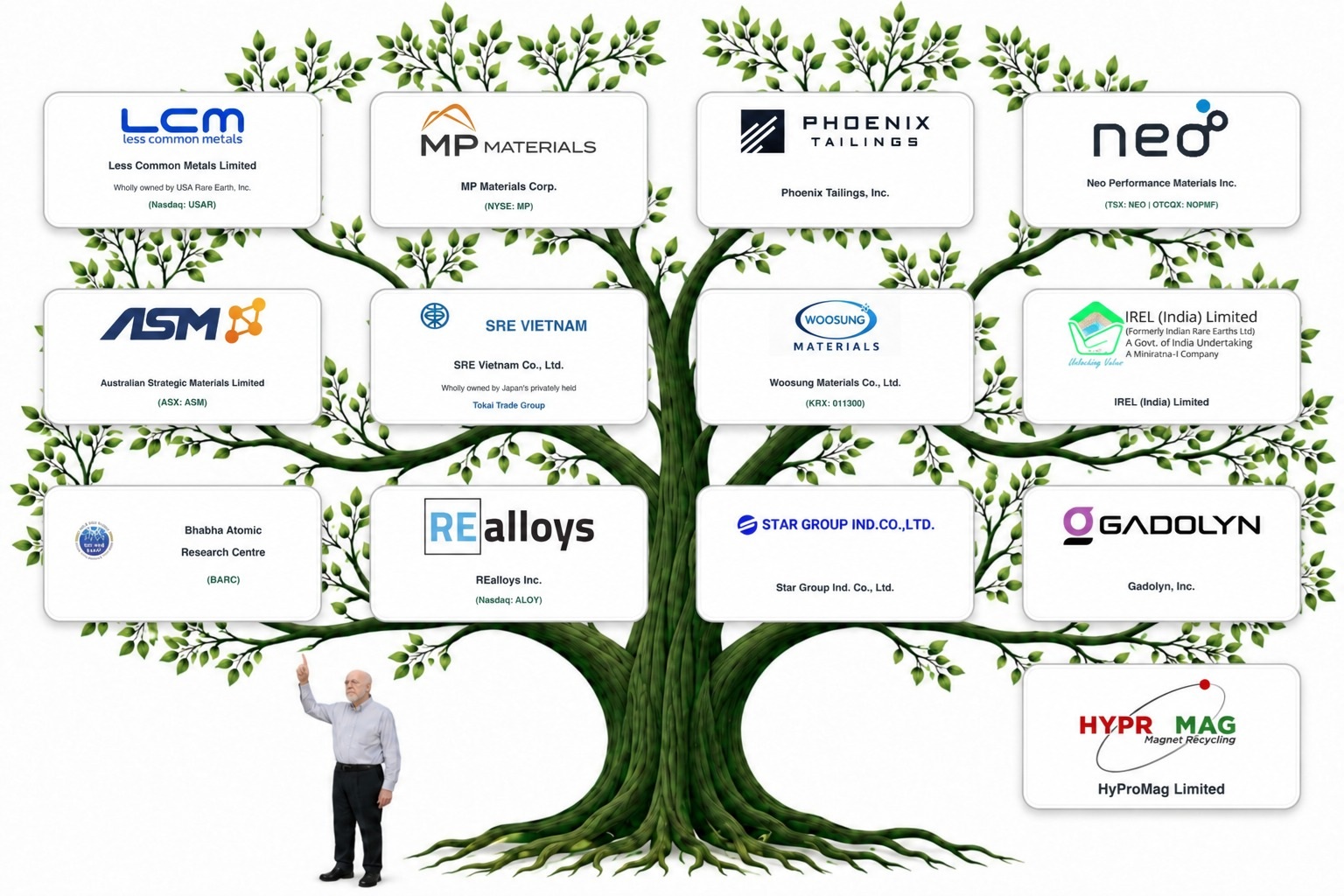
In my September 21 article, I reviewed the state of rare earth metal and alloy production outside China, distinguishing between companies that can manufacture these materials and those that have only announced plans to do so. I have since identified two additional operations that deserve consideration for inclusion in that inventory. One is in Vietnam and the other in India. Both are important, but for different reasons, and neither should be mistaken for an established, large scale commercial producer without further qualification.
The first is SRE Vietnam, a wholly owned subsidiary of Japan’s Tokai Trading Co., Ltd. In July 2026, Evolution Metals & Technologies Corp. (Nasdaq: EMAT) announced it had received an initial shipment of five metric tonnes of neodymium-praseodymium metal from SRE Vietnam via Japan’s Senri Trading. The material was reportedly destined for subsequent alloy and magnet manufacturing in South Korea. This matters because it describes an actual delivery of rare earth metal to a customer, not just another announcement of an intention to manufacture metal at some future date.
However, one important qualification remains. The delivery of five tonnes of neodymium-praseodymium metal does not, by itself, establish that SRE Vietnam manufactured that metal from rare earth oxides at its own facility. I have not yet independently verified the company’s metallization process, installed equipment, production capacity, or the material’s full origin. Consequently, I believe SRE Vietnam should be provisionally included in the inventory as an operating supplier of rare earth metal, with its independent metallization capability still requiring confirmation.
I also want to emphasize that SRE Vietnam should not be confused with Shin-Etsu’s activities in Vietnam. These are separate operations and must be evaluated independently. If SRE Vietnam can show an operating metallization facility capable of producing commercial quantities of neodymium-praseodymium metal from oxide feedstock, it will deserve a more definitive place among the relatively few producers outside China. For now, the reported delivery is encouraging evidence of commercial activity, but not yet conclusive evidence of independent, industrial scale metal production.
The second addition is India’s government owned IREL (India) Limited. India’s situation is particularly interesting because it illustrates the difference between having the technical knowledge to produce rare earth metals and having an established commercial industry that can supply them.
IREL has long produced and refined rare earth compounds. Its Rare Earths Division at Aluva, Kerala, produces separated, high-purity rare earth oxides. This is an important industrial capability, but oxide production is not metal production. I have repeatedly emphasized this distinction because too many discussions of rare earth supply chains assume that producing a separated oxide somehow completes the process of making a useful industrial material. It does not.
More relevant to this discussion is IREL’s establishment of rare earth metal demonstration facilities at its Rare Earth and Titanium Theme Park in Bhopal, Madhya Pradesh. In January 2026, the Indian government reported that IREL had established mini-plants to produce lanthanum, cerium, and neodymium metals. In addition, research and development conducted by the Bhabha Atomic Research Center has demonstrated kilogram-scale metallothermic reduction of neodymium-praseodymium compounds and small-batch production of samarium metal.
These developments matter because they show India is moving beyond purely academic research toward practical demonstrations of indigenous rare earth metallization technologies. They do not, however, establish that India has created a commercially competitive rare earth metal industry.
I would therefore classify IREL as a pilot-scale and demonstration-stage producer of rare earth metals. I would not include its oxide-refining capacity, its proposed magnet-manufacturing capacity, or the nominal capacity of its demonstration facilities in any calculation of established commercial rare earth metal production outside China. Until we have evidence of sustained throughput, reproducible product quality, competitive production costs, and actual customer qualification, it would be premature to describe these facilities as established sources of commercial supply.
These two additions illustrate a larger problem in evaluating the development of the rare earth supply chain outside China. We have become accustomed to treating announcements of technical achievements, pilot plant construction, and even proposed production capacities as interchangeable with operating industrial facilities. They are not.
Manufacturing rare earth metals is a specialized branch of extractive metallurgy. It requires not only the ability to reduce rare earth compounds to metals but also the ability to control impurities, achieve reproducible composition, manage energy and reagent consumption, and produce material in the physical and chemical forms downstream manufacturers require. When alloys are involved, the specifications become still more demanding. The customer is not buying a scientific achievement. The customer is buying an industrial input that must perform predictably in a manufacturing process.
This is why I continue to insist that the proper measure of progress in establishing rare earth supply chains outside China is not the number of companies announcing projects, nor the number of governments financing demonstration plants. It is the number of operating facilities that can deliver qualified products in commercially meaningful quantities, at prices customers can afford and that allow suppliers to remain in business.
I have spent much of my industrial career observing the distance between a successful laboratory experiment and a sustainable manufacturing operation. Investors, government agencies, and, unfortunately, some entrepreneurs themselves frequently underestimate that distance. Metallurgical feasibility is necessary, but it is not sufficient. The economics of sustained production and the ultimate customer’s qualification requirements determine whether a technology becomes an industry.
The reported shipment from SRE Vietnam and the demonstrated metallization work in India are therefore welcome additions to our understanding of the emerging rare earth industry outside China. They show progress at two different stages of industrial development. They do not yet justify revising the central conclusion of my September analysis.
China’s dominance in rare earth metal and alloy production stems not only from its access to rare earth minerals or its extensive separation capacity. It results from decades of building and operating the industrial infrastructure that converts separated compounds into the materials manufacturers actually purchase. Replicating that infrastructure elsewhere requires much more than capital expenditure. It requires experienced metallurgists, process engineers, trained operating personnel, reliable feedstocks, quality control, customers willing to qualify the products, and, above all, a business model capable of surviving commercial competition.
The number of organizations outside China that have demonstrated some ability to produce rare earth metals is slowly increasing. The number that have demonstrated sustained, economically competitive production of qualified metals and alloys remains very small indeed.
I will continue to update my inventory as additional evidence becomes available. My purpose is not to compile the longest possible list of companies claiming to participate in the rare earth supply chain. It is to identify those upon which an industrial customer can actually depend.
A facility that has produced a kilogram of rare earth metal has demonstrated a process. A facility that can repeatedly deliver qualified tons of that metal at an economically sustainable price has demonstrated an industry.
The future of rare earth supply security outside China depends upon understanding that distinction.


Leave a Reply