
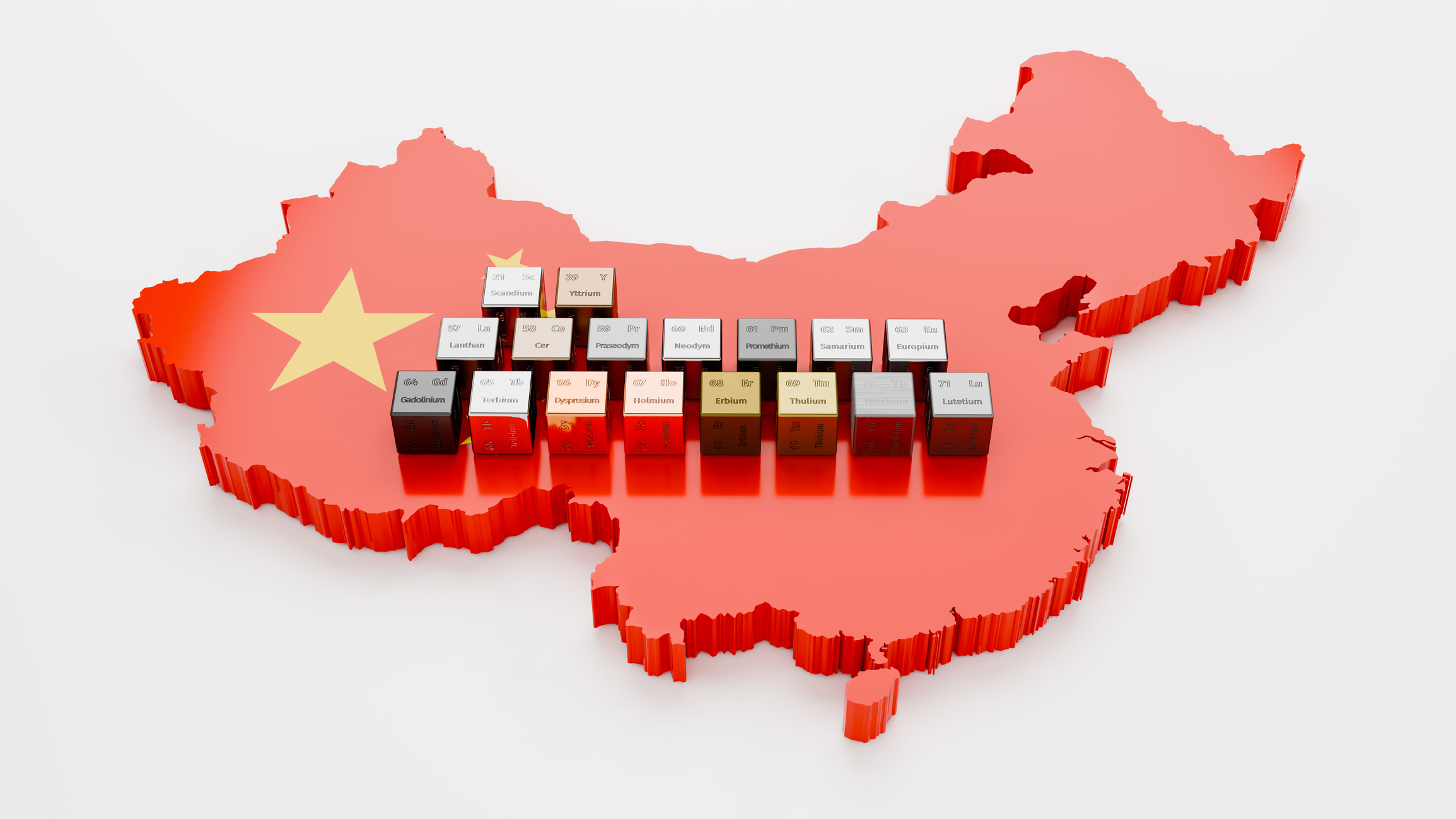
Over the last 40 years (!) China has built five overlapping, vertically integrated rare earth magnet ecosystems, each spanning mining, separation, metalmaking, alloying, and NdFeB magnet production. This is not a single supply chain but a redundant national architecture engineered for resilience, scale, and geopolitical leverage. No other nation possesses even one complete mine‑to‑magnet chain at an industrial scale.
China’s Five Ecosystems are:
- China Northern Rare Earth (Group) High-Tech Co., Ltd. (SSE: 600111): Global NdPr anchor; Bayan Obo is the world’s largest light rare earth element (REE) producer, even though the REEs are largely a byproduct of primary magnetite (iron ore) production.
- China Rare Earth Resources and Technology Co., Ltd. (SZSE: 000831) / China Minmetals Corporation: Controls nearly all domestic Chinese heavy REE (Dy/Tb) ionic adsorption clay deposits; effectively the only scalable coercivity-element supply chain on Earth. (Note: China today imports most of its heavy rare earths — and a significant amount of light rare earths — as concentrates produced in Myanmar, with which it shares a border. The separation and purification of these imports are almost entirely performed in China, primarily at facilities owned or controlled by China Rare Earth Group / Minmetals.)
- Shenghe Resources Holding Co., Ltd. (SSE: 600392): Global feedstock aggregator; integrates purchased production from overseas mines (including, historically, feedstock associated with MP Materials Corp. and Serra Verde Group) into China’s midstream rare earth processing ecosystem.
- Beijing Zhong Ke San Huan High-Tech Co., Ltd. (SZSE: 000970): One of the world’s largest producers of high-end sintered NdFeB permanent magnets; functionally integrated through state-allocated feedstock systems.
- JL MAG Rare-Earth Co., Ltd. (SZSE: 300748 | HKEX: 06680): One of the fastest-growing EV and wind-energy magnet manufacturers/exporters globally, with deep alloying expertise and OEM-grade production capabilities.
Choke‑Point Control (2020s)
- Mining: ~60% global REE ore
- Separation: ~90% of global capacity
- Metal: ~95% of Nd/Pr metal; ~100% of Dy/Tb metal
- Alloy: China dominant; only country with full EV/wind‑grade alloying
- Magnets: 85–90% of global NdFeB output
China’s dominance is deepest in Dy/Tb, the coercivity enhancing elements essential for EV traction motors and direct‑drive wind turbines, although today almost all of China’s supply of Dy/Tb comes from Myanmar.
1990s vs 2020s Shift
- In the 1990s: Japan controlled separation, metal, and the manufacturing of high-end magnets; the U.S. produced significant amounts of rare earth ore; China was a low‑cost oxide supplier due to its low cost separation facilities.
- By the 2020s: China controls every stage from ore to finished magnets, with multiple redundant chains and global offtake control.
Implications for the U.S., Allies, and Industry
- Defense: Precision‑guided munitions, radar, actuators, and propulsion systems depend on Chinese produced Dy/Tb.
- EVs: No non‑Chinese supply chain can meet projected U.S./EU EV magnet demand.
- Wind: Direct‑drive turbines require high‑coercivity magnets; China is the sole scalable source.
- Industry: Robotics, automation, and medical devices face structural exposure.
Strategic Reality
Mining is not the bottleneck. The bottlenecks are:
- Separation
- Metal production
- Alloying
- High‑performance magnet manufacturing
- Dy/Tb availability
Required Actions (for governments, OEMs, and investors)
- Build domestic separation + metal plants before new mines.
- Co‑invest in alloy + magnet capacity with OEM backing.
- Develop Dy/Tb substitution pathways (GBD, Ce‑rich magnets, ferrite hybrids).
- Establish rationally organized strategic stockpiles for Dy/Tb and NdPr metal.
- Mandate domestic magnet content for defense and critical infrastructure.
Bottom Line
China’s rare earth magnet dominance is not an accident — it is a 40‑year industrial strategy that created the only complete, scalable, and redundant mine‑to‑magnet architecture on Earth. The West’s vulnerability is structural, not cyclical, and cannot be solved by mining alone.


Leave a Reply