
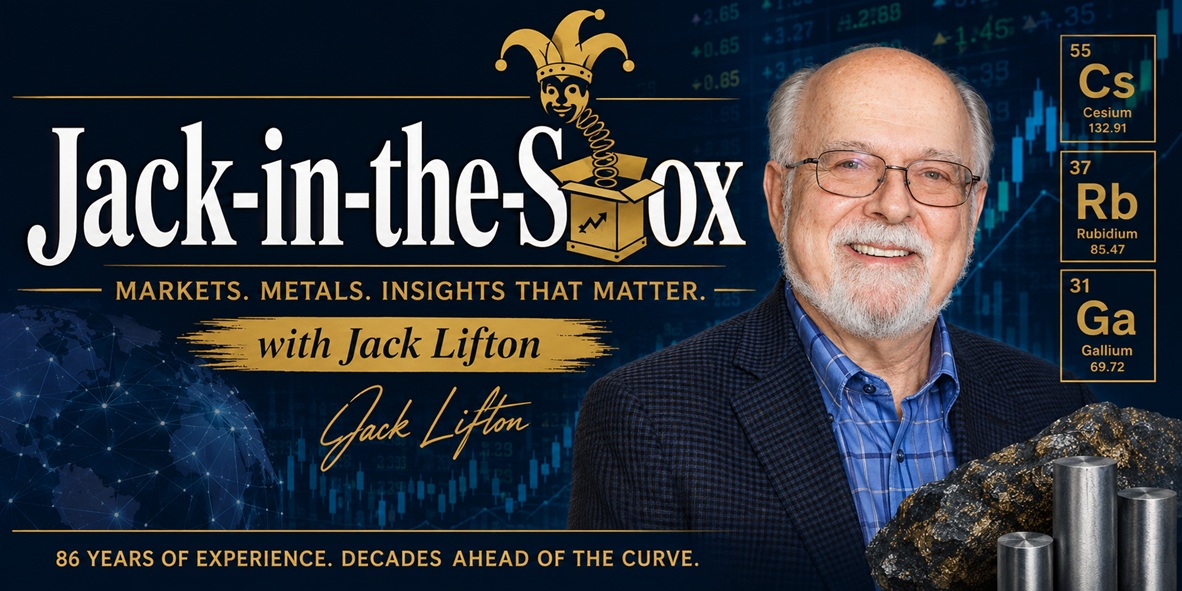
In his ongoing Jack-in-the-Stox series, Jack Lifton comments on public companies, technologies, capital markets, supply chains and geopolitics. He is not a licensed investment adviser, and his views are provided for informational purposes only. Nothing in this column constitutes investment advice or a recommendation to buy, sell or hold any security.
Last week, I attended the 5th Annual Symposium of the Critical Minerals Institute (CMI), CMI Summit 5, in Toronto. I met and spoke with many well-informed actors in mining, processing, and finance. Full disclosure: I am a co-founder of the Critical Minerals Institute and currently serve as its co-chairman.
The CMI Symposia bring together participants in physical resource development in the critical minerals space, interested investors, government officials seeking information, and sector analysts, all to interact for the collective benefit.
I now plan to write a weekly column identifying those critical mineral companies that I think should be noted by my readers for further, in-depth inquiry, not only by investors but also by those interested in the future directions and trends in our society.
Among those I met at CMI Summit 5, for the first time, was Marcy Kiesman, CEO and Director of Quantum Critical Metals Corp. (TSXV: LEAP | OTCQB: ATOXF).
I was intrigued by the discussion of her company’s discovery in Quebec of a cesium, rubidium, and gallium-bearing mica formation, and astounded when she described the “grades” of gallium in the samples recovered so far from targeted borehole drilling.
Readers should note that gallium is currently recovered only from the tailings (residues) of the processing of aluminum and zinc ores. These ores typically contain a maximum of 50 ppm of gallium, measured as, but not found as, a metal.
The first time gallium was recovered in large quantities was during the Second World War, when the Department of War ordered Alcoa to produce it and, of course, paid for the special facilities required. Alcoa originally refused to undertake the project because it said it could never recover the large investment, then $10 million dollars, which would now be around $250 million, from the sale of gallium, which, as far as Alcoa knew, had no commercial uses whatsoever.
Unbeknownst to Alcoa, the Manhattan Project had determined that in order to stabilize the plutonium required as the core of an atomic bomb, it was necessary to manufacture a plutonium-gallium alloy.
After the war, gallium, vastly overproduced as were all materials during World War II, became readily available for academic study. In those bygone days, even after the war, the Defense Department continued to heavily fund basic research by industry as well as by academia.
On a personal note, I would add that in 1963 I had lunch with a small group that included Dr. William Shockley, the Nobel Prize-winning co-inventor of the transistor, who regaled our lunch table with stories of its early development, which included many of the facts I’m today writing about regarding the history of the discovery of the uses of the less common metals: gallium and indium, and the metalloid germanium, about which I will write later.
As a side note, I might mention that ten years after that, the development of the cathodoluminescent phosphor utilizing the properties of the heavy rare earths, the commercial production of which only began at the end of the 1950s, along with the properties of the chemical compounds of the aluminum and gallium related element indium, allowed the ultimate development of what we now call flat-screen TV.
But now let’s step back from memory lane and get back to Quantum Critical Metals Corp.
I am ordinarily not a fan of polymetallic deposits, which can be defined as those that contain more than one payable metal mineral. Particularly if only one of the many such minerals contained in a deposit can be produced in a commercial quantity, the difficulty is often that the cost of producing the mixture and then selectively separating the one desired payable mineral is usually too high to make the recovery of only that mineral economical. In particular, the desired mineral can often only be extracted at a low rate.
I am, however, convinced that Quantum Critical Metals’ mica deposit may well be able to be processed economically for the recovery of not only gallium but cesium and rubidium. As the CEO informed me, and as the company’s website states, the extraction efficiency of gallium from the sample materials reached 93%. This would mean that at scale, the recovery of gallium from Quantum’s mica formations could reach as much as five times the equivalent recovery of gallium from nearby Rio Tinto’s bauxite, the ore of aluminum, operations. Full disclosure: the Quantum samples were run by a Canadian processing firm, which I consider to be the very best one in Canada. I have not, at this point, been given permission to name that facility.
Canada, by the way, is the world’s leading source of cesium. However, at this point, cesium comes from a single Chinese-owned mining operation in Manitoba. The addition of Quantum Critical Metals’ Quebec site as a producer of cesium and gallium would, in my opinion, be extremely welcome to the West’s largest user of these materials, the United States Department of Defense, as well as to the non-Chinese electronics and semiconductor industries.
I’m going to keep my eye on Quantum Critical Metals. The Critical Minerals Derby is just now running, but I think we have a candidate for the winner’s circle.


Leave a Reply