
The past week forced the critical minerals sector into a hard confrontation with reality: geopolitics is no longer a backdrop—it is the market itself. From the Strait of Hormuz to Kinshasa, from Canberra to Brussels, the scramble for control over supply chains is accelerating, but not coherently. What is emerging is not a coordinated Western response to China’s dominance, but a patchwork of policy experiments, national assertions, and—perhaps most dangerously—market distortions masquerading as strategy.
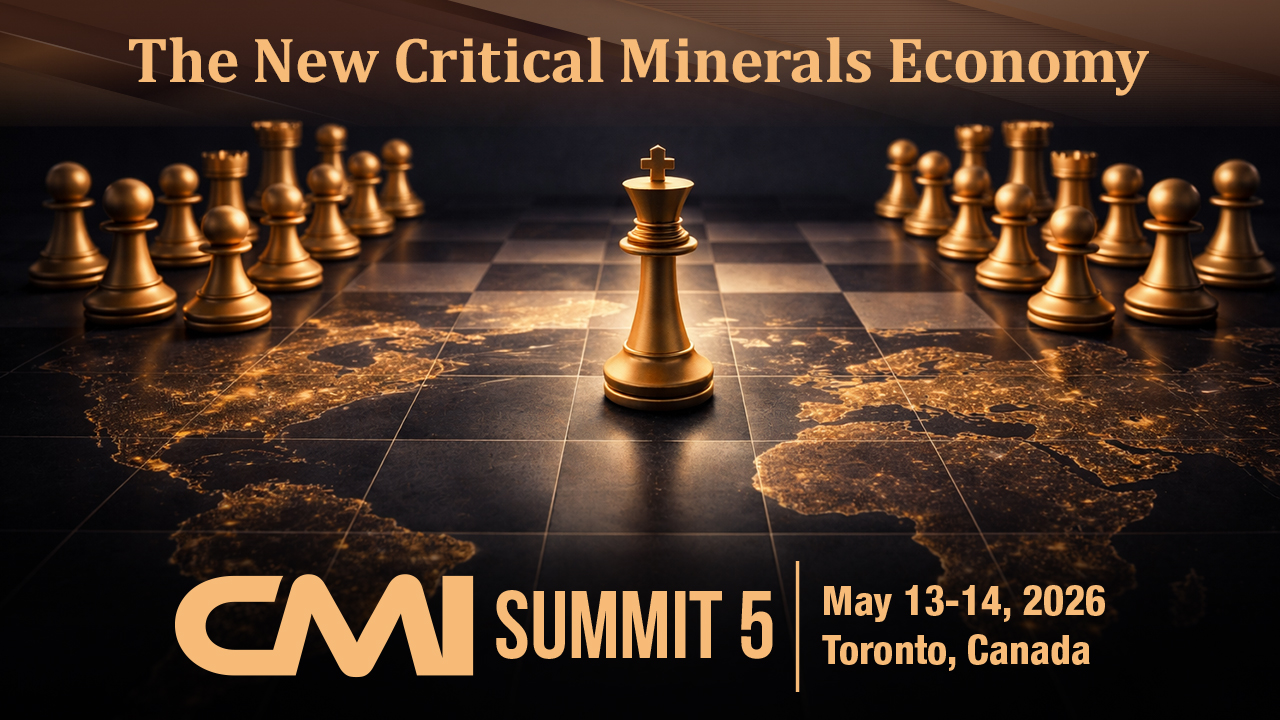
These are precisely the themes that will be addressed at the upcoming Critical Minerals Institute (CMI) Summit 5, taking place May 13–14 in Toronto under the theme “The New Critical Minerals Economy.” A draft of the speaker agenda was released this afternoon (to access the CMI Summit 5 agenda, Click Here).
The most immediate signal came from the escalation surrounding Iran, where fears of a broader regional conflict sent aluminum prices to four-year highs (Source) and exposed the fragility of chemical supply chains essential to mining and processing. Congo’s copper and cobalt miners—already operating within razor-thin logistical tolerances—were forced to reduce chemical usage due to disruptions tied to the conflict (Source). This is not a marginal issue. Sulfuric acid, reagents, and processing inputs are as critical as the ores themselves. Without them, production doesn’t slow—it stops.
That same conflict sharpened focus on a metal long neglected by Western policymakers: antimony. Canada’s “antimony gap” is no longer theoretical (Source). It is a glaring vulnerability in defense supply chains, particularly as antimony remains essential in munitions, flame retardants, and military-grade alloys. The uncomfortable truth is that while Western nations debate frameworks and funding mechanisms, adversarial or non-aligned jurisdictions continue to dominate the production and refining of key defense inputs. Allow me to mention that Jim Atkinson, CEO and Director for Antimony Resources Corp. (CSE: ATMY | OTCQB: ATMYF) will be leading the discussions on antimony at the upcoming CMI Summit 5.
Meanwhile, the Democratic Republic of the Congo is moving in a different direction—one that may prove more consequential than any Western initiative. Its decision to begin stockpiling critical minerals (Source) signals a shift from passive supplier to active market participant. If executed effectively, this could introduce a new layer of state-driven price management into already opaque markets for cobalt, copper, and potentially germanium and gallium. It is, in essence, OPEC logic applied to minerals. Allow me to point out that the Honourable Kassongo bin Nassor, President, National Chamber of Mines, DRC, will be a speaker at the upcoming CMI Summit 5.
The Honourable Kassongo bin Nassor, President of the National Chamber of Mines of the DRC, will be speaking at the upcoming Critical Minerals Institute (CMI) Summit 5.
Brazil is thinking along similar lines, but with a sharper industrial policy edge. Its demand that rare earths be processed domestically (Source) is recognition that value capture lies in processing, not extraction. The United States and its allies continue to fund upstream projects, but countries like Brazil are increasingly unwilling to export raw materials only to re-import finished products at a premium.
Against this backdrop, China remains disciplined and methodical. Chinese rare earth companies saw share price gains following quarterly price increases (Source), while copper smelters considered production curbs amid an acid export ban (Source). These are not reactive measures; they are calibrated moves within a long-term strategy that integrates mining, processing, pricing, and export controls into a single system. The West, by contrast, continues to treat each of these as separate policy domains.
The response from Western governments has been energetic—but fragmented. The European Union’s launch of a joint procurement platform for critical minerals (Source) represents a significant attempt to “socialize” resource security across member states. Yet, as Jack Lifton has bluntly observed, such approaches risk distorting markets and undermining private capital formation. Centralized procurement may secure short-term supply, but it does little to incentivize the long-term investment required to build resilient supply chains. In fact, it may do the opposite.
Similarly, the United States and Australia continue to deepen cooperation, backing projects with substantial public financing. These include support for Arafura Rare Earths Limited (ASX: ARU) and its Nolans Project, as well as broader funding initiatives involving companies such as Lynas Rare Earths Limited (ASX: LYC; OTCQX: LYSDY) and Iluka Resources Limited (ASX: ILU), all of which are central to Australia’s rare earth and mineral sands supply chains (Source). On paper, this is exactly what the industry has been calling for. In practice, however, capital alone does not solve permitting delays, technical bottlenecks in processing, or the absence of a fully integrated midstream.
Even within financial markets, the signals are mixed. The launch of a rare earths ex-China ETF by Sprott (Source) reflects growing investor appetite for diversification away from Chinese supply chains. Yet it also underscores a fundamental issue: the investable universe outside China remains thin. Without a pipeline of viable, scalable projects, financial products risk becoming vehicles of speculation rather than engines of capital formation.
Even within financial markets, the signals are mixed. The launch of a rare earths ex-China ETF by Sprott Inc. (TSX: SII) (Source) reflects growing investor appetite for diversification away from Chinese supply chains. Yet it also underscores a fundamental issue: the investable universe outside China remains thin. Without a pipeline of viable, scalable projects, such vehicles risk drifting toward speculation rather than serving as effective channels for capital formation.
In an interview on Friday, Mark Tory, President, CEO, and Director of Defense Metals Corp. (TSXV: DEFN | OTCQB: DFMTF), confirmed that the company has been included in the Sprott ETF. He will also be speaking at the upcoming CMI Summit 5.
Corporate developments further highlight this imbalance. USA Rare Earth, Inc. (NASDAQ: USAR) has achieved the production of commercial yttrium metal (Source), a notable milestone—particularly given the strategic importance of heavy rare earths. But isolated successes do not constitute a system. The midstream—the separation, refining, and metallization capacity—remains the single greatest bottleneck in the Western supply chain. Without it, upstream discoveries and downstream ambitions cannot connect.
Alex Moyes, Ph.D., SVP of Mining and Processing at USA Rare Earth, Inc. (NASDAQ: USAR), will also be speaking at the upcoming CMI Summit 5.
At the same time, CATL’s expansion into critical minerals (Source) illustrates how integrated players are positioning themselves. The company is not merely securing supply; it is embedding itself deeper into the value chain, linking raw materials directly to battery production and energy storage. This is the model the West has yet to replicate at scale.
Overlaying all of this is a growing willingness among policymakers to intervene directly in markets—often without fully accounting for the underlying complexities. The concept of a U.S. strategic mineral reserve under “Project Vault” (Source) has already prompted discussion among industry participants. As Lifton notes, such initiatives must contend with the practical realities of mineral economics, storage, and form. Stockpiling is not analogous to warehousing oil; different minerals degrade, oxidize, or require specific conditions to retain value. The metaphor of a “vault” may be useful—but only if these technical constraints are properly understood.
In a recent discussion with one of the architects of Project Vault, I extended an invitation to participate in CMI Summit 5, where these considerations can be explored in greater detail with the industry.
Even global financial institutions are being pulled into the fray. U.S. Treasury Secretary Scott Bessent’s call for IMF quota reforms and World Bank financing for critical minerals (Source) reflects a recognition that traditional funding mechanisms are insufficient for the scale of investment required. Yet it also raises questions about governance, efficiency, and the role of multilateral institutions in what is increasingly a strategic competition.
Taken together, these developments point to a market that is beginning to fracture along geopolitical lines. Supply chains are being reconfigured not for efficiency, but for security. Capital is being deployed not purely for return, but for resilience. And governments are stepping in not as regulators, but as participants.
The risk is straightforward: in the rush to secure supply, the West risks undermining the very market mechanisms required to build it. Subsidies, stockpiles, and centralized procurement all have a role—but they are not substitutes for disciplined capital allocation, technical capability, and fully integrated value chains.
China understood this decades ago. The West is only now beginning to catch up.
The question is not whether the response is well-intentioned—it is whether it is coherent. Because if it is not, the current wave of policy intervention risks reinforcing the very dependencies it is trying to solve.
Join us at the upcoming CMI Summit 5 in Toronto to join this debate. We will discuss the supply chain experts attending the CMI Summit 5 in an upcoming Critical Minerals Report (CMR). For more information, go to CriticalMineralsInstitute.com.
Do you enjoy the Critical Minerals Report?
Click here to become a Critical Minerals Institute member and get each edition delivered straight to your inbox.
InvestorNews Critical Minerals Institute (CMI) Directorial Headline Picks for the Past Week:
- April 16, 2026 – Canada’s antimony gap shows as Iran war sharpens focus on defence metals (Source)
- April 16, 2026 – DR Congo to stockpile critical minerals with new reserves (Source)
- April 15, 2026 – Op-Ed: Critical mineral sovereignty starts with deep tech (Source)
- April 15, 2026 – USA Rare Earth Completes First Commercial Yttrium Metal Production (Source)
- April 15, 2026 – Sprott Launches Rare Earths Ex-China ETF (Source)
- April 15, 2026 – Brazil demands rare earths be processed at home as US and China compete (Source)
- April 15, 2026 – CATL Shares Jump on Critical-Minerals Expansion Plan, Earnings (Source)
- April 15, 2026 – Bessent supports IMF quota revamp, wants World Bank financing for critical minerals (Source)
- April 14, 2026 – China copper smelters may press ahead with production curbs amid acid export ban (Source)
- April 13, 2026 – EU launches operations of critical minerals procurement platform (Source)
- April 13, 2026 – Australia and United States advance cooperation on critical minerals and rare earths supply chains (Source)
- April 13, 2026 – Aluminum Prices Rise to Four-Year High on Hormuz Blockade Fears, Failed Iran Talks (Source)
- April 13, 2026 – Congo copper and cobalt miners cut chemical use as Iran war disrupts supplies, sources say (Source)
- April 13, 2026 – How Donald Trump’s ‘Project Vault’ risks upending strategic minerals market (Source)
- April 12, 2026 – US, Australia Offer $600 Million Backing for Rare Earths Project (Source)
- April 12, 2026 – Australia and US boost support for critical minerals with $3.5 billion (Source)
- April 12, 2026 – Chinese Rare Earth Companies Jump After Quarterly Price Hike (Source)
InvestorNews.com Media Updates:
- April 15, 2026 – Grid Metals and Boliden Advance Thompson East Through Strategic Earn-In https://bit.ly/4cbXEth
InvestorNews.com News Release Updates:
- April 17, 2026 – Brett Lynch to Be Appointed Non-Executive Director to Support Next Phase of U.S. Expansion https://bit.ly/3Or02Dq
- April 16, 2026 – Ucore Receives a Crucial DPAS-Rated Long Lead Equipment Component at the Louisiana SMC https://bit.ly/4sFEbGp
- April 16, 2026 – Greenland Mines Enters into LOI to Evaluate Brownfield Downstream Icelandic Industrial Processing Site, Outlines Strategic Supply Chain Security Program https://bit.ly/3QfaazF
- April 16, 2026 – Defense Metals Announces Inclusion in New Sprott Rare Earths Ex-China ETF https://bit.ly/4vzPiTW
- April 15, 2026 – Nord Precious Metals Closes Unit Financings https://bit.ly/48QNlbP
- April 15, 2026 – West High Yield (W.H.Y.) Resources Ltd. Announces Exercise of Options https://bit.ly/41BYNEo
- April 15, 2026 – Power Metallic Intercepts 27.10 Meters of 2.17% CuEqRec¹, including 4.76 Meters of 10.43% CuEqRec¹ in Hole 26-050 at Lion https://bit.ly/3Qm7ujF
- April 15, 2026 – Grid Metals and Boliden Sign $10 Million Earn-In Agreement for the Thompson East Copper/Nickel Project in Northern Manitoba https://bit.ly/4dKg6uf
- April 15, 2026 – Deep Sea Minerals Corp. Appoints Anthony Zelen to the Board of Directors https://bit.ly/4czCeW6
- April 14, 2026 – Allied Critical Metals Files New Technical Report on Previously Announced PEA https://bit.ly/4cGCUKl
- April 14, 2026 – Ucore Updates Mineral Resource Estimate and Technical Report for Bokan Dotson-Ridge Rare Earth Property https://bit.ly/3Qbs9qC
- April 14, 2026 – Antimony Ridge Metallurgy Advancing with Antimony Trioxide Produced https://bit.ly/4tmfP5q
- April 13, 2026 – Fox Tungsten Announces Appointment of Mark Wellings and Greg Huffman to the Board of Directors and Grants Incentive Stock Options https://bit.ly/47Y0BuZ
- April 13, 2026 – Deep Sea Minerals Corp. Appoints Dan McConnell as Vice President of Exploration https://bit.ly/4cqx1zy
- April 13, 2026 – Spartan Metals Announces Increase to Private Placement https://bit.ly/41xlJ7Q
About the Critical Minerals Institute (CMI)
The Critical Minerals Institute (CMI) is a global brain trust for the critical minerals’ economy, serving as a hub that connects companies, capital markets, and policymakers. Through CMI Masterclasses, the weekly Critical Minerals Report (CMR), bespoke research, and board-level advisory services, CMI delivers actionable intelligence spanning exploration finance, supply chains, and geopolitics.
CMI also convenes the flagship Annual Critical Minerals Institute Summit. The next event, CMI Summit 5 — “The New Critical Minerals Economy”, will take place May 13–14, 2026, at the historic National Club in Toronto, Canada.
For more information, visit CriticalMineralsInstitute.com or contact CMI Membership Director Chrissy Hessam at [email protected].


Leave a Reply