
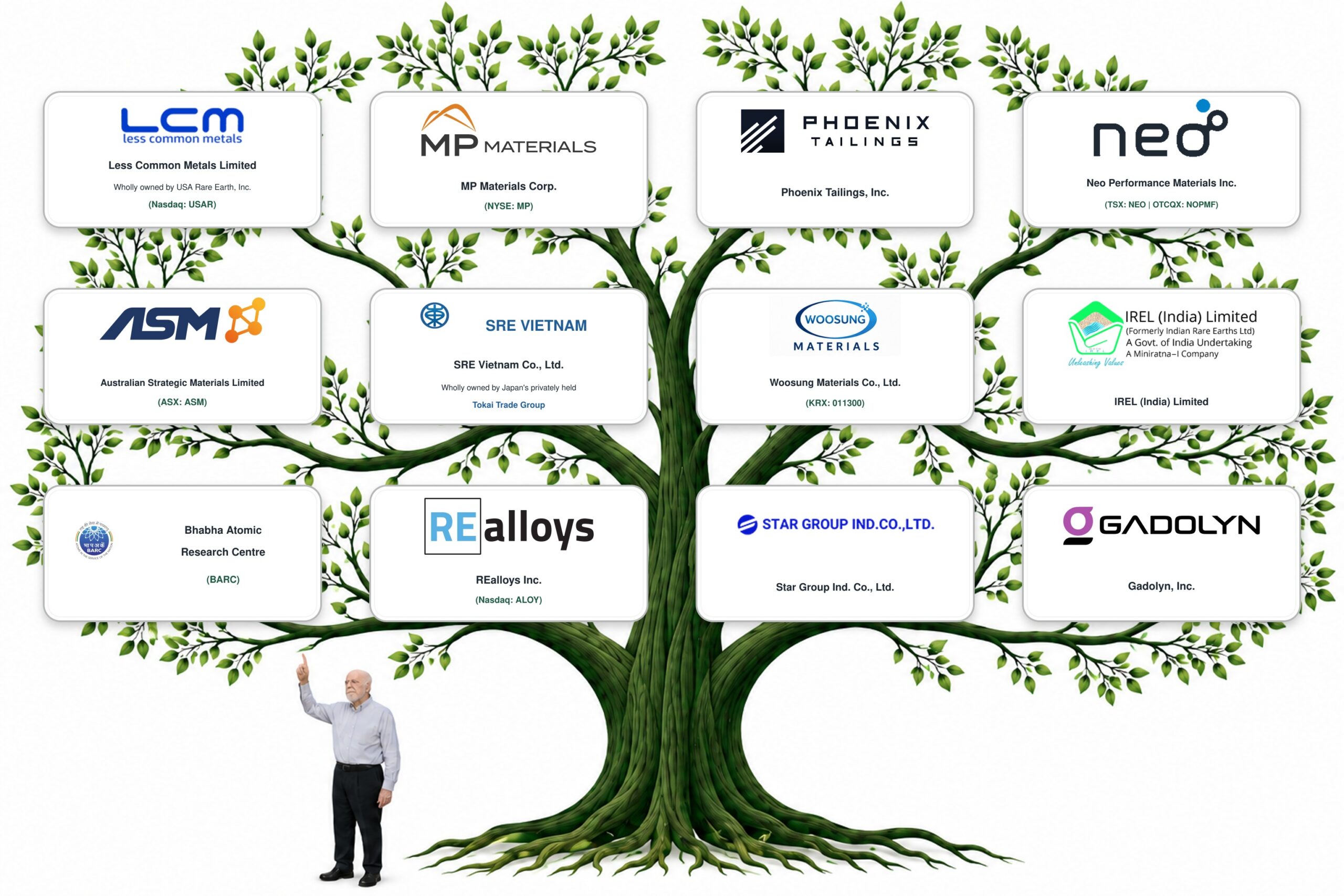
InvestorNews is introducing a new continuing feature: The Lifton Living Rare Earths Tree, tracking companies outside China with the capability to produce rare earth metals, rare earth alloys, or both. The purpose of this tree is not simply to repeat corporate announcements. It distinguishes between the separate branches of the rare earth value chain: companies that can reduce rare earth oxides to metals, companies that can melt those metals into useful alloys, and companies that manufacture magnets from materials produced by others. These are very different industrial capabilities, yet they are too often described as interchangeable.
Like the industry it tracks, the tree will continue to grow and evolve as new and better information becomes available. Production capacity will be classified as operating, demonstrated, under construction, or merely announced, and production methods will be identified only when they can be verified. The rare earth industry is changing rapidly, but its progress must be measured by demonstrated capability, reproducible production, customer qualification and economic operation—not by press releases. As always, the objective is to follow where value is actually added.
The Lifton Living Rare Earths Tree
Status: August 2026
Scope. The tree tracks companies outside China with demonstrated or developing capabilities to produce primary rare earth metals, rare earth alloys or finished rare earth permanent magnets. Announced capacity is separated from demonstrated and operating capability wherever possible.
*Please note that the Companies named must sell into the open market place.
Inclusion requirement: To qualify in a particular category, a company must sell—or have documented contracts or qualification shipments for—the relevant rare-earth metal, alloy, magnetic powder or finished magnet to unaffiliated third-party customers. Captive-only intermediate production does not qualify as merchant production but may be identified separately.
| Company / Location (Alphabetical) | Primary Metal | Alloy / Magnets | Technology, Status & Capacity |
| Australian Strategic Materials Ltd. (ASX: ASM) — South Korea | Yes – NdPr, Dy and Tb metals | Yes – strip-cast NdFeB alloy | Proprietary metallization; not publicly confirmed as conventional MSE. Commercial/ramp-up. About 1,300 t/y Phase 1 alloy capacity; 3,600 t/y Phase 2 design. |
| Gadolyn, Inc. — United States | No separate primary-metal stage in proposed process | Direct production of NdFeB, SmCo, FeDy and related alloys targeted | Hydrogen direct co-reduction of mixed oxides. Demonstration / precommercial. Neither molten-salt electrolysis nor metallothermic reduction. |
| HyProMag — United Kingdom, Germany and United States | No separate primary-metal stage — recovers NdFeB alloy powder directly from end-of-life magnets and production scrap. | Yes — recycled NdFeB alloy powder and sintered permanent magnets. | Patented Hydrogen Processing of Magnet Scrap (HPMS) technology extracts and demagnetises embedded NdFeB magnets for short-loop recycling. The UK facility is producing alloy powder and magnet blocks, targeting 100–350 tpa. The German plant is being commissioned with initial capacity of approximately 100 tpa, increasing to 350 tpa; it is permitted for up to 750 tpa. HyProMag USA targets magnet finishing in H1 2027 and integrated HPMS operations in Q2 2028. |
| IREL (India) Limited –– India | Yes – La and Ce demonstrated; historical Nd work | Limited / not established commercially | Chloride molten-salt electrolysis developed in collaboration with the Bhabha Atomic Research Centre (BARC). Pilot/TRL 8. Genuine technical capability has been demonstrated, but sustained high-volume commercial NdPr-metal production has not been verified. |
| Less Common Metals (LCM) – United Kingdom Wholly owned subsidiary of USA Rare Earth, Inc. (Nasdaq: USAR) | Yes – Nd, NdPr; selected Dy, Tb and specialty products | Yes – NdFeB, SmCo and specialty alloys; no finished magnets | Fused-salt electrolysis for Nd/NdPr; other reduction routes for selected products. Commercial. About 330 t/y metal design capacity after six-cell expansion; about 1,400 t/y strip-cast alloy capacity. |
| MP Materials Corp. (NYSE: MP) – United States | Yes – NdPr metal | Yes – strip-cast NdFeB alloy and finished magnets | Molten-salt electrolysis. Commercial production began in 2024. Separate metal and alloy nameplate capacities are not publicly disclosed. |
| Neo Performance Materials Inc. (TSX: NEO | OTCQX: NOPMF) | Neodymium oxide is toll-converted into metal by GQD Special Material (Thailand) Co. Ltd., a Rayong-based joint venture in which Neo holds a 20% interest. The resulting metal supports Neo’s internal supply chain; external metal sales, processing route and nameplate capacity are not publicly established. | Yes — NdFeB magnetic alloy powder and finished magnets | Neo’s wholly owned Korat facility commercially produces melt-spun NdFeB magnetic alloy powder and supplies third-party manufacturers. Nameplate powder capacity is approximately 1,800 t/y. Neo’s Narva facility performs strip casting and subsequent processing to produce sintered NdFeB magnets. Phase 1 nameplate capacity is approximately 2,000 t/y, with expansion to 5,000 t/y planned. Narva is producing and shipping qualification magnets, with commercial customer programs ramping during 2026. |
| Phoenix Tailings, Inc. — United States | Yes – light and heavy rare earth metals | Yes – selected alloys; no established finished-magnet output | Proprietary mixed-halide molten-salt reduction/electrolysis. Commercial scale-up. Exeter initial capacity about 200 t/y, scalable above 1,000 t/y; larger expansion remains future capacity. |
| REalloys Inc. (NASDAQ: ALOY) — Canada/United States | Developing / ramping NdPr; Sm/Gd project planned | Developing alloys and magnets | REalloys is developing its Canadian separation, refining and metallization platform through agreements with the Saskatchewan Research Council (SRC), a separate Saskatchewan Crown corporation. The reduction route is not fully public. Reported plans target approximately 500–530 t/y of NdPr-related output; a separate 300 t/y Sm/Gd project is planned and should not be classified as current production. |
| SRE Vietnam Co., Ltd. — Vietnam | Yes – NdPr metal shipment confirmed | Not established | Reduction route undisclosed. Commercial shipment demonstrated in July 2026. Broader processing figure of 3,929 t/y should not be treated as verified metal capacity. |
| Star Group Ind. Co., Ltd. — South Korea | No public evidence of oxide-to-metal reduction | Yes – NdFeB alloy, strip casting and finished magnets | Commercial alloy and magnet producer. Uses purchased rare earth metal inputs. Separate strip-casting tonnage is not publicly established. |
| Woosung Materials Co., Ltd. (KRX: 011300) — Vietnam / South Korea | Yes – NdPr metal reported | Not clearly established; downstream plans announced | Formerly Seong An Materials Co., Ltd. Oxide-to-metal technology is not fully disclosed. Limited production/ramp-up. Approximately 144 t/y of installed capacity has been reported; larger expansion targets remain unverified. |
Important downstream companies not classified as confirmed primary metal producers for the Marketplace
- Vacuumschmelze (VAC): Major alloy and permanent-magnet producer; primary oxide-to-metal production has been done by j/v in China
- Shin-Etsu, Proterial, Daido Steel, and TDK: Leading Japanese magnet and magnetic-material producers; current primary-metal routes and capacity are not transparent. but for internal use only, and
- Noveon Magnetics Inc., USA Rare Earth, Inc. (NASDAQ: USAR) Oklahoma and EM&T: Magnet, recycling or downstream processing platforms; not openly classified as primary metallizers for the open market without specific evidence.
Definitions
- Primary rare earth metal producer: Converts rare earth oxides or halides into metallic rare earths.
- Rare earth alloy producer: Produces NdFeB, SmCo, DyFe or related alloys from rare earth metals or, in an emerging direct process, from oxide mixtures.
- Commercial: Customer shipments or sustained production have been reported; this does not necessarily prove nameplate operation or profitability.
- Ramp-up: Initial production is in place, but announced capacity has not yet been demonstrated consistently.
- Pilot / demonstration: The chemistry or equipment has been shown to work, but sustained commercial throughput has not been established.
Editor’s note. This is a living tree that will grow and evolve as reliable new information becomes available. Samples, installed equipment, announced capacity, commercial shipments, and sustained qualified production are not equivalent measures of industrial capability. The objective is to follow where value is actually added. Please email [email protected] with any requests you may have (Last updated: August 4, 2026).
Additional note: I am listing only those non-Chinese companies currently known to me that sell into the marketplace. This may change in the near term as some of the companies on the tree have been or are being acquired by other (non Chinese) companies with existing or proposed magnet manufacturing capability and capacity. Therefore, it is likely that those companies will withdraw their products from the open marketplace to avoid competing with their new owner’s magnet manufacturing operations.


Leave a Reply