
For decades, policymakers in Washington, Brussels, and allied capitals have spoken about the need to reduce dependence on China for rare earths. Yet despite billions of dollars in announcements, studies, and strategic plans, the reality remains stubbornly unchanged: China continues to dominate the most valuable segments of the rare earth supply chain, particularly separation, refining, and permanent magnet production.
The challenge has never been geological. Rare earth deposits exist throughout North America, Australia, Africa, and elsewhere. The challenge has always been industrial. Building an integrated supply chain requires capital, technical expertise, government support, customers, and, perhaps most importantly, international cooperation.
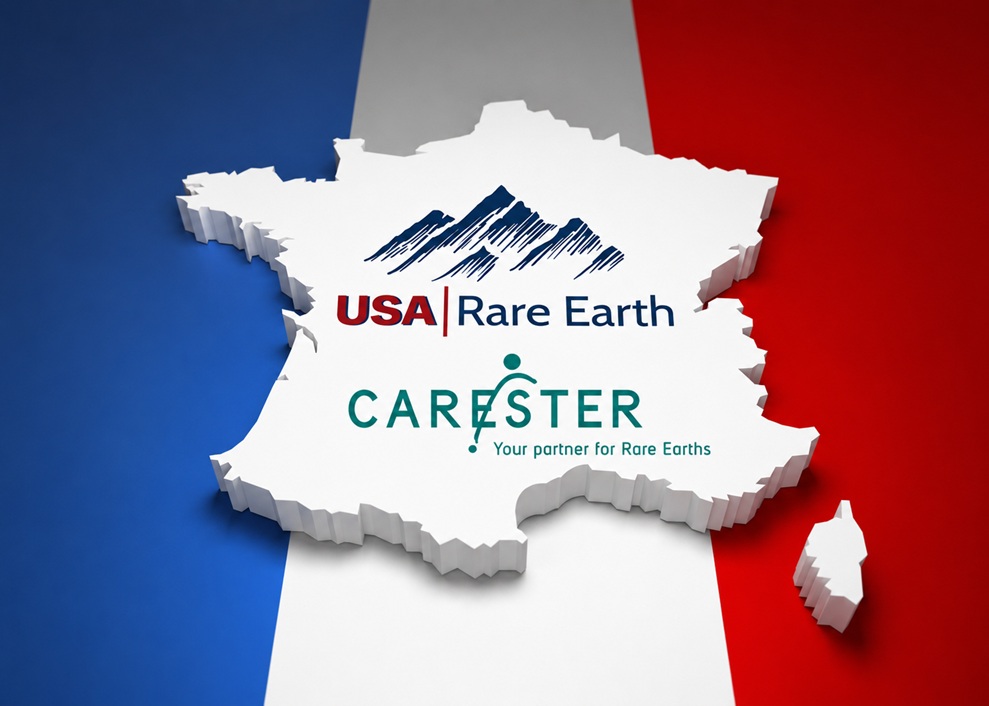
Against that backdrop, an investment by USA Rare Earth, Inc. (NASDAQ: USAR) in France’s Carester and its Caremag initiative would represent far more than a conventional corporate transaction. It would signal the emergence of something the Western world has lacked for decades: a coordinated transatlantic rare earth industrial ecosystem.
The strategic logic is compelling.
USA Rare Earth is advancing a rare earth supply chain anchored by the Round Top project in Texas and its planned processing capabilities in the United States. Carester, meanwhile, possesses something exceedingly rare in the Western world: deep technical expertise in rare earth separation and processing, developed by one of the most experienced rare earth engineering teams outside China.
Together, the companies could help establish a supply chain that spans two continents. Raw materials and separated rare earth products originating in North America could feed downstream manufacturing in Europe, creating a mutually reinforcing industrial network that serves both regions. Such an arrangement would mirror the increasingly common model seen in semiconductors, aerospace, and defense manufacturing, where supply chains are distributed across allied nations rather than concentrated in a single jurisdiction.
For the United States, the benefits extend well beyond commercial considerations.
The U.S. Department of War has repeatedly identified rare earth magnets as a strategic vulnerability. Modern defense systems—from fighter aircraft and missile guidance systems to naval propulsion technologies and advanced radar platforms—depend upon rare earth permanent magnets. Today, China remains the dominant supplier of those materials. Creating allied processing and manufacturing capacity is therefore not merely an economic objective; it is a national security imperative.
A partnership between an American rare earth company and a French processing and manufacturing platform would fit squarely within the broader objectives of NATO industrial cooperation. Rather than attempting to replicate every stage of the supply chain within a single country, it would leverage the strengths of allied nations while reducing collective dependence on Chinese suppliers.
The timing may also be advantageous.
Europe is undergoing its own industrial awakening regarding critical raw materials. The European Union’s Critical Raw Materials Act, France’s industrial sovereignty initiatives, and various subsidy programs aimed at strategic manufacturing all reflect a growing recognition that industrial resilience requires domestic and allied supply chains. Companies capable of positioning themselves within that policy framework stand to benefit from access to incentives, financing mechanisms, and long-term customer relationships that would be difficult to replicate independently.
For USA Rare Earth, participation in a European project could provide something equally valuable: market access.
Europe remains home to some of the world’s most important automotive, aerospace, defense, and renewable energy manufacturers. These industries are increasingly seeking non-Chinese sources of critical materials, not only because of geopolitical concerns but also because regulators and customers are demanding greater transparency and supply chain security. A European presence would place USA Rare Earth much closer to these customers and could accelerate discussions around long-term offtake agreements and strategic partnerships.
There is also a technological dimension that should not be overlooked.
The future of rare earths will not be determined solely by mining. It will be determined by who controls the intellectual property, processing expertise, separation technologies, recycling systems, and magnet manufacturing capabilities that transform ores into finished products. Carester’s expertise in separation technology and advanced processing complements USA Rare Earth’s ambitions to become a vertically integrated participant in the sector. Together, the companies could advance heavy rare earth separation, dysprosium and terbium optimization, magnet materials development, and circular economy initiatives that will become increasingly important as the industry matures.
From an investor’s perspective, the significance is equally clear.
Development-stage rare earth companies often face a credibility challenge. Investors understand the complexity of building processing facilities, securing customers, and navigating regulatory environments. Strategic partnerships can reduce that uncertainty. They provide validation, expand market opportunities, and demonstrate that management teams are thinking beyond the mine gate.
An alliance between USA Rare Earth and Carester would likely be viewed through precisely that lens. It would position USA Rare Earth not as a single-project developer but as a participant in a broader international strategy aimed at rebuilding a non-Chinese rare earth supply chain.
The larger significance, however, extends beyond any one company.
The rare earth industry has entered a new phase. The debate is no longer about whether the West needs an alternative to Chinese dominance. That question was settled years ago. The challenge now is execution.
No single nation is likely to recreate the entire supply chain on its own. Success will require cooperation among allied countries, each contributing its comparative strengths. The United States possesses resources, capital markets, and growing processing capacity. Europe offers engineering expertise, advanced manufacturing capabilities, and a deep base of industrial customers. If successful, USA Rare Earth’s investment in Carester may ultimately be remembered not simply as a corporate transaction, but as an important milestone in the construction of a transatlantic rare earth supply chain designed to compete with China’s vertically integrated industrial ecosystem.
A USA Rare Earth investment in Carester and the Caremag initiative has the potential to become a strategic masterstroke. It would connect American resource development with European separation expertise, metallization capabilities, and manufacturing demand, creating precisely the type of industrial partnership required to compete with China’s dominance across the rare earth value chain. At a time when governments on both sides of the Atlantic are prioritizing supply chain security and critical mineral independence, such a partnership aligns with both commercial realities and public policy objectives. Most importantly, it would strengthen the collective ability of the United States, Europe, and their allies to build a resilient, non-Chinese rare earth and magnet ecosystem—one of the defining industrial challenges of the next decade.


Leave a Reply