
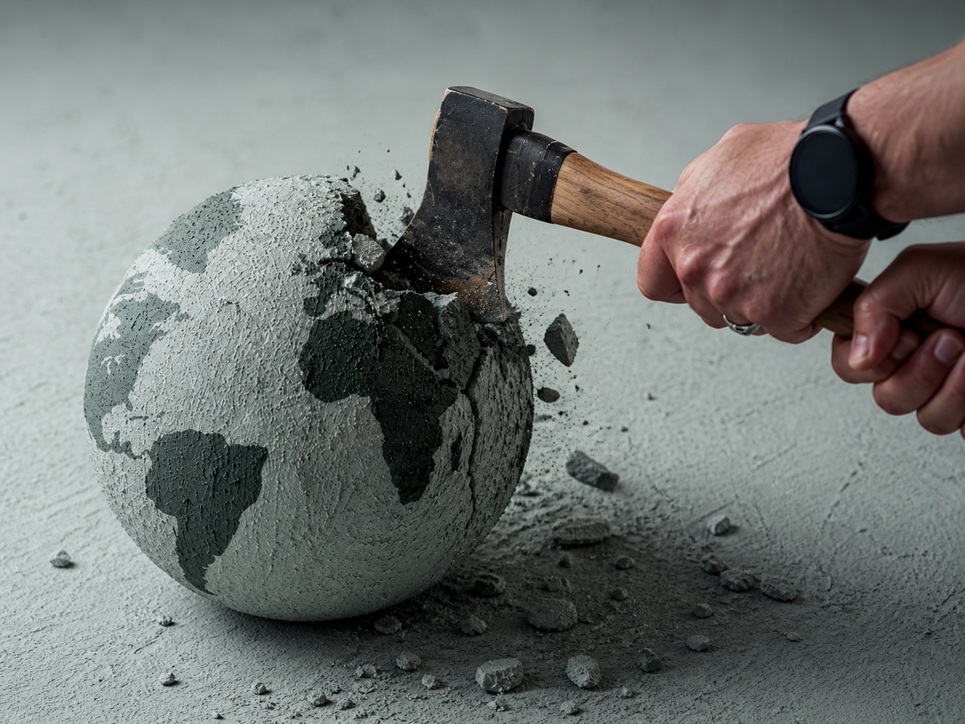
The end of globalization is now widely discussed as if it were an inevitable consequence of China’s rise. It was not. It was, in fact, the predictable outcome of American policy choices made over the last eighty years—choices that substituted military dominance and financial abstraction for genuine economic development.
At the close of World War II, the United States inherited not only global hegemony but also a historic opportunity. The collapse of the European empires created a vast collection of newly independent nations—what we now call the Global South—whose economies were structured almost entirely around the export of raw materials. These nations did not ask for charity; they asked for partnership. Specifically, they sought capital and technology to build domestic manufacturing and consumption-based economies.
America declined.
Instead, it constructed a system of “aid” and multilateral institutions that were, in reality, extensions of its own strategic interests. The United Nations and its satellite agencies were funded and shaped by Washington, but their effectiveness was constrained by a singular condition: nothing could be done that did not ultimately benefit the United States, either militarily or economically.
This was not globalization. It was management.
By the late 20th century, the United States made a second, more consequential decision. It allowed its financial class—untethered from national interest—to globalize capital without globalizing responsibility. In doing so, it financed the industrial rise of China under Deng Xiaoping, believing that economic liberalization would produce political alignment.
It did not.
China took the capital, absorbed the technology, and did what the Global South had long hoped the United States would do: it invested in building manufacturing capacity, infrastructure, and domestic consumption across developing economies. It did not offer lectures. It offered railways, ports, processing plants, and industrial ecosystems.
And it is expected to be paid—not in ideology, but in resources.
Today, China’s engagement with the Global South is not altruistic. It is strategic. But it is also effective. It transforms resource-exporting economies into industrial participants, while securing long-term access to the very materials that underpin modern industry. In doing so, China has assumed the role that the United States declined to play.
The consequences are now visible.
The United States, having outsourced its industrial base and financialized its domestic economy, finds itself increasingly reliant on military power to maintain its global position. Its foreign policy has not fundamentally changed since 1945; only its execution has. What was once carried out by statesmen is now influenced—if not dictated—by financial interests whose priorities are global, but whose accountability is nonexistent.
The result is a hollowing out of both capability and credibility.
Canada, under Mark Carney, appears to recognize this shift. At Davos, Carney spoke openly of the erosion of the “rules-based international order” and the need for middle powers to assert their own agency in a world increasingly defined by great power rivalry.
More importantly, his government has begun to act. The creation of a $25 billion sovereign-style investment vehicle—the Canada Strong Fund—is not merely an economic initiative. It is a statement of intent: Canada will deploy its own capital to build its own strategic capacity and reduce dependence on the United States.
This is a profound departure from the postwar model of integration.
Canada is not rejecting the United States. It is acknowledging that the assumptions underpinning that relationship are no longer sufficient. Trade tensions, tariffs, and geopolitical divergence have made it clear that reliance is not resilience.
The broader implication is unavoidable. The age of American-led globalization is ending—not because China replaced it, but because the United States never truly embraced it in the first place.
Globalization, properly understood, is not the movement of capital in search of efficiency. It is the deliberate construction of interconnected, self-sustaining economies. America chose not to build such a system. China is now attempting to.
Whether China succeeds in becoming the next hegemon is beside the point. What matters is that it has demonstrated a more effective method of expanding influence: build capacity, secure resources, and embed yourself in the economic future of your partners.
The United States, by contrast, risks becoming a power whose global influence rests increasingly on force rather than function.
The decline of globalization, therefore, should not be attributed to China’s ascent. It should be understood as the cumulative result of American decisions—decisions driven by short-term financial gain rather than long-term national strategy.
Until the United States reconciles its foreign policy with its economic reality, its ability to shape the world will continue to diminish.
And in that vacuum, others will not hesitate to act.


Leave a Reply