
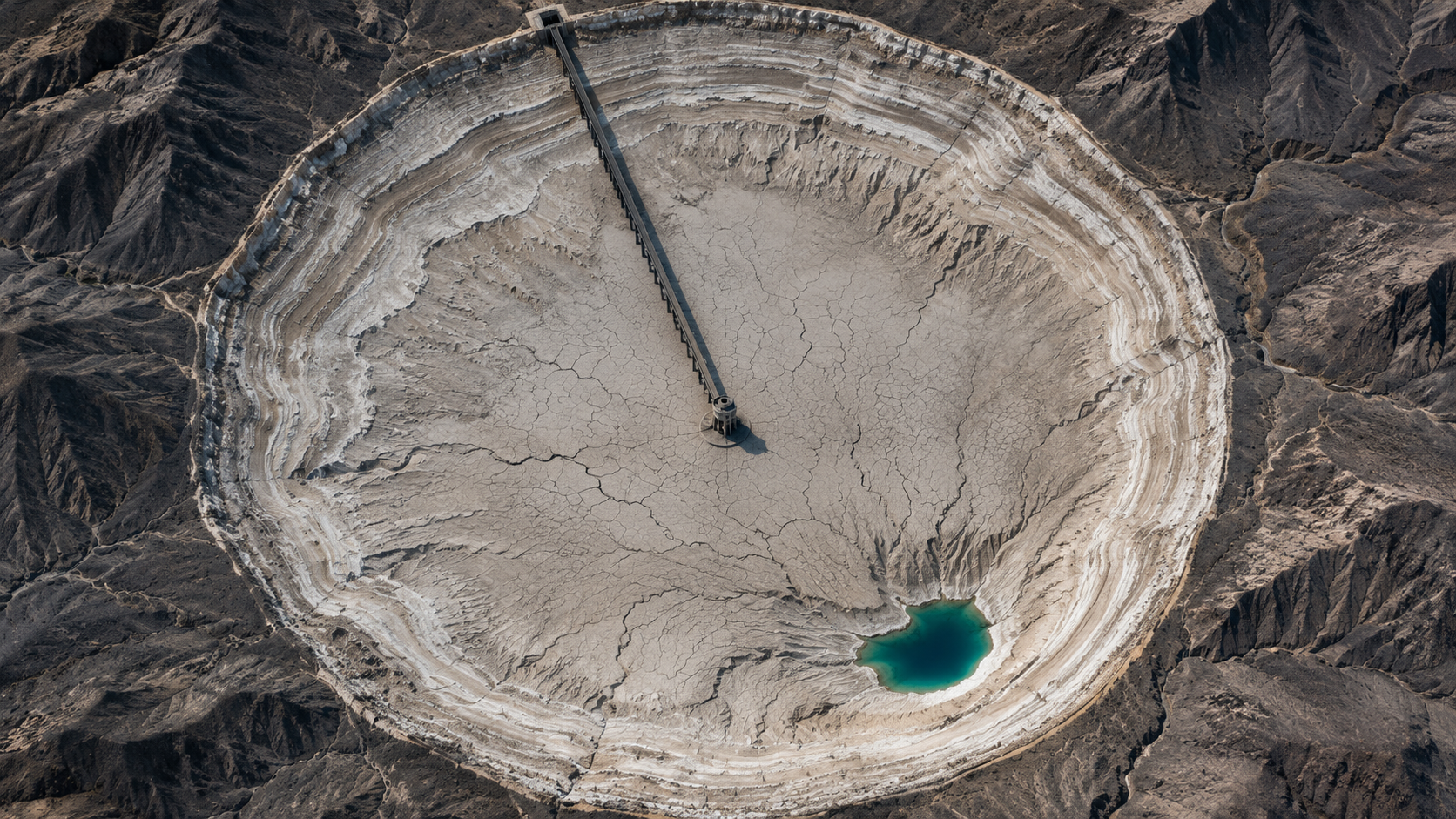
It rained this week. Twice. This didn’t used to be headline news but practically is these days.
I’m writing this in Phoenix, Arizona, one of the most water-stressed States in America. It’s also one of the most successful States in America in semiconductors, mining and agriculture – all high-demand water industries. Arizona is at risk of drying up and blowing away while States such as Mississippi are in danger of washing away.
Arizona’s water squeeze already has a measurable cost. Under the Colorado River’s 2026 operating conditions, Arizona’s annual allocation is reduced by 512,000 acre-feet, approximately 18% of its apportionment. The Arizona Department of Water Resources identifies irrigated agriculture as the state’s largest water user, accounting for about 72% of available supplies. New industrial projects are entering a market in which water is already heavily committed. — Sources: US Bureau of Reclamation & Arizona Department of Water Resources
This is climate change at work. More extremes – extremely dry, extremely wet, extremely hot, extremely cold. Records broken almost weekly, sometimes daily. The ‘new normal’ is a world of hazards which have not been fully considered nor understood.
The World Meteorological Organization reports that 2025 was among the driest years for river flows in 35 years, with below-normal flows across 36% of global river-basin area. Its September 2026 assessment also identifies a persistent decline in the amount of water stored on and beneath land since the mid-2010s. –Source: World Meteorological Organization
The impacts on humans already is visible. So-called climate migrants and involuntarily displaced populations, sometimes on the scale of whole villages or districts, are an increasingly common occurrence.
The Internal Displacement Monitoring Centre recorded 45.8 million disaster-related internal displacements across 163 countries and territories in 2024. — Source: Internal Displacement Monitoring Centre
The climate extremes also are stressing energy systems. Both extreme heat and extreme cold mean household thermostats are adjusted, and correspondingly, demand loads on aging grids increase, sometimes suddenly. Overheated transmission lines catch fire and spark wildfires of historic size and equally historic cost.
Industrial demand adds another load. Lawrence Berkeley National Laboratory estimates that US data centers consumed 176 terawatt-hours of electricity in 2023, or 4.4% of the national total. Their direct water consumption reached 66 billion litres, compared with 21.2 billion litres in 2014—more than tripling in nine years. — Sources: Berkeley Lab data center report & Berkeley Lab electricity findings
Beyond these sadly obvious realities, however, lie other risks.
Demand for critical minerals extraction and processing has soared exponentially in just the last few years, as both economic and military needs have grown. Energy reform – whether renewable or ‘sustainable,’ requires more rare earths, as does the burgeoning semiconductor industry, the global defense industry, healthcare (think MRI and other advanced imaging systems) and AI data centers. Whether primary mining (greenfield or brownfield) or recycled, sourcing, separating and processing rare earths and other critical minerals is highly water intensive. Existing technologies rely on water. Sourcing water is rapidly becoming one of the largest challenges for new projects trying to enter the market.
This is true not only in the US or North America, but around the world. It is as much a challenge in China as in the US, possibly even more so, since in China vast tracts of land are drying up, fueling population displacement and reducing agricultural output.
Flooding, also on the rise, poses a different water-related risk to mining. Flooded mines cannot operate. Putting a mine on “care and maintenance” is costly. Consistently flooded mines will be closed, further squeezing supply.
This exposure is already material to mineral supply. The IEA reported that floods or droughts put 7% of global copper supply at risk of disruption in 2024. — Source: IEA Global Critical Minerals Outlook 2025
This is a time-sensitive problem to which no good answer currently exists. As far as I know, humans cannot (yet) artificially create water where it is scarce. One solution could be massive pipeline structures moving excess water from flood zones to drought zones. Tremendously expensive, time consuming and politically unpopular due to associated land use/seizure issues to permit construction of pipelines.
Recycling helps, but it does not remove the need for supply. Cochilco reports that recovered and recirculated water accounted for 72.5% of the Chilean copper industry’s total water use in 2025. Even with that reuse, operations withdrew 13.94 cubic metres per second from inland sources, as well as drawing on seawater. The industry’s inland withdrawals fell 7% from 2024. — Source: Chilean Copper Commission (Cochilco)
The US Department of Energy is experimenting with moving discharged water from oil field sites to mining operations or projects in dry areas. This could be some help but only as long as the fracking water itself holds out. It is by no means an infinitely renewable source.
The volumes available for potential reuse are substantial. A 2026 Department of Energy fact sheet estimates that the Permian Basin alone generated approximately 22 million barrels of produced water a day in 2025. DOE supports treatment and reuse research, alongside recovery of minerals such as lithium. Produced water includes formation water brought up with oil and gas; it is not simply spent fracking fluid, and its composition can make treatment costly and energy intensive. — Source: US Department of Energy
Desalinization on a massive scale? Destabilizes further the already stressed oceans, with some oceanographers warning that we don’t understand how removing the salt could, among many other negative consequences, change the weight of the oceans and therefore the rotation of the Earth. Not to mention that more pipelines would be needed to transport the potable water.
One operating example puts a price on the engineering. Escondida’s desalination and water-delivery project, inaugurated in Chile in 2018, required US$3.43 billion of investment. BHP reported that the project included pipelines carrying water to 3,200 metres above sea level, four high-pressure pumping stations and electricity infrastructure. Securing water can require a multibillion-dollar project of its own. — Source: BHP
Cloud seeding on an industrial scale? Somehow capturing melting glacier water?
Cloud seeding offers no guaranteed rescue. A 2024 US Government Accountability Office assessment found that estimates of additional precipitation in the studies it reviewed ranged from 0% to 20%. GAO also stressed that suitable clouds must already be present and that limitations in the research make effectiveness difficult to establish. — Source: US Government Accountability Office
Water is a crucial commodity to enable mining which underpins the march of human technology.
Water, in the right amounts and right balance, is a natural resource which could in future shift the balance of economic power. It could become the new definition of economically sustainable industry and mining. It might even see currently unpopular areas of the world considered too difficult or risky rise as newly valuable partners. Water even could become a flashpoint for international conflict, fueling tomorrow’s wars just as control of oil fuels conflict today.
Nations need to make some politically difficult but rational decisions to try and stem the consequences of water imbalance. Most importantly, water needs to be priced as a crucial commodity not a universal good. In some countries there is no charge at all for water: in others, water is grossly underpriced, particularly for commercial and industrial consumers. That needs to stop. Already we have seen rationing in effect in some countries, and have seen how inefficient and polarizing such measures are. Although not a fan myself, more pipelines probably are needed to redistribute water.
There is also evidence that existing subsidies often miss the people who need them. A 2019 World Bank study found that, on average across 10 low- and middle-income countries examined, the richest 20% of households received 56% of water and sanitation subsidies, while the poorest 20% received only 6%. Those findings support better-targeted subsidies and pricing reform while preserving affordable access to basic water services. — Source: World Bank
Without courageous and concerted political leadership there is no reasonable chance of the situation improving. Governments around the world, and particularly in the US, are doing little or nothing to mitigate the damage to the planet – and that would be the only hope for naturally putting things right.
Therefore, collectively, we need to pay the price if we want to continue living as we are.
Otherwise, we’ll wind up paying the piper.


Leave a Reply