
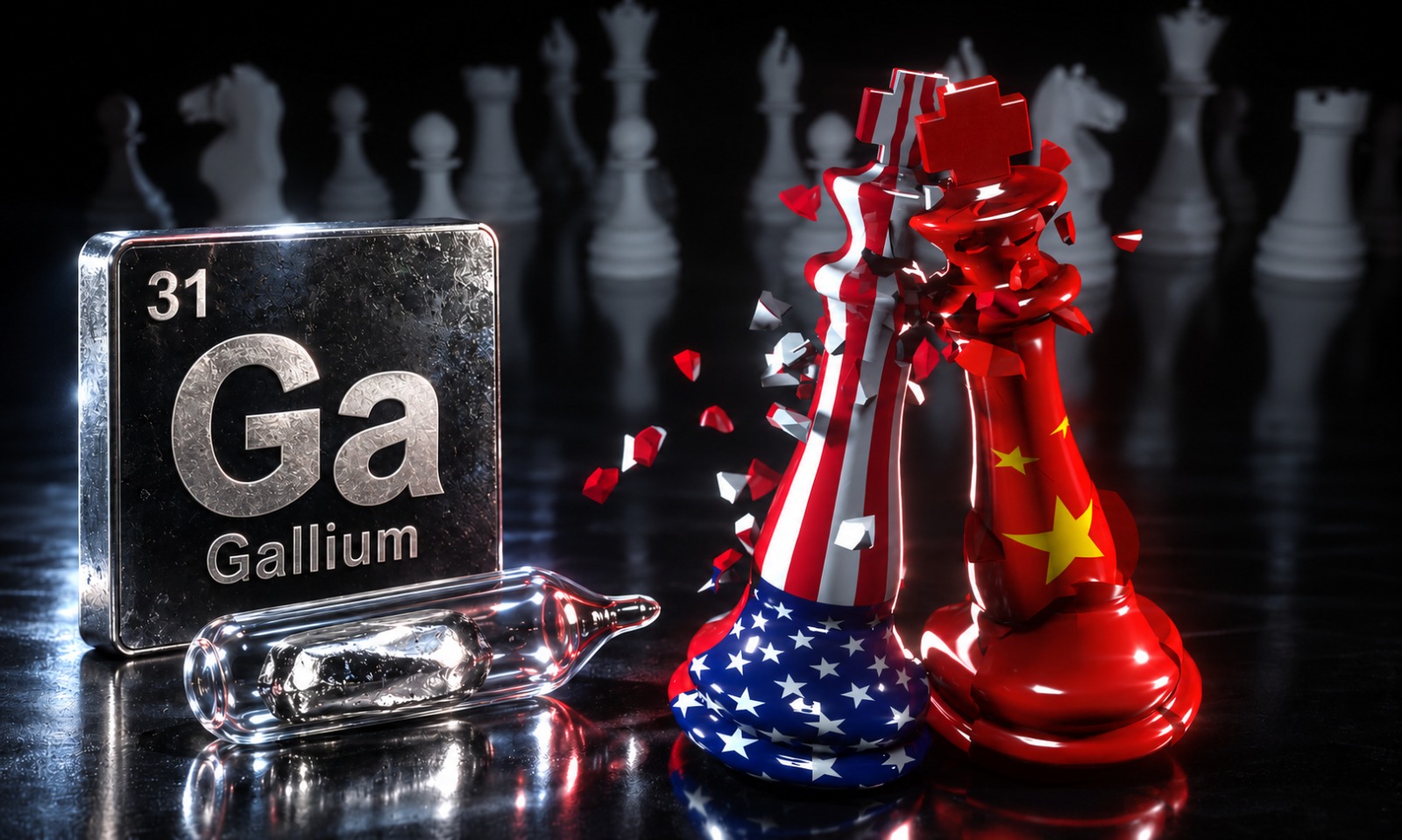
The broader trade truce extends into January, while China’s separate gallium notice still names November 27. Western manufacturers need clarity and dependable alternative supply.
China’s published notice sets November 27, 2026, as the expiry date for the suspension of its tighter restrictions on U.S. bound gallium exports. Without a further extension, the rule that controlled exports are “in principle not permitted” would apply again after that date.
You may have read that the trade truce was extended. It was — sort of. On September 28, China’s Commerce Ministry said the Kuala Lumpur arrangement would run to January 10, 2027. But that statement never names the separate November 2025 gallium notice, Announcement No. 72. An October 22 analysis by Nami Tech Solutions found no amending notice and no clear statement from either government that the January date covered November 27.
Industrial buyers need confirmation of how any extension applies to their shipments. The larger task will remain even if the deadline moves. A diplomatic agreement can extend access to Chinese material; developing and qualifying an alternative supplier requires sustained investment in processing capacity and customer relationships.
A License Still Controls Access
The November 2025 decision suspended one clause of the earlier restrictions. It left intact the separate prohibition on dual-use exports to U.S. military users or for military uses. Gallium’s export-licensing requirements, effective since August 2023, also remained. A further extension would therefore preserve a system in which Beijing controls approval of shipments.
Western manufacturers can contract with Chinese suppliers, but fulfilment still depends on the required export permissions. That leaves a policy risk which purchasing agreements alone cannot remove.
One Country Dominates Primary Supply
The U.S. Geological Survey’s 2026 assessment attributes 99% of world primary low-purity gallium output in 2025 to China. It records no U.S. primary recovery since 1987.
According to Critical Minerals Platform (CMP), the CMP Verified Price for 99.99% gallium was US$230.83 per kilogram as of October 20, 2026, on an FOB Asia Pacific basis. That was up 1.22% from the previous month and 31.11% over 12 months. CMP reported a 12-month average of US$229.42 per kilogram and a 52-week range of US$190.02 to US$242.55. This regional benchmark does not establish the price or availability of a licensed shipment to the United States. North American buyers must also consider export approvals, delivery times, transport costs and whether the material meets their specifications.
Gallium Pricing From Critical Minerals Platform


Source: Critical Minerals Platform. Original CMP artwork for 99.99% gallium, FOB Asia Pacific in U.S. dollars. Price as of October 20, 2026.
For North America, the strategic issue is whether manufacturers can obtain qualified material consistently enough to plan production and investment in recovery, purification and customer qualification. Long term purchase agreements can help bridge the gap by giving developers clearer evidence of demand and buyers a role in establishing additional sources. The value of diversification lies partly in reducing exposure to a single government’s export decisions, even when Chinese material remains available.
The concentration figure concerns upstream metal. A diverse list of refining countries does not establish that the original feedstock is equally diverse. Supply assessments need to follow material back through the processing chain.
Gallium’s importance comes from what it enables. Gallium arsenide serves radio-frequency communications, while gallium nitride can improve power-electronics efficiency. In May, Oak Ridge National Laboratory reported a gallium nitride power converter developed with future AI data center applications in mind. Efficient power conversion is becoming an increasingly important part of the infrastructure supporting advanced computing.
Washington is investing in those capabilities. On October 22, the Commerce Department announced letters of intent for up to US$389 million in CHIPS research awards, including up to US$73 million for vertical gallium nitride power devices. These remain proposed research commitments. Their eventual industrial value will depend partly on access to the materials needed to manufacture the devices.
How Alternative Supply Is Developing
Most primary gallium is recovered as a by-product of processing bauxite, with zinc ores providing another route. Existing refineries therefore offer a practical starting point for diversification. Metal recovered from those ores is primary production even when aluminium or zinc is the principal commercial product. Buyers must still assess dependence on the host operation and its feedstock.
Exploration companies are also investigating alternative mineral sources. I serve as CEO and Chair of Quantum Critical Metals Corp. (TSXV: LEAP | OTCQB: ATOXF | FSE: 86A1), which is included below. At NMX East in Québec, Quantum is studying gallium recovery from mica. Its results are preliminary bench-scale findings, and the process requires further validation before any conclusion about commercial production can be drawn.
| Company or programme | Development stage | Capacity and funding |
| Rio Tinto plc (LSE: RIO | NYSE: RIO) Vaudreuil, Québec | Pilot plant expected to operate in 2027. | Demonstration plant of up to 4 tonnes a year planned; a commercial plant could reach 40 tonnes a year. Federal support of up to C$18.95 million conditionally approved, alongside C$7 million committed by Québec. |
| Alcoa Corporation (NYSE: AA | ASX: AAI) and Sojitz Corporation (TSE: 2768) Wagerup, Western Australia | Groundbreaking announced August 24, 2026. | Australian government says the completed facility could produce up to 10% of world supply. Project backed by cooperation among Australia, Japan and the United States. |
| Quantum Critical Metals Corp. (TSXV: LEAP | OTCQB: ATOXF | FSE: 86A1) NMX East, Québec | Exploration and preliminary bench-scale metallurgy. | Reported 93% gallium recovery from mica samples on November 13, 2025. This is a laboratory result, not annual production capacity. Commercial output and economics have not been established. |
| U.S. DOE TRACE-Ga Five projects | Selected April 2026, subject to award negotiations. | Approximately US$5.4 million proposed across five projects to develop gallium recovery technologies. Selection does not guarantee a funding award. |
These examples occupy different stages of development. Groundbreaking, a laboratory recovery result and a proposed commercial plant each establish something different. The eventual test is consistent delivery of material that meets customers’ requirements at a sustainable cost.
Recovery Must Become a Saleable Product
Extraction is only part of the task. Semiconductor supply chains use gallium at very high purity, with commercial grades reaching 99.9999% and 99.99999%. Developers must account for losses and costs between initial recovery and finished metal. They then need to demonstrate that successive batches perform consistently in customers’ manufacturing processes.
The same discipline applies to refinery additions and new deposits. A high extraction rate from a laboratory sample provides useful technical evidence, but does not establish continuous plant performance or economic viability. Public funding should help promising approaches reach pilot scale, with further support tied to independently verified results and a credible route to customers.
Use the Time the Reprieve Provides
Governments should fund work across extraction, purification and customer qualification, with clear technical conditions at each stage. Industrial buyers can strengthen viable projects through long-term purchase agreements. Where public support protects capacity against weak prices, its terms should be transparent and linked to delivery.
Faster permitting decisions can help, but they must be accompanied by workable processes and committed customers. The next export dispute will test whether alternative suppliers can deliver gallium when manufacturers need it. Any further reprieve should be used to ensure those suppliers are ready.
Disclosure: Marcy Kiesman is CEO and Chair of Quantum Critical Metals Corp. (TSXV: LEAP | OTCQB: ATOXF | FSE: 86A1), which is discussed in this column. Quantum is an exploration-stage company. Its reported metallurgical results are preliminary laboratory results and do not establish commercial production or economic viability.


Leave a Reply