

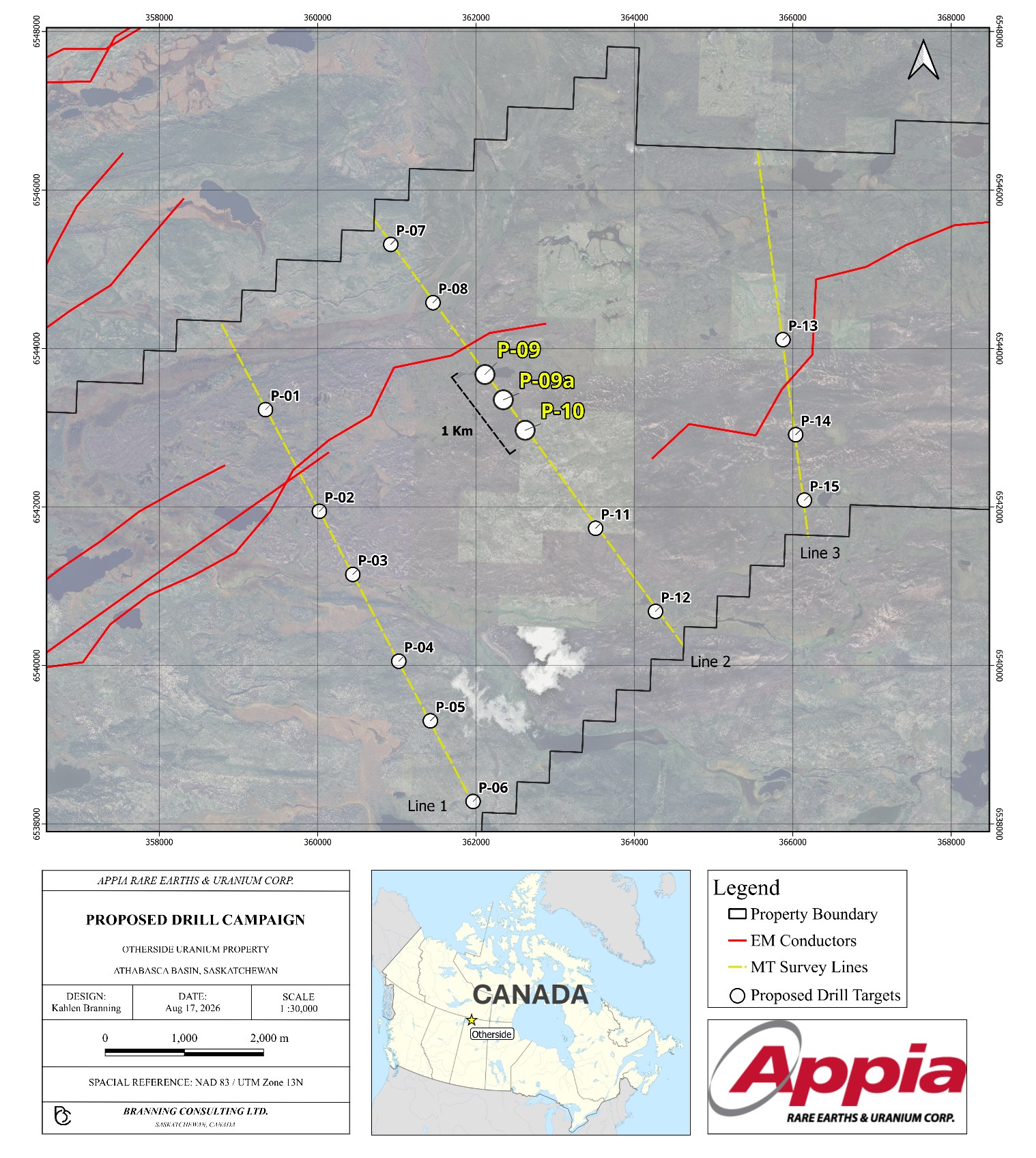
August 31, 2026 (Source) — Appia Rare Earths & Uranium Corp. (CSE: API) (OTCQB: APAAF) (FSE: A0I0) (MUN: A0I0) (BER: A0I0) (the “Company” or “Appia“) is pleased to announce that final interpretation of Lines 1 and 3 from the Company’s Q1 2026 SPARTAN Magnetotelluric (“MT”) survey (Figure 1) has outlined several additional preliminary drill targets for potential uranium mineralization at its 100%-owned Otherside Uranium Property (the “Property”) in Saskatchewan’s Athabasca Basin. These targets were selected from multiple prospective geophysical anomalies along the Otherside conductor trend and further strengthen Appia’s pipeline of priority uranium targets across the Property.
The priority targets include P-02, P-04, and P-06 on Line 1, and P-13, P-14, and P-15 on Line 3. These six form part of Appia’s broader 16-target inventory, which also includes the previously identified Line 2 targets P-09, P-09a and P-10. The interpretation of Lines 1 and 3 highlights several features considered favourable for Athabasca-style uranium exploration, including conductive zones, density anomalies, magnetic gradients, interpreted unconformity disruption, sandstone disruption, and potential structural pathways. Together, Lines 1 and 3 show that prospective geophysical features extend beyond Line 2, supporting a broader property-scale target system and potential uranium discovery.
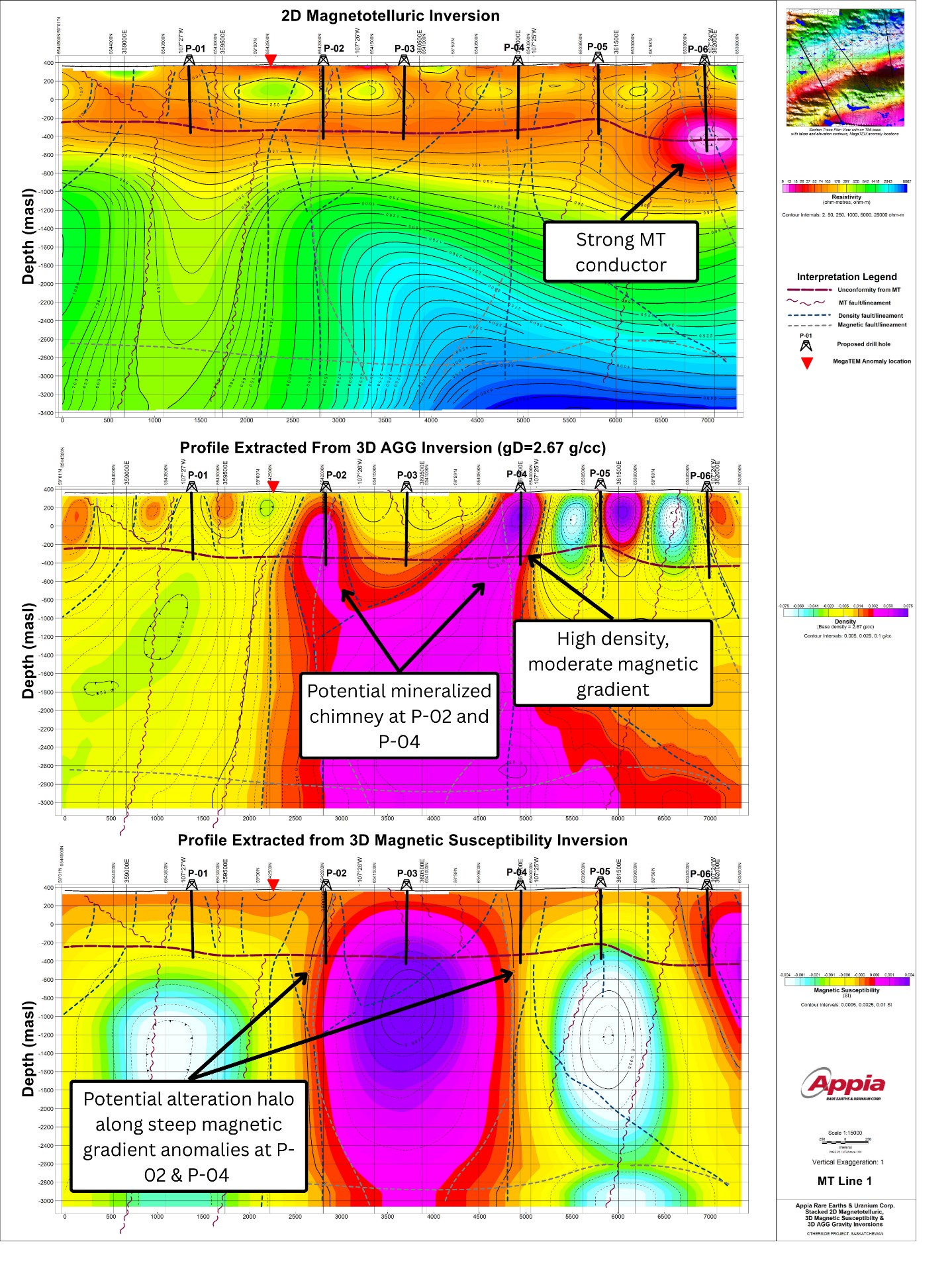
Line 1 Highlights (Figure 2):
Line 1 returned several encouraging features, including an interpreted offset in the unconformity near the south end of the profile, a strong conductor at the south end of the line, and a historical ZTEM anomaly that may indicate a deeper conductive body within the basement.
- Line 1 Priority Preliminary Drill Targets:
- P-02 – Associated with a magnetic gradient, positive density anomaly, moderate MT response, a chimney-like geophysical response that may reflect structural disruption or alteration, and a possible alteration halo.
- P-04 – Associated with a high-density response, magnetic gradient, weak MT conductor, a chimney-like geophysical response that may reflect structural disruption or alteration, and a possible alteration halo.
- P-06 – Associated with a deep MT conductor, interpreted as the strongest conductor response on Line 1, along with moderate density and a high magnetic response.
These targets are considered prospective because they may be associated with structural disruption, basement conductivity, density features, and magnetic gradients that could represent favourable pathways for uranium-bearing fluids.
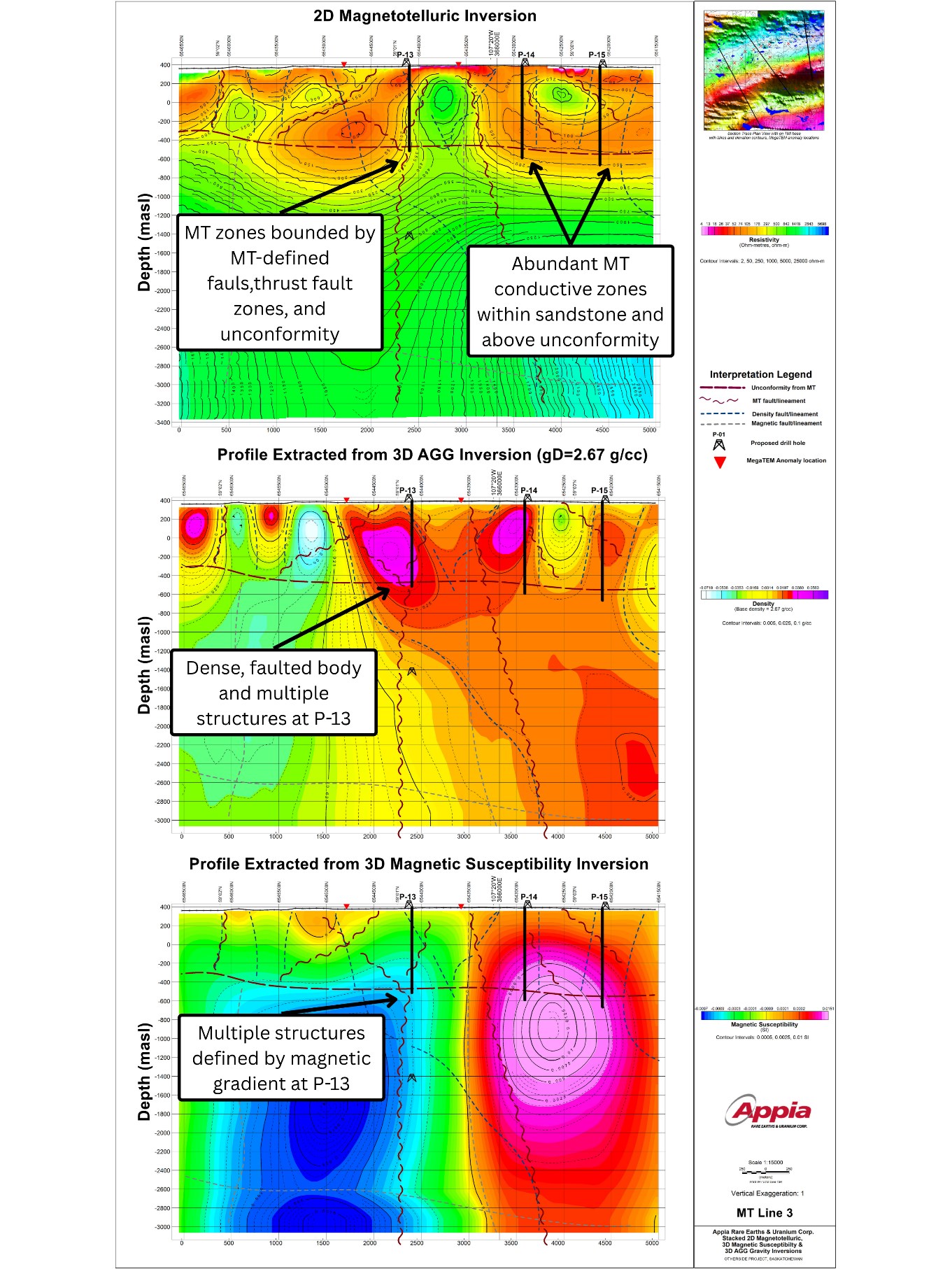
Line 3 Highlights (Figure 3)
Line 3 identified evidence of disruption within the sandstone above the unconformity, along with ZTEM anomalies that may be responding to shallower conductive features. Interpretation of Line 3 indicates increased conductivity and density in the sandstone, including a moderate MT conductor along an interpreted MT fault and a dense, faulted body with a coincident magnetic low at P-13, as well as MT conductors in the sandstone above the unconformity at P-14 and P-15.
- Line 3 Priority Preliminary Drill Targets:
- P-13 – Associated with a dense, faulted body in the sandstone, a magnetic low, and a moderate MT conductor along an interpreted MT fault.
- P-14 – Associated with a dense body in the sandstone, moderate magnetic response, and an MT conductor in the sandstone above the unconformity.
- P-15 – Associated with a dense body in the sandstone, moderate magnetic response, and an MT conductor in the sandstone above the unconformity.
These targets are designed to test areas of increased conductivity and density within the sandstone, along with geophysical features that may reflect structural disruption or alteration related to uranium-bearing systems.
Tom Drivas, CEO of Appia, commented:
“The results from Lines 1 and 3 continue to build momentum at Otherside and further support the uranium discovery potential of this large-scale conductor trend. Line 1 is especially compelling, with evidence of an interpreted unconformity offset, strong conductor response, and a possible deeper basement conductor. Line 3 adds additional priority targets associated with sandstone disruption/offsets and shallower conductive features. Together with the targets identified on Line 2, Appia now has a strong inventory of preliminary uranium drill targets across Otherside as we continue advancing the Property toward a planned 2027 drill program.”
Next Steps
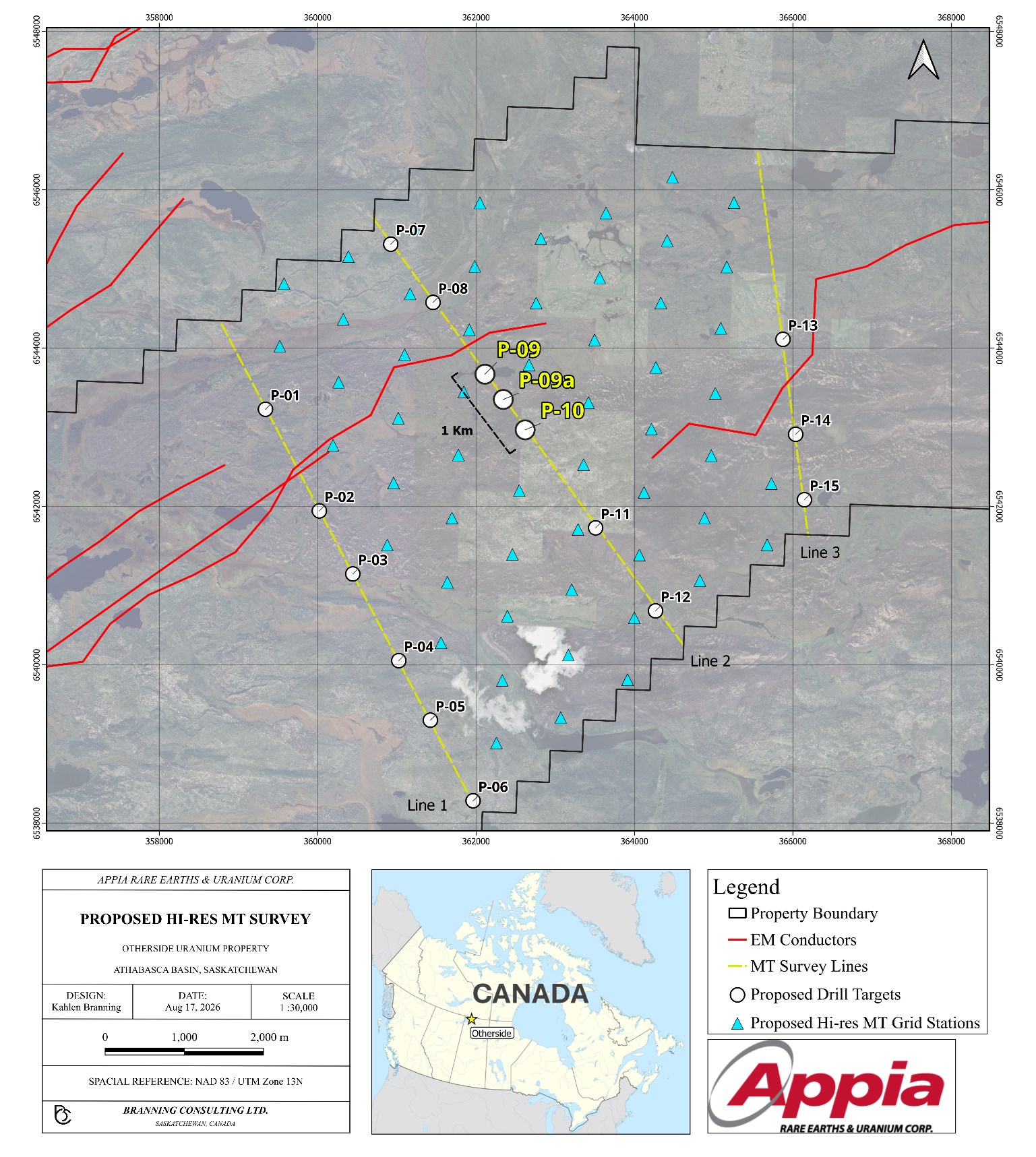
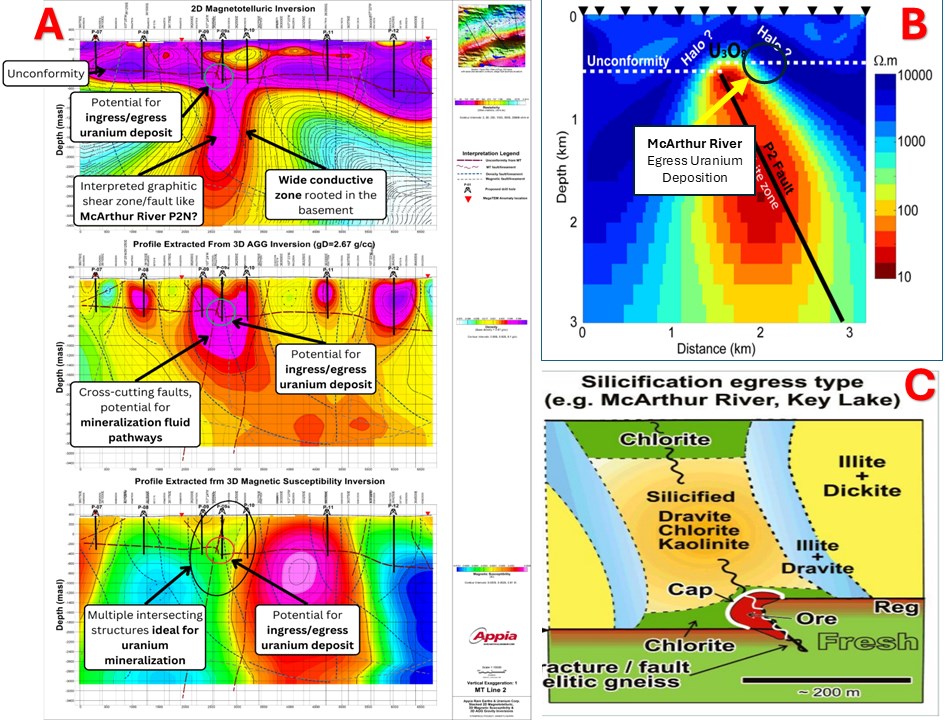
Appia plans a tight-spaced, high-resolution ground MT 3D grid (Figure 4) and Ambient Noise Tomography (“ANT”) surveys over the Line 2 priority corridor to further evaluate an ingress/egress exploration model based on interpreted geophysical similarities to McArthur River (Figure 5). The resulting model will refine the main conductor break and local structural setting before drilling.
Following the planned MT and ANT surveys, Appia aims to advance the highest-priority targets to precision diamond drilling in 2027. Please note: Cameco’s McArthur River and all other comparable deposits are currently conceptual models based on interpretations of Appia’s compelling geophysical dataset. Although uranium mineralization at Otherside has not yet been confirmed by drilling, these geophysical similarities strengthen the exploration case at Otherside.

Figure 1 – MT Survey Lines and 16 Preliminary Drill Targets – Otherside Uranium Property, Saskatchewan. Source: Google Earth Satellite Image – QGIS
To view an enhanced version of this graphic, please visit:
https://images.newsfilecorp.com/files/5416/312090_c942ae66d4146bbc_001full.jpg

Figure 2 – Line 1 – Magnetotellurics, density, and magnetic survey anomalies from Appia’s geophysical datasets.
To view an enhanced version of this graphic, please visit:
https://images.newsfilecorp.com/files/5416/312090_c942ae66d4146bbc_002full.jpg

Figure 3 – Line 3 – Magnetotellurics, density, and magnetic survey anomalies from Appia’s geophysical datasets.
To view an enhanced version of this graphic, please visit:
https://images.newsfilecorp.com/files/5416/312090_c942ae66d4146bbc_003full.jpg

Figure 4 – Proposed Hi-Res 3D MT Survey at the Otherside property, focused on refining preliminary drill targets P-09, P-09a and P-10 and a conceptual McArthur River-style exploration model. Source: Google Earth Satellite Image – QGIS
To view an enhanced version of this graphic, please visit:
https://images.newsfilecorp.com/files/5416/312090_c942ae66d4146bbc_004full.jpg

Figure 5- Comparison of McArthur River’s egress type uranium deposit v.s. Appia’s MT survey results along Line 2 displaying potentially similar geophysical and structural signatures. A) Appia’s MT Survey Results, B) Resistivity model from the McArthur River AMT dataset (Tuncer et al., 2006). Image modified by Appia on June 24, 2026., C) Typical egress-type deposit models in the Athabasca Basin (Jefferson et al., 2007).
To view an enhanced version of this graphic, please visit:
https://images.newsfilecorp.com/files/5416/312090_c942ae66d4146bbc_006full.jpg
References
Government of Saskatchewan. Saskatchewan Bouguer Gravity Map. Saskatchewan GeoAtlas, Government of Saskatchewan, accessed 24 June 2026. GeoAtlas, gisappl.saskatchewan.ca/Html5Ext/index.html?viewer=GeoAtlas.
Jefferson, C. W., D. J. Thomas, S. S. Gandhi, P. Ramaekers, G. Delaney, D. Brisbin, C. Cutts, P. Portella and R. A. Olson, 2007. Unconformity associated uranium deposits, in Jefferson, C.W., and Delaney, G., eds., EXTECH IV: Geology and Uranium EXploration TECHnology of the Proterozoic Athabasca Basin, Saskatchewan and Alberta: Geological Survey of Canada, Bulletin 588 (also Saskatchewan Geological Society, Special Publication 18; Geological Association of Canada, Mineral Deposits Division, Special Publication 4).
Tuncer, V., M. J. Unsworth, W. Siripunvaraporn and J. A. Craven, 2006. Exploration for unconformity type uranium deposits with audio magnetotelluric data: A case study from the McArthur River Mine, Saskatchewan (Canada), Geophysics, 71 (6), B201 – B209.
About the Otherside Project
The Otherside Project is strategically located within the prolific, uranium-bearing Athabasca Basin of Saskatchewan, Canada. This area is renowned for its significant uranium deposits and conditions that have historically led to major high-grade uranium discoveries.
The Otherside Property contains geological and geophysical features considered prospective for Athabasca Basin uranium exploration. These include long structural corridors hosting multiple conductors with associated magnetic gradients and gravity low areas.
Otherside’s property area is 15,146.129 hectares and is 100% owned by Appia.
Qualified Person
The technical content in this news release was reviewed and approved by Dr. Irvine R. Annesley, P.Geo., Senior Exploration Advisor of Appia and a Qualified Person as defined by National Instrument 43-101.
About Appia Rare Earths & Uranium Corp.
Appia is a publicly traded Canadian company in the rare earth element and uranium sectors. The Company holds a 25% interest in Ultra Rare Earth Inc. (“Ultra USA“) and Ultra USA indirectly holds a 100% interest in the Ultra Hard Rock and Ultra IAC Projects, which total 42,932.24 ha. in size and are located within the state of Goiás in Brazil (see June 1, 2026 Press Release here).
The Company is also focusing on delineating high-grade critical rare earth elements and gallium on the Alces Lake property and exploring for high-grade uranium in the prolific Athabasca Basin on its Otherside, Loranger, North Wollaston, and Eastside properties. The Company holds the surface rights to exploration for 101,692.35 hectares (251,287.27 acres) in Saskatchewan. The Company also has a 100% interest in 14,483 hectares (35,788 acres), with rare earth elements and uranium deposits over five mineralized zones in the Elliot Lake Camp, Ontario.
Appia has 194.9 million common shares outstanding, 206.6 million shares fully diluted.
Cautionary note regarding forward-looking statements: This News Release contains forward-looking statements which are typically preceded by, followed by or including the words “believes”, “expects”, “anticipates”, “estimates”, “intends”, “plans” or similar expressions. Forward-looking statements are not a guarantee of future performance as they involve risks, uncertainties and assumptions. We do not intend and do not assume any obligation to update these forward-looking statements and shareholders are cautioned not to put undue reliance on such statements.
Neither the Canadian Securities Exchange nor its Market Regulator (as that term is defined in the policies of the CSE) accepts responsibility for the adequacy or accuracy of this release.
For more information, visit www.appiareu.com.
As part of our ongoing effort to keep investors, interested parties and stakeholders updated, we have several communication portals. If you have any questions online (X, Facebook, LinkedIn) please feel free to send direct messages.
Contact:
Tom Drivas
CEO and Director
(416) 876-3957
[email protected]


Leave a Reply